Centre for Psychiatry Research, Department of Clinical Neuroscience, Karolinska Institutet, Stockholm, Sweden.
Stockholm Health Care Services, Region Stockholm, Stockholm, Sweden.
JAMA Neurol. 2022 May 1;79(5):459-467. doi: 10.1001/jamaneurol.2022.0167.
Tic disorders are associated with multiple social adversities, but little is known about the experience of violent assault (including sexual assault) and criminality in this group.
To establish if Tourette syndrome (TS) and chronic tic disorder (CTD) are associated with an increased risk of experiencing violent assault and criminal convictions.
DESIGN, SETTING, AND PARTICIPANTS: In this cohort study, all individuals living in Sweden at any time between January 1, 1973, and December 31, 2013, were identified from Swedish nationwide health and administrative registers. Cox proportional hazards regression models were used to estimate the risk of violent assault and criminal convictions among people with TS or CTD, compared with the general population and unaffected full siblings. Data analyses were conducted between September 1 and October 22, 2021.
The Swedish version of the International Classification of Diseases, Eighth Revision (ICD-8), ICD-9, and ICD-10 diagnoses of TS or CTD in the Swedish National Patient Register.
Records of sexual and nonsexual violent assault and death due to violent assaults were obtained from the National Patient Register and the Cause of Death Register, respectively. Convictions for violent and nonviolent criminal offenses were obtained from the Crime Register. Covariates included sex and birth year.
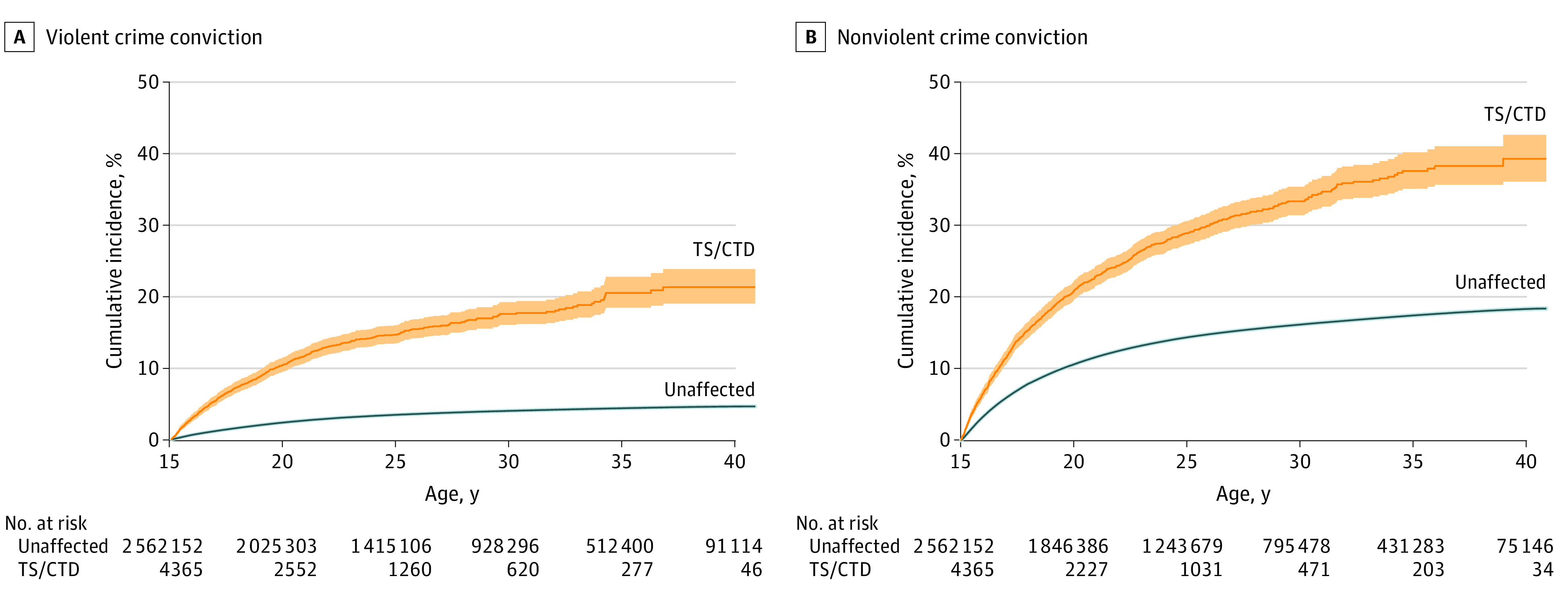
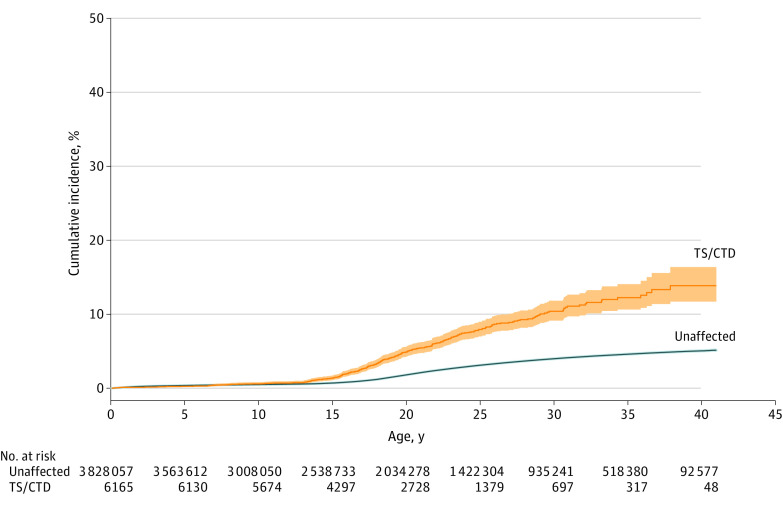
The study cohort included 13 819 284 individuals living in Sweden between 1973 and 2013. A total of 7791 individuals with TS or CTD were identified (median [IQR] age at first diagnosis, 13.4 [10.0-21.8] years; 5944 [76%] male). Compared with unaffected individuals from the general population, people with TS or CTD had a 2-fold increased risk of experiencing any violent assault (sexual and nonsexual) (adjusted hazard ratio [aHR], 2.21; 95% CI, 2.00-2.43), a 3-fold increased risk of violent convictions (aHR, 3.13; 95% CI, 2.92-3.36), and a 1.6-fold increased risk of nonviolent crime convictions (aHR, 1.62; 95% CI, 1.54-1.71). Among people with TS or CTD, 37.0% (114 of 308; 95% CI, 31.6%-42.4%) of individuals who had experienced violent assault also had a violent crime conviction, compared with 17.9% (16 067 of 89 920; 95% CI, 17.6%-18.1%) in the general population. Exclusion of individuals with attention-deficit/hyperactivity disorder and substance use disorders partially attenuated the associations. Similarly, within-sibling models attenuated but did not eliminate the associations (any violent assault: aHR, 1.32; 95% CI, 1.08-1.61; violent crime: aHR, 2.23; 95% CI, 1.86-2.67; nonviolent crime: aHR, 1.34; 95% CI, 1.20-1.50).
Results of this cohort study suggest that most individuals with TS or CTD are not assaulted nor are perpetrators of crime. However, individuals with TS or CTD diagnosed in specialist settings were more likely to both experience violent assault and be perpetrators of violence compared with the general population. The risk was highest in individuals with comorbid attention-deficit/hyperactivity disorder and substance use disorders. The increased risk found in specialty clinics will need to be better understood in the general population.
抽动障碍与多种社会逆境相关,但关于该群体中暴力侵犯(包括性侵犯)和犯罪的经历知之甚少。
确定妥瑞氏综合征(TS)和慢性抽动障碍(CTD)是否与经历暴力侵犯和刑事定罪的风险增加有关。
设计、地点和参与者:在这项队列研究中,通过瑞典全国卫生和行政登记册,确定了在 1973 年 1 月 1 日至 2013 年 12 月 31 日期间任何时候居住在瑞典的所有个人。使用 Cox 比例风险回归模型来估计与普通人群和未受影响的全同胞相比,患有 TS 或 CTD 的人发生暴力侵犯和刑事定罪的风险。数据分析于 2021 年 9 月 1 日至 10 月 22 日进行。
瑞典版的国际疾病分类第 8 版(ICD-8)、ICD-9 和 ICD-10 在瑞典国家患者登记册中的 TS 或 CTD 诊断。
从国家患者登记册和死因登记册分别获得性和非性暴力侵犯以及因暴力侵犯而死亡的记录。从犯罪登记册获得暴力和非暴力犯罪的定罪记录。协变量包括性别和出生年份。
该研究队列包括 1973 年至 2013 年期间居住在瑞典的 13819284 人。确定了 7791 名患有 TS 或 CTD 的人(首次诊断的中位年龄[IQR],13.4[10.0-21.8]岁;5944[76%]为男性)。与普通人群中未受影响的个体相比,患有 TS 或 CTD 的人经历任何形式的暴力侵犯(包括性和非性)的风险增加了两倍(调整后的危险比[aHR],2.21;95%CI,2.00-2.43),暴力定罪的风险增加了三倍(aHR,3.13;95%CI,2.92-3.36),非暴力犯罪定罪的风险增加了 1.6 倍(aHR,1.62;95%CI,1.54-1.71)。在患有 TS 或 CTD 的人群中,与普通人群中 17.9%(89920 人中的 16067 人;95%CI,17.6%-18.1%)相比,37.0%(308 人中的 114 人;95%CI,31.6%-42.4%)经历过暴力侵犯的人也有暴力犯罪的定罪。排除注意力缺陷/多动障碍和物质使用障碍的个体后,这些关联部分减弱。同样,同胞内模型减弱但没有消除关联(任何形式的暴力侵犯:aHR,1.32;95%CI,1.08-1.61;暴力犯罪:aHR,2.23;95%CI,1.86-2.67;非暴力犯罪:aHR,1.34;95%CI,1.20-1.50)。
这项队列研究的结果表明,大多数患有 TS 或 CTD 的人没有受到侵犯,也不是犯罪者。然而,在专科诊所中诊断出的患有 TS 或 CTD 的个体更有可能经历暴力侵犯和成为暴力的实施者,与普通人群相比。在患有注意力缺陷/多动障碍和物质使用障碍共病的个体中,风险最高。需要更好地理解专科诊所中发现的这种增加的风险。