Department of Cardiology, Translational Research Center for Regenerative Medicine and 3D Printing Technologies, The Third Affiliated Hospital of Guangzhou Medical University, Guangzhou 510150, China.
State Key Laboratory of Organ Failure Research, Southern Medical University, Guangzhou 510000, China.
Oxid Med Cell Longev. 2022 Mar 11;2022:7969916. doi: 10.1155/2022/7969916. eCollection 2022.
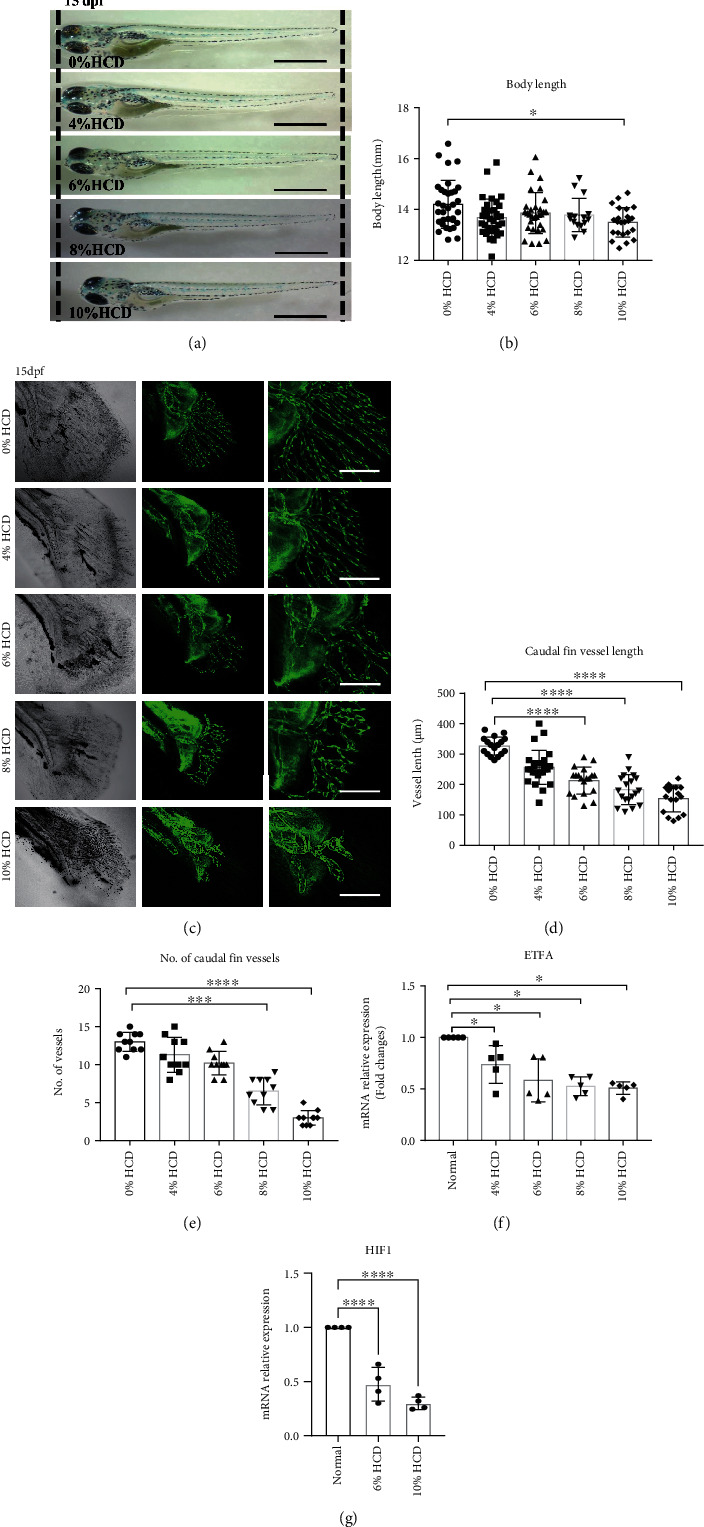
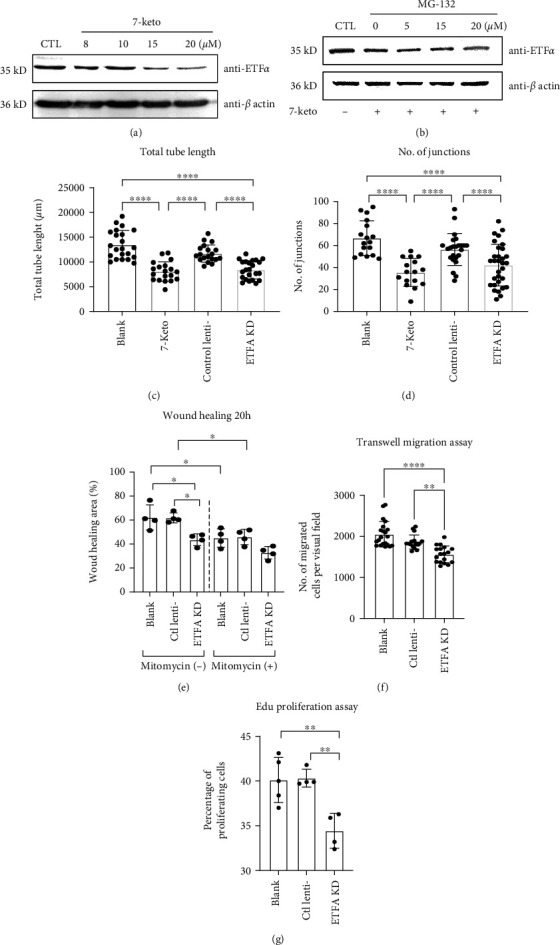
While impairment of vascular homeostasis induced by hypercholesterolemia is the first step of cardiovascular diseases, the molecular mechanism behind such impairment is not well known. Here, we reported that high-cholesterol diet (HCD) induced defective vessel sprouting in zebrafish larvae. Electron transfer flavoprotein subunit (ETF) (encoded by the ETFA gene), a protein that mediates transfer of electrons from a series of mitochondrial flavoenzymes to the respiratory chain, was downregulated in HCD-fed zebrafish and in endothelial cells treated with oxidized low-density lipoprotein. Knockdown of ETF with morpholino antisense oligonucleotides reproduced vascular sprouting defects in zebrafish larvae, while replenishing with exogeneous ETFA mRNA could successfully rescue these defects. ETFA knockdown in endothelial cells reduces cell migration, proliferation, and tube formation in vitro. Finally, knockdown of ETFA in endothelial cells also reduced fatty acid oxidation, oxygen consumption rate, and hypoxia-inducible factor-1 (HIF1) protein levels. Taken together, we demonstrate that downregulation of ETF is involved in hypercholesterolemia-induced defective vessel sprouting in zebrafish larvae via inhibition of endothelial proliferation and migration. The molecular mechanism behind this phenomenon is the decrease of HIF1 induced by downregulation of ETF in endothelial cells. This work suggests that disturbance of ETF-mediated oxygen homeostasis is one of the mechanisms behind hypercholesterolemia-induced vascular dysfunction.
虽然高胆固醇血症引起的血管稳态受损是心血管疾病的第一步,但这种损伤背后的分子机制尚不清楚。在这里,我们报道了高胆固醇饮食(HCD)诱导斑马鱼幼虫血管芽生缺陷。电子传递黄素蛋白亚基(ETF)(由 ETFA 基因编码),一种介导一系列线粒体黄素酶向呼吸链传递电子的蛋白质,在 HCD 喂养的斑马鱼和用氧化低密度脂蛋白处理的内皮细胞中下调。用反义寡核苷酸的 ETFA 基因敲低重现了斑马鱼幼虫的血管芽生缺陷,而外源性 ETFA mRNA 的补充可以成功挽救这些缺陷。内皮细胞中 ETFA 的敲低减少了细胞迁移、增殖和体外管形成。最后,内皮细胞中 ETFA 的敲低也降低了脂肪酸氧化、耗氧率和缺氧诱导因子-1(HIF1)蛋白水平。总之,我们证明了 ETF 的下调通过抑制内皮细胞的增殖和迁移,参与了高胆固醇血症诱导的斑马鱼幼虫血管芽生缺陷。内皮细胞中 ETF 下调导致 HIF1 减少是其背后的分子机制之一。这项工作表明,ETF 介导的氧稳态紊乱是高胆固醇血症诱导的血管功能障碍的机制之一。