Shin Yong Cheol, Bae Ji-Hyeon, Lee Jong Ho, Raja Iruthayapandi Selestin, Kang Moon Sung, Kim Bongju, Hong Suck Won, Huh Jung-Bo, Han Dong-Wook
Department of Cogno-Mechatronics Engineering, College of Nanoscience & Nanotechnology, Pusan National University, Busan, 46241, South Korea.
Department of Biomedical Engineering, The University of Texas at Austin, Austin, TX, 78712, USA.
Biomater Res. 2022 Mar 21;26(1):11. doi: 10.1186/s40824-022-00257-7.
The implants of pure titanium (Ti) and its alloys can lead to implant failure because of their poor interaction with bone-associated cells during bone regeneration. Surface modification over implants has achieved successful implants for enhanced osseointegration. Herein, we report a robust strategy to implement bioactive surface modification for implant interface enabled by the combinatorial system of reduced graphene oxide (rGO)-coated sandblasted, large-grit, and acid-etched (SLA) Ti to impart benefits to the implant.
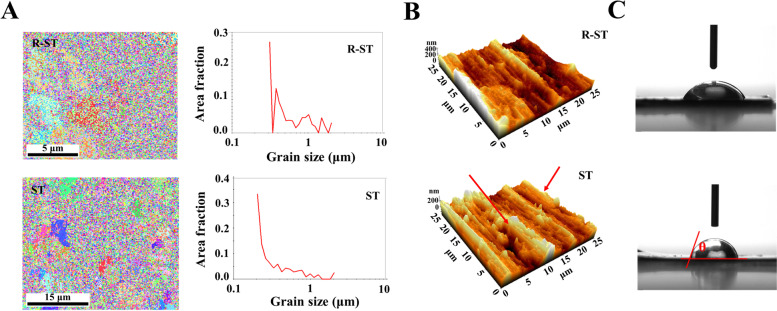
We prepared SLA Ti (ST) implants with different surface modifications [i.e., rGO and recombinant human bone morphogenetic protein-2 (rhBMP-2)] and investigated their dental tissue regenerating ability in animal models. We performed comparative studies in surface property, in vitro cellular behaviors, and in vivo osseointegration activity among different groups, including ST (control), rhBMP-2-immobilized ST (BI-ST), rhBMP-2-treated ST (BT-ST), and rGO-coated ST (R-ST).
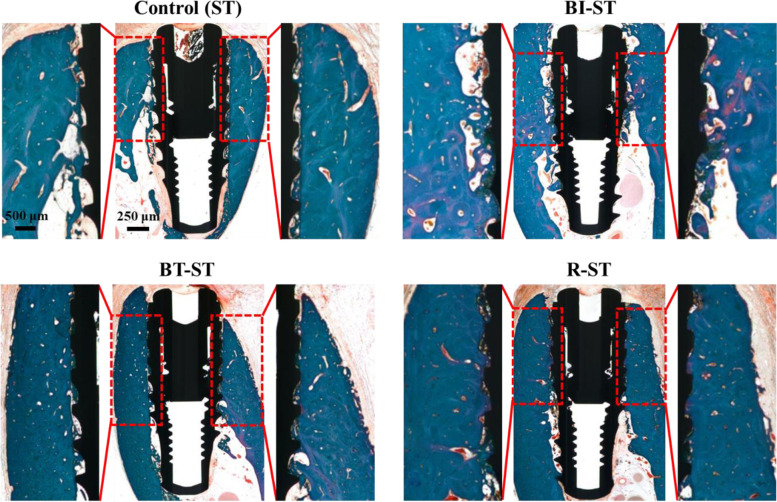
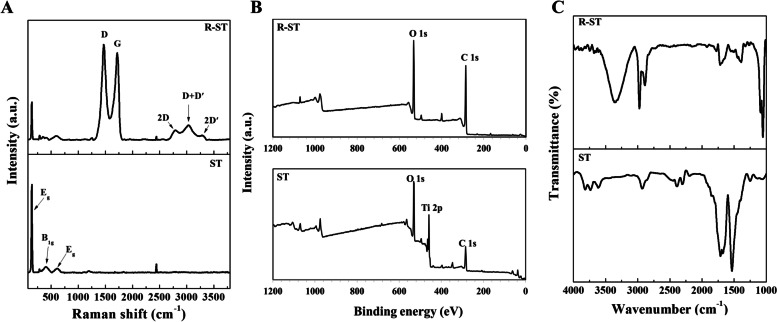
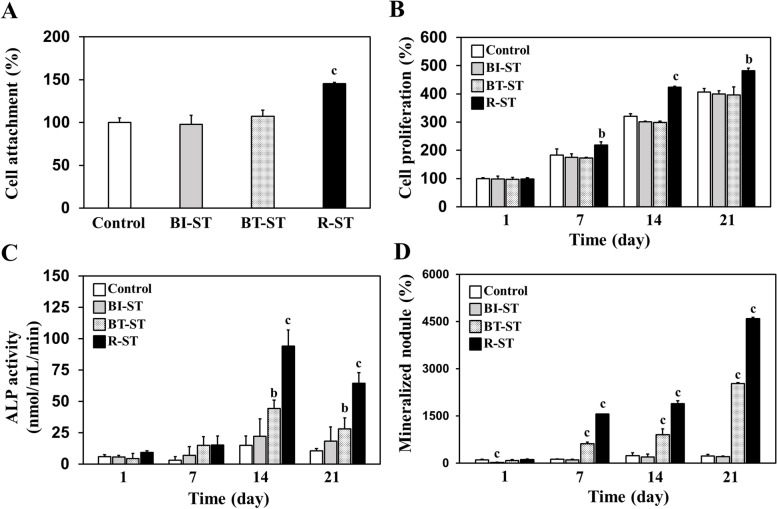
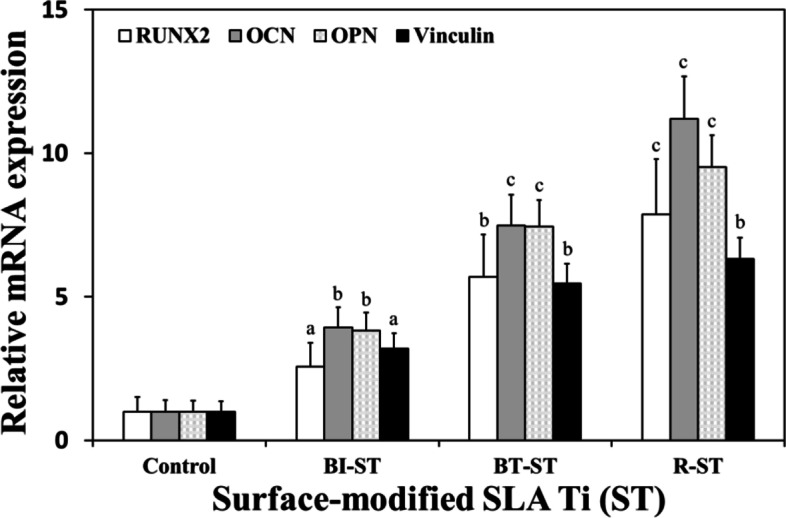
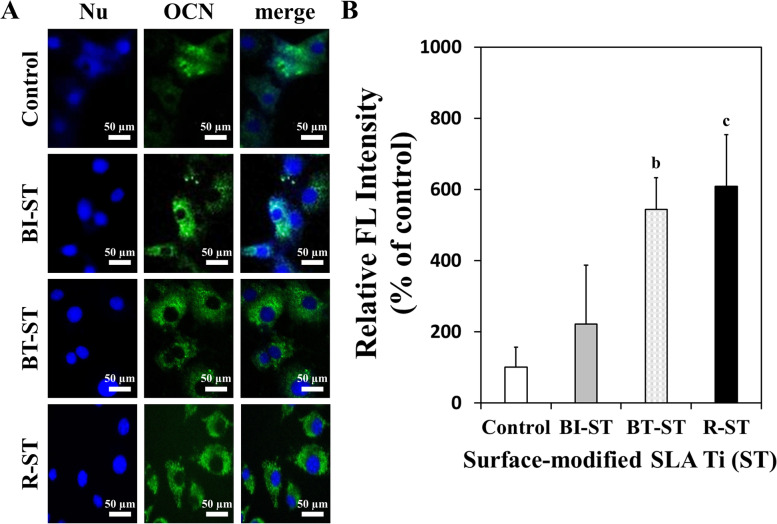
Spectroscopic, diffractometric, and microscopic analyses confirmed that rGO was coated well around the surfaces of Ti discs (for cell study) and implant fixtures (for animal study). Furthermore, in vitro and in vivo studies revealed that the R-ST group showed significantly better effects in cell attachment and proliferation, alkaline phosphatase activity, matrix mineralization, expression of osteogenesis-related genes and protein, and osseointegration than the control (ST), BI-ST, and BT-ST groups.
Hence, we suggest that the rGO-coated Ti can be a promising candidate for the application to dental or even orthopedic implants due to its ability to accelerate the healing rate with the high potential of osseointegration.
纯钛(Ti)及其合金植入物在骨再生过程中与骨相关细胞的相互作用较差,可能导致植入失败。通过对植入物进行表面改性已成功实现增强骨整合的植入物。在此,我们报告一种强大的策略,通过还原氧化石墨烯(rGO)涂层的喷砂、大颗粒和酸蚀(SLA)钛的组合系统,对植入物界面进行生物活性表面改性,从而使植入物受益。
我们制备了具有不同表面改性(即rGO和重组人骨形态发生蛋白-2(rhBMP-2))的SLA钛(ST)植入物,并在动物模型中研究了它们的牙组织再生能力。我们对不同组进行了表面性质、体外细胞行为和体内骨整合活性的比较研究,包括ST(对照组)、固定rhBMP-2的ST(BI-ST)、rhBMP-2处理的ST(BT-ST)和rGO涂层的ST(R-ST)。
光谱、衍射和显微镜分析证实,rGO很好地包覆在钛盘(用于细胞研究)和植入固定装置(用于动物研究)的表面周围。此外,体外和体内研究表明,R-ST组在细胞附着和增殖、碱性磷酸酶活性、基质矿化、成骨相关基因和蛋白的表达以及骨整合方面,比对照组(ST)、BI-ST组和BT-ST组显示出明显更好的效果。
因此,我们认为rGO涂层的钛由于其能够加速愈合速度并具有高骨整合潜力,有望应用于牙科甚至骨科植入物。