
结核分枝杆菌编码一种具有溶血磷脂酶活性的 YhhN 家族膜蛋白,该蛋白可抵御有毒的宿主溶血磷脂。
Mycobacterium tuberculosis encodes a YhhN family membrane protein with lysoplasmalogenase activity that protects against toxic host lysolipids.
机构信息
Department of Biological Chemistry and Pharmacology, The Ohio State University, Columbus, Ohio, USA.
Host Pathogen Interactions Program, Texas Biomedical Research Institute, San Antonio, Texas, USA.
出版信息
J Biol Chem. 2022 May;298(5):101849. doi: 10.1016/j.jbc.2022.101849. Epub 2022 Mar 18.
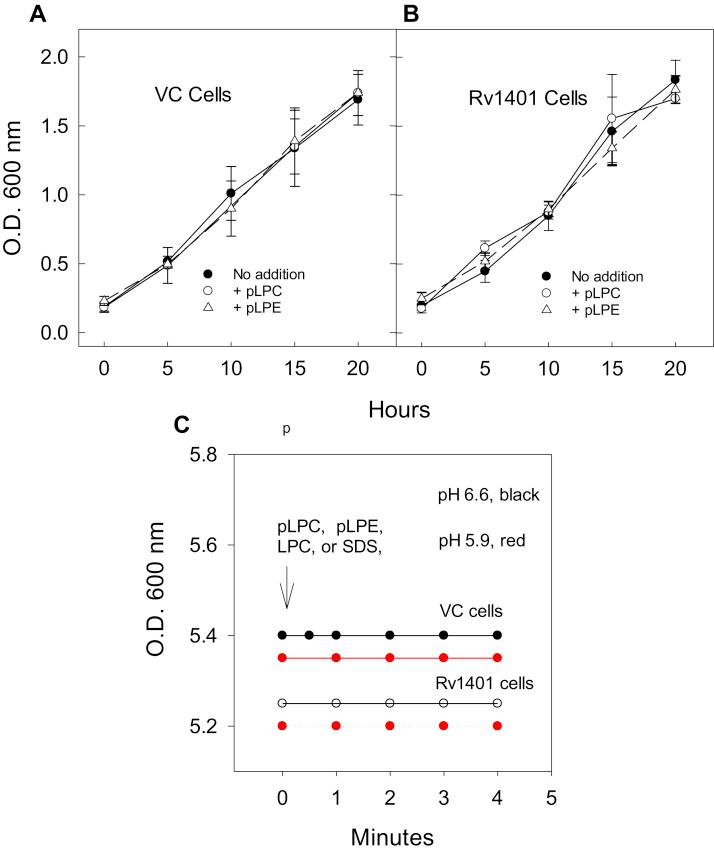
The pathogen Mycobacterium tuberculosis (M.tb) resides in human macrophages, wherein it exploits host lipids for survival. However, little is known about the interaction between M.tb and macrophage plasmalogens, a subclass of glycerophospholipids with a vinyl ether bond at the sn-1 position of the glycerol backbone. Lysoplasmalogens, produced from plasmalogens by hydrolysis at the sn-2 carbon by phospholipase A, are potentially toxic but can be broken down by host lysoplasmalogenase, an integral membrane protein of the YhhN family that hydrolyzes the vinyl ether bond to release a fatty aldehyde and glycerophospho-ethanolamine or glycerophospho-choline. Curiously, M.tb encodes its own YhhN protein (MtbYhhN), despite having no endogenous plasmalogens. To understand the purpose of this protein, the gene for MtbYhhN (Rv1401) was cloned and expressed in Mycobacterium smegmatis (M.smeg). We found the partially purified protein exhibited abundant lysoplasmalogenase activity specific for lysoplasmenylethanolamine or lysoplasmenylcholine (pLPC) (V∼15.5 μmol/min/mg; K∼83 μM). Based on cell density, we determined that lysoplasmenylethanolamine, pLPC, lysophosphatidylcholine, and lysophosphatidylethanolamine were not toxic to M.smeg cells, but pLPC and LPC were highly toxic to M.smeg spheroplasts, which are cell wall-deficient mycobacterial forms. Importantly, spheroplasts prepared from M.smeg cells overexpressing MtbYhhN were protected from membrane disruption/lysis by pLPC, which was rapidly depleted from the media. Finally, we found that overexpression of full-length MtbYhhN in M.smeg increased its survival within human macrophages by 2.6-fold compared to vector controls. These data support the hypothesis that MtbYhhN protein confers a growth advantage for mycobacteria in macrophages by cleaving toxic host pLPC into potentially energy-producing products.
分枝杆菌(M.tb)病原体寄生于人体巨噬细胞内,通过利用宿主脂质来存活。然而,人们对分枝杆菌与巨噬细胞溶血磷脂的相互作用知之甚少,溶血磷脂是甘油磷脂的一个子类,在甘油主链的 sn-1 位具有乙烯醚键。溶血磷脂由磷脂酶 A 在 sn-2 位的碳上水解产生,是潜在的有毒物质,但可以被宿主溶血磷脂酶分解,该酶是 YhhN 家族的一种完整膜蛋白,通过水解乙烯醚键释放脂肪酸醛和甘油磷酸乙醇胺或甘油磷酸胆碱。奇怪的是,尽管分枝杆菌没有内源性溶血磷脂,但它却编码自己的 YhhN 蛋白(MtbYhhN)。为了了解该蛋白的目的,克隆并在耻垢分枝杆菌(M.smeg)中表达了 MtbYhhN 基因(Rv1401)。我们发现部分纯化的蛋白表现出丰富的溶血磷脂酶活性,特异性针对溶血磷脂乙醇胺或溶血磷脂胆碱(pLPC)(V∼15.5 μmol/min/mg;K∼83 μM)。根据细胞密度,我们确定溶血磷脂乙醇胺、pLPC、溶血磷脂酰胆碱和溶血磷脂酰乙醇胺对 M.smeg 细胞没有毒性,但 pLPC 和 LPC 对缺乏细胞壁的分枝杆菌形式的 M.smeg 原生质体具有高度毒性。重要的是,过表达 MtbYhhN 的 M.smeg 细胞制备的原生质体可免受 pLPC 的膜破坏/溶解的影响,pLPC 可迅速从培养基中耗尽。最后,我们发现与对照载体相比,M.smeg 中全长 MtbYhhN 的过表达可使分枝杆菌在人巨噬细胞中的存活率增加 2.6 倍。这些数据支持了这样一种假设,即 MtbYhhN 蛋白通过将宿主有毒的 pLPC 切割成潜在的产能产物,为分枝杆菌在巨噬细胞中的生长提供了优势。




 Zotero 插件