Valke Lars L F G, Meijer Danielle, Nieuwenhuizen Laurens, Laros-van Gorkom Britta A P, Blijlevens Nicole M A, van Heerde Waander L, Schols Saskia E M
Department of Hematology Radboud University Medical Center Nijmegen The Netherlands.
Hemophilia Treatment Center Nijmegen-Eindhoven-Maastricht The Netherlands.
Res Pract Thromb Haemost. 2022 Mar 15;6(2):e12681. doi: 10.1002/rth2.12681. eCollection 2022 Feb.
Analysis of fibrinolytic disorders is challenging and may potentially lead to underdiagnosis of patients with an increased bleeding tendency.
To compare clinical characteristics, laboratory measurements, and treatment modalities in a monocenter cohort of patients in whom fibrinolytic studies were performed.
Retrospective study of patients in whom fibrinolytic studies were performed between January 2016 and February 2020 in the Hemophilia Treatment Center, Nijmegen-Eindhoven-Maastricht, the Netherlands. Plasminogen activator inhibitor type 1 (PAI-1) antigen and activity level, α2-antiplasmin activity, tissue plasminogen activator, and euglobulin clot lysis time (ECLT) before and after venous compression were determined in all patients. Data of bleeding assessment tool (BAT) score, clinical characteristics, results of primary and secondary hemostasis assays, and general treatment plans were collected.
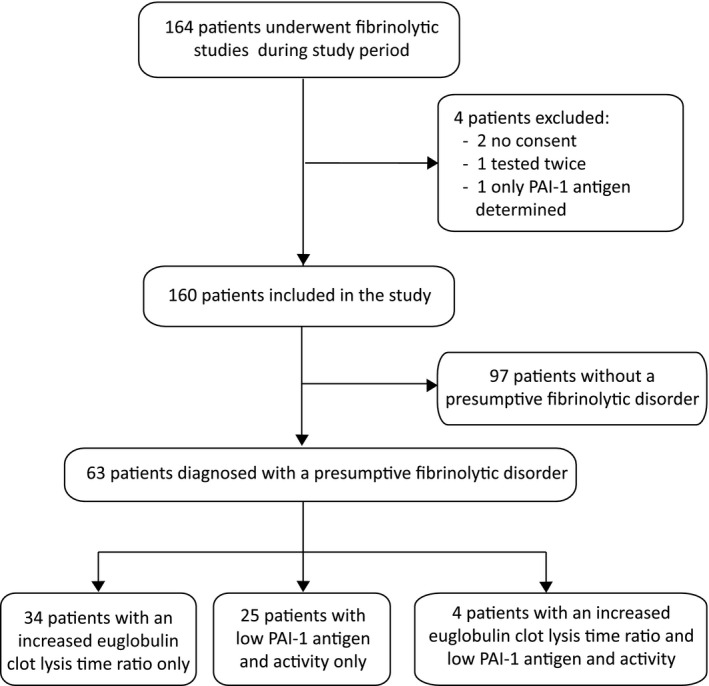
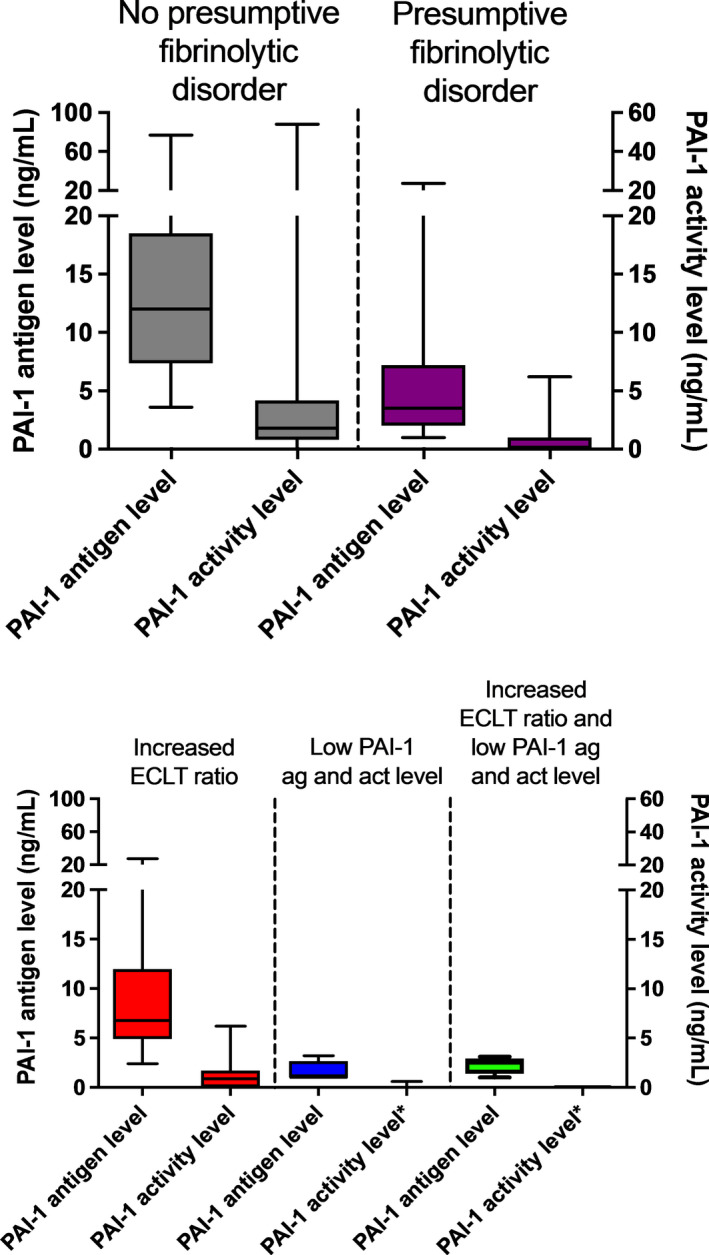
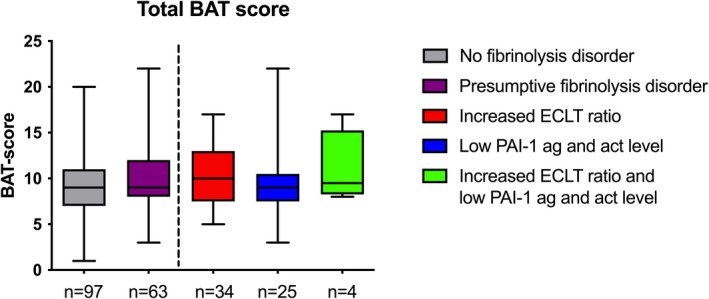
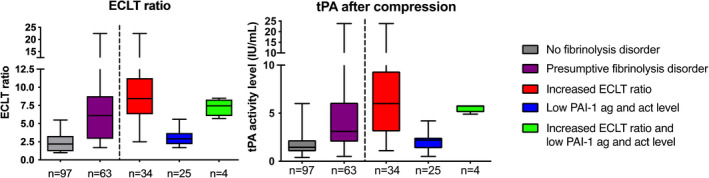
In total, 160 patients were included: 97 (61%) without and 63 (39%) with a laboratory-based fibrinolytic disorder. Mean BAT score did not differ between the groups (9.3 vs 9.8, respectively). The presumptive fibrinolytic disorders were distributed as follows: 34 patients had an increased ECLT ratio or low baseline ECLT, 25 patients had low PAI-1 antigen and activity level, and four patients had both. The majority of these patients were treated with tranexamic acid monotherapy (60%) with only 40% additional treatment options, whereas 80% of patients without a presumptive fibrinolytic disorder had multiple treatment modalities.
Analysis of fibrinolytic disorders in selected patients has a high diagnostic yield. General incorporation of fibrinolytic analysis in the diagnostic workup of patients with bleeding of unknown cause can improve diagnosis and management of their bleeding episodes.
纤溶异常的分析具有挑战性,可能导致出血倾向增加的患者被漏诊。
比较在单中心队列中进行纤溶研究的患者的临床特征、实验室检测结果和治疗方式。
对2016年1月至2020年2月在荷兰奈梅亨 - 埃因霍温 - 马斯特里赫特血友病治疗中心进行纤溶研究的患者进行回顾性研究。测定所有患者静脉压迫前后的纤溶酶原激活物抑制剂1(PAI - 1)抗原和活性水平、α2 - 抗纤溶酶活性、组织纤溶酶原激活物以及优球蛋白凝块溶解时间(ECLT)。收集出血评估工具(BAT)评分、临床特征、初级和次级止血检测结果以及一般治疗计划的数据。
共纳入160例患者:97例(61%)无基于实验室的纤溶异常,63例(39%)有纤溶异常。两组的平均BAT评分无差异(分别为9.3和9.8)。推测的纤溶异常分布如下:34例患者ECLT比值升高或基线ECLT较低,25例患者PAI - 1抗原和活性水平较低,4例患者两者兼有。这些患者中的大多数接受了氨甲环酸单一疗法(60%),仅有40%有其他治疗选择,而80%无推测纤溶异常的患者有多种治疗方式。
对选定患者进行纤溶异常分析具有较高的诊断价值。将纤溶分析普遍纳入不明原因出血患者的诊断检查中可改善其出血发作的诊断和管理。