Rodeghiero Francesco, Pabinger Ingrid, Ragni Margaret, Abdul-Kadir Rezan, Berntorp Erik, Blanchette Victor, Bodó Imre, Casini Alessandro, Gresele Paolo, Lassila Riitta, Leebeek Frank, Lillicrap David, Mezzano Diego, Noris Patrizia, Srivastava Alok, Tosetto Alberto, Windyga Jerzy, Zieger Barbara, Makris Mike, Key Nigel
Hematology Project Foundation, Vicenza, Italy, affiliated to the Hematology Department, San Bortolo Hospital, Vicenza, Italy.
Clinical Division of Hematology and Hemostaseology, Department of Medicine I, Medical University of Vienna, Austria.
Hemasphere. 2019 Sep 17;3(4):e286. doi: 10.1097/HS9.0000000000000286. eCollection 2019 Oct.
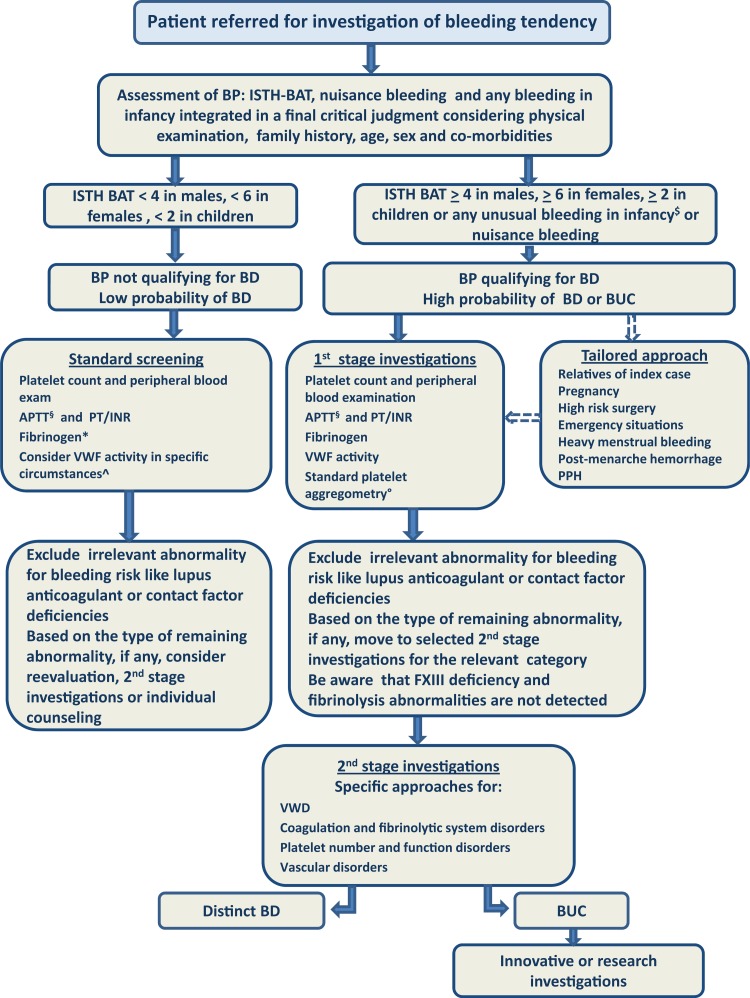
Healthy subjects frequently report minor bleedings that are frequently 'background noise' of normality rather than a true disorder. Nevertheless, unexpected or unusual bleeding may be alarming. Thus, the distinction between normal and pathologic bleeding is critical. Understanding the underlying pathologic mechanism in patients with an excessive bleeding is essential for their counseling and treatment. Most of these patients with significant bleeding will result affected by non-severe inherited bleeding disorders (BD), collectively denominated mild or moderate BD for their relatively benign course. Unfortunately, practical recommendations for the management of these disorders are still lacking due to the current state of fragmented knowledge of pathophysiology and lack of a systematic diagnostic approach. To address this gap, an International Working Group (IWG) was established by the European Hematology Association (EHA) to develop consensus-based guidelines on these disorders. The IWG agreed that grouping these disorders by their clinical phenotype under the single category of mild-to-moderate bleeding disorders (MBD) reflects current clinical practice and will facilitate a systematic diagnostic approach. Based on standardized and harmonized definitions a conceptual unified framework is proposed to distinguish normal subjects from affected patients. The IWG proposes a provisional comprehensive patient-centered initial diagnostic approach that will result in classification of MBD into distinct clinical-pathological entities under the overarching principle of clinical utility for the individual patient. While we will present here a general overview of the global management of patients with MBD, this conceptual framework will be adopted and validated in the evidence-based, disease-specific guidelines under development by the IWG.
健康受试者经常报告轻微出血情况,这些情况往往是正常的“背景噪音”,而非真正的病症。然而,意外或异常出血可能令人担忧。因此,区分正常出血和病理性出血至关重要。了解出血过多患者的潜在病理机制对于为他们提供咨询和治疗至关重要。这些有明显出血症状的患者中,大多数会受到非严重遗传性出血性疾病(BD)的影响,由于其病程相对良性,这些疾病统称为轻度或中度BD。不幸的是,由于目前对病理生理学的认识零散,且缺乏系统的诊断方法,针对这些疾病的实际管理建议仍然不足。为填补这一空白,欧洲血液学协会(EHA)成立了一个国际工作组(IWG),以制定关于这些疾病的基于共识的指南。IWG一致认为,将这些疾病按临床表型归为轻度至中度出血性疾病(MBD)这一单一类别,反映了当前的临床实践,并将有助于采用系统的诊断方法。基于标准化和统一的定义,提出了一个概念性统一框架,以区分正常受试者和患病患者。IWG提出了一种以患者为中心的临时全面初始诊断方法,这将导致在对个体患者具有临床实用性的总体原则下,将MBD分类为不同的临床病理实体。虽然我们将在此概述MBD患者的全球管理情况,但这一概念框架将在IWG正在制定的基于证据的、针对特定疾病的指南中采用并得到验证。