Department of Nutrition, Yuan's General Hospital, Kaohsiung, Taiwan.
Department of Healthcare Administration and Medical Informatics, College of Health Sciences, Kaohsiung Medical University, Kaohsiung, Taiwan.
BMC Nephrol. 2022 Mar 22;23(1):115. doi: 10.1186/s12882-022-02739-1.
Studies have revealed that patients with chronic kidney disease (CKD) have dietary patterns different from those of the general population. However, no studies have compared the dietary patterns of between patients with early-stages (stages 1-3a) and late-stages (stages 3b-5) of CKD. Our objective was to investigate the associations between dietary patterns in early and late-stage CKD.
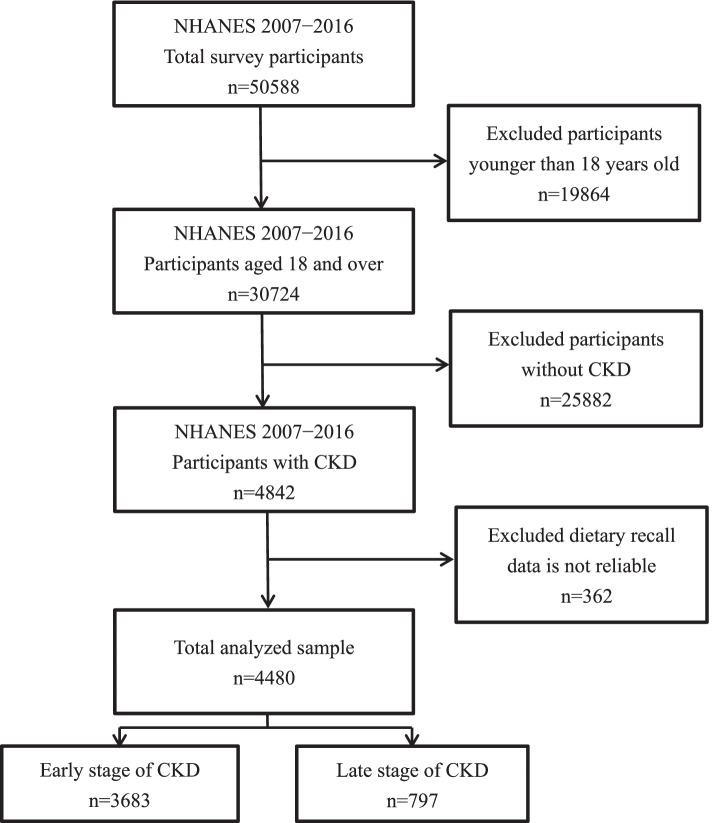
We analyzed 4480 participants with CKD at various stages based on the data recorded between 2007 and 2016 from the database of the American National Health and Nutrition Examination Survey.
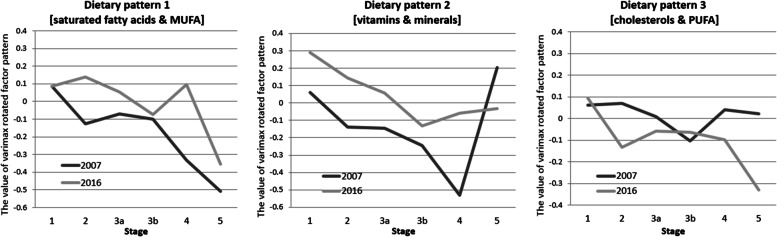
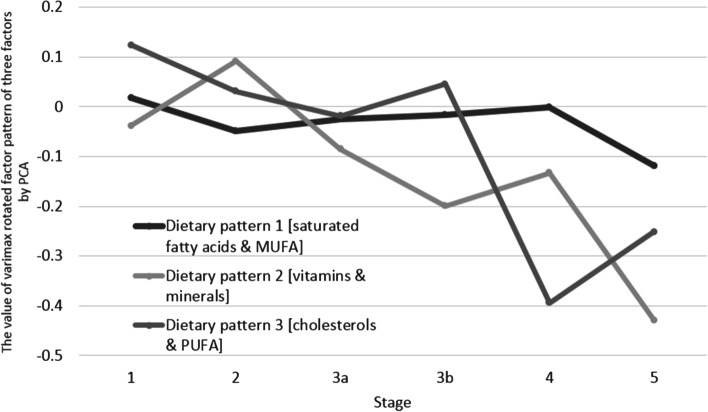
In total, 3683 and 797 participants had early and late-stage CKD, respectively. Through principal components analysis, the dietary intake dimension was reduced from 63 variables to 3 dietary patterns. We adopted logistic regression for analysis. The three dietary patterns are as follows: (1) saturated fatty acids and mono-unsaturated fatty acids (MUFA); (2) vitamins and minerals; and (3) cholesterols and polyunsaturated fatty acids (PUFA). These 3 patterns explained > 50% of dietary nutrient intake. Results indicated that among participants with dietary patterns 2 (vitamins and minerals) and 3 (cholesterols and PUFA), those with low intakes were more likely to have late-stage CKD. The odds ratios for patterns 2 and 3 were 1.74 (95% CI: 1.21-2.50) and 1.66 (95% CI: 1.13-2.43), respectively.
This study revealed that intakes of vitamins and minerals and cholesterols and PUFA were associated with the stages of CKD.
研究表明,慢性肾脏病(CKD)患者的饮食模式与普通人群不同。然而,尚无研究比较 CKD 早期(1-3a 期)和晚期(3b-5 期)患者的饮食模式。我们的目的是探讨 CKD 早期和晚期患者饮食模式之间的关系。
我们根据美国国家健康和营养调查数据库中 2007 年至 2016 年期间记录的数据,对不同分期的 4480 名 CKD 患者进行了分析。
共有 3683 名和 797 名患者分别患有早期和晚期 CKD。通过主成分分析,将 63 个变量的饮食摄入维度减少到 3 种饮食模式。我们采用逻辑回归进行分析。这三种饮食模式分别是:(1)饱和脂肪酸和单不饱和脂肪酸(MUFA);(2)维生素和矿物质;和(3)胆固醇和多不饱和脂肪酸(PUFA)。这 3 种模式解释了>50%的饮食营养素摄入。结果表明,在饮食模式 2(维生素和矿物质)和 3(胆固醇和 PUFA)的参与者中,低摄入量者更有可能患有晚期 CKD。模式 2 和 3 的比值比分别为 1.74(95%可信区间:1.21-2.50)和 1.66(95%可信区间:1.13-2.43)。
本研究表明,维生素和矿物质以及胆固醇和 PUFA 的摄入量与 CKD 分期有关。