Heart Center Bonn, Department of Medicine II, University Hospital Bonn, Venusberg-Campus 1, 53127, Bonn, Germany.
Heart Center, Department of Cardiology, University Hospital Düsseldorf, Düsseldorf, Germany.
Clin Res Cardiol. 2022 Aug;111(8):944-954. doi: 10.1007/s00392-022-02010-5. Epub 2022 Mar 23.
Clinical data regarding the association between the left atrial function index (LAFI) and outcome in patients undergoing transcatheter aortic valve replacement (TAVR) are limited.
We aimed to investigate the association between the left atrial function index (LAFI) and outcome in patients undergoing TAVR.
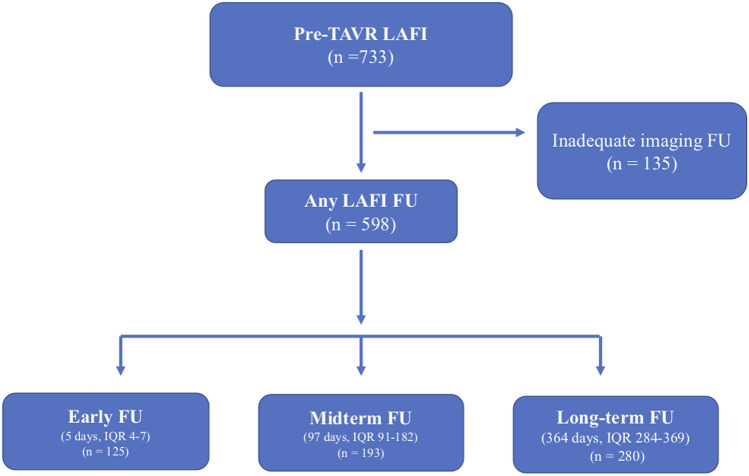
In this retrospective multicenter study, we assessed baseline LAFI in 733 patients undergoing TAVR for severe aortic stenosis in two German high-volume centers between 2008 and 2019. Based on receiver operating characteristic curves, patients were stratified according to their baseline LAFI into two groups (LAFI ≤ 13.5 vs. LAFI > 13.5) and assessed for post-procedural outcome. The primary endpoint of our study was the 1-year all-cause mortality.
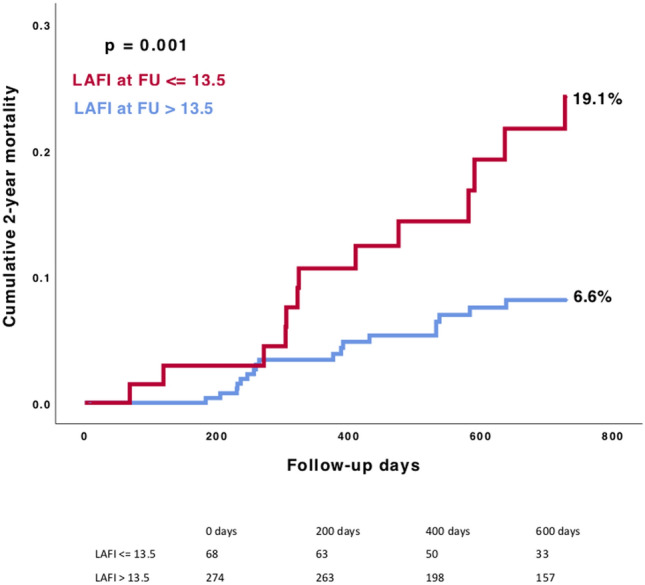
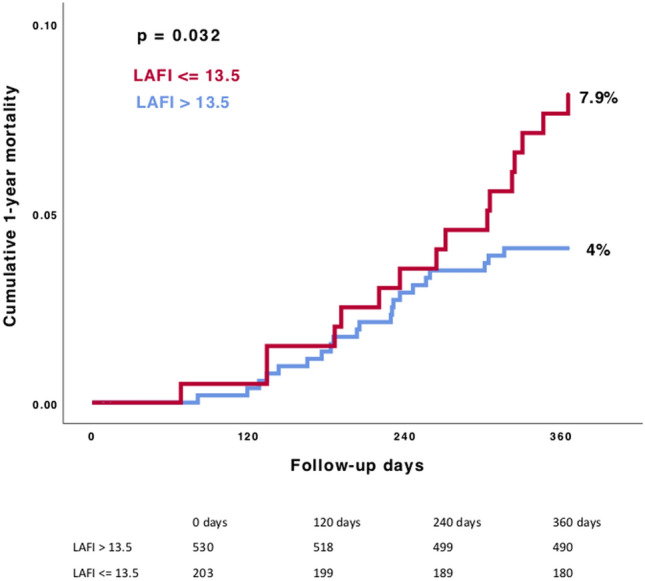
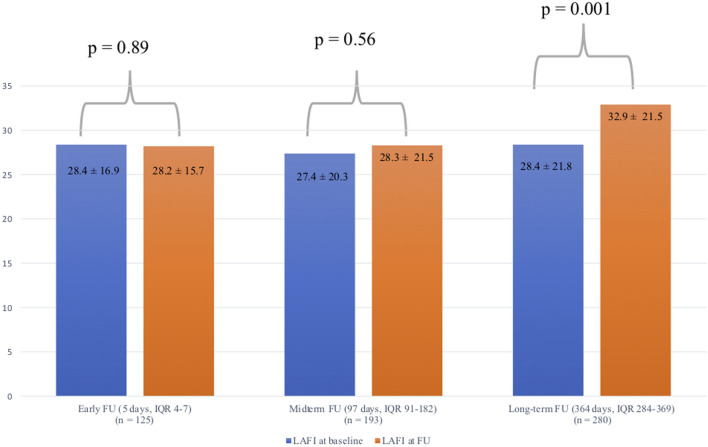
Patients with a LAFI ≤ 13.5 had significantly more often atrial fibrillation (p < 0.001), lower LVEF (p < 0.001) and higher levels of NT-proBNP (p < 0.001). After TAVR, a significant improvement in the LAFI as compared to baseline was observed at 12 months after the procedure (28.4 vs. 32.9; p = 0.001). Compared to patients with a LAFI > 13.5, those with a LAFI ≤ 13.5 showed significantly higher rate of 1-year mortality (7.9% vs. 4.0%; p = 0.03). A lower LAFI has been identified as independent predictor of mortality in multivariate analysis (HR (95% CI) 2.0 (1.1-3.9); p = 0.03).
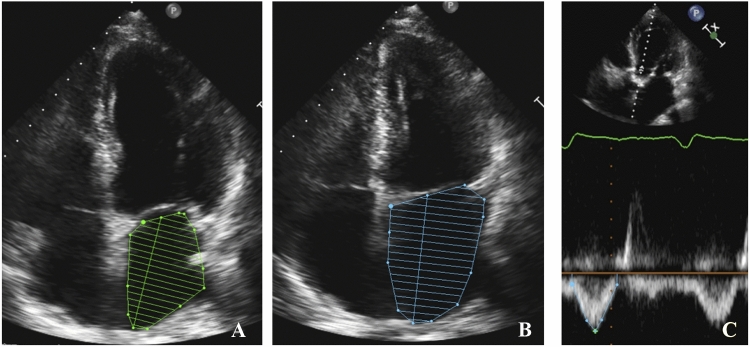
A reduced LAFI is associated with adverse outcome and an independent predictor of mortality in TAVR patients. TAVR improves LAFI within 12 months after the procedure. Left Atrial Function Index (LAFI) in Patients undergoing Transcatheter Aortic Valve Implantation. A Kaplan-Meier survival analysis of 1-year all-cause mortality in patients with LAFI ≤ 13.5 compared with patients with LAFI > 13.5. Comparing rates of 1-year all-cause mortality between the different LAFI groups, we found a significant association between left atrial function and mortality. LAFI Left atrial function index. B Comparison of the mean LAFI before and after TAVR. After long-term follow-up the LAFI improved significantly. LAFI Left atrial function index; FU follow-up. C Assessment of the left atrial function index using the pre-procedural transthoracic echocardiography. A Measurement of the minimal left atrial volume (LAEDV). B Assessment of the maximal left atrial volume (LAESV).
经导管主动脉瓣置换术(TAVR)患者左心房功能指数(LAFI)与结局的临床数据有限。
我们旨在研究 TAVR 患者左心房功能指数(LAFI)与结局的相关性。
在这项回顾性多中心研究中,我们评估了 2008 年至 2019 年间在德国两个高容量中心接受 TAVR 治疗严重主动脉瓣狭窄的 733 例患者的基线 LAFI。根据接受者操作特征曲线,根据基线 LAFI 将患者分为两组(LAFI≤13.5 vs. LAFI>13.5),并评估术后结局。我们研究的主要终点是 1 年全因死亡率。
LAFI≤13.5 的患者更常发生心房颤动(p<0.001)、左心室射血分数(LVEF)更低(p<0.001)和 NT-proBNP 水平更高(p<0.001)。与基线相比,TAVR 后 12 个月时 LAFI 显著改善(28.4 比 32.9;p=0.001)。与 LAFI>13.5 的患者相比,LAFI≤13.5 的患者 1 年死亡率显著更高(7.9%比 4.0%;p=0.03)。多变量分析显示,较低的 LAFI 是死亡率的独立预测因素(HR(95%CI)2.0(1.1-3.9);p=0.03)。
LAFI 降低与不良结局相关,是 TAVR 患者死亡率的独立预测因素。TAVR 在术后 12 个月内可改善 LAFI。经导管主动脉瓣植入患者的左心房功能指数(LAFI)。LAFI≤13.5 的患者与 LAFI>13.5 的患者相比,1 年全因死亡率的 Kaplan-Meier 生存分析。比较不同 LAFI 组之间 1 年全因死亡率的发生率,我们发现左心房功能与死亡率之间存在显著相关性。LAFI 左心房功能指数。B TAVR 前后 LAFI 的均值比较。经过长期随访,LAFI 显著改善。LAFI 左心房功能指数;FU 随访。C 使用术前经胸超声心动图评估左心房功能指数。A 测量最小左心房容积(LAEDV)。B 评估最大左心房容积(LAESV)。