Center for Family Welfare, Faculty of Public Health, Universitas Indonesia, Depok, Indonesia.
Faculty of Public Health, Universitas Airlangga, Surabaya, Indonesia.
PLoS One. 2022 Mar 23;17(3):e0257278. doi: 10.1371/journal.pone.0257278. eCollection 2022.
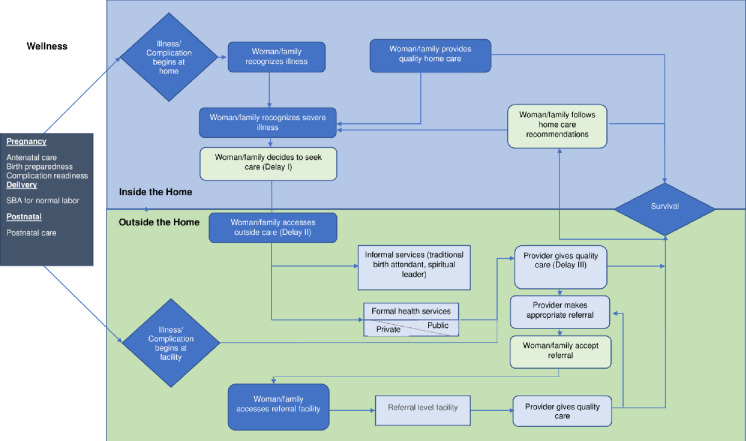
Despite the increased access to facility-based delivery in Indonesia, the country's maternal mortality remains unacceptably high. Reducing maternal mortality requires a good understanding of the care-seeking pathways for maternal complications, especially with the government moving toward universal health coverage. This study examined care-seeking practices and health insurance in instances of pregnancy-related deaths in Jember District, East Java, Indonesia.
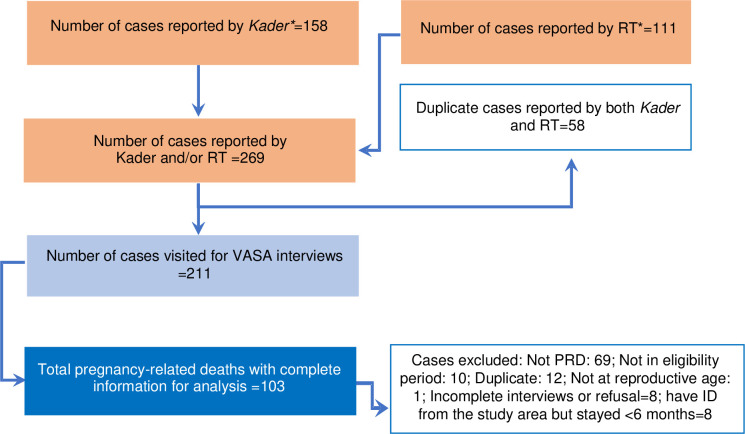
This was a community-based cross-sectional study to identify all pregnancy-related deaths in the district from January 2017 to December 2018. Follow-up verbal and social autopsy interviews were conducted to collect information on care-seeking behavior, health insurance, causes of death, and other factors.
Among 103 pregnancy-related deaths, 40% occurred after 24 hours postpartum, 36% during delivery or within the first 24 hours postpartum, and 24% occurred while pregnant. The leading causes of deaths were hemorrhage (38.8%), pregnancy-induced hypertension (20.4%), and sepsis (16.5%). Most deaths occurred in health facilities (81.6%), primarily hospitals (74.8%). Nearly all the deceased sought care from a formal health provider during their fatal illness (93.2%). Seeking any care from an informal provider during the fatal illness was more likely among women who died after 24 hours postpartum (41.0%, OR 7.4, 95% CI 1.9, 28.5, p = 0.049) or during pregnancy (29.2%, OR 4.4, 95% CI 1.0, 19.2, p = 0.003) than among those who died during delivery or within 24 hours postpartum (8.6%). There was no difference in care-seeking patterns between insured and uninsured groups.
The fact that women sought care and reached health facilities regardless of their insurance status provides opportunities to prevent deaths by ensuring that every woman receives timely and quality care. Accordingly, the increasing demand should be met with balanced readiness of both primary care and hospitals to provide quality care, supported by an effective referral system.
尽管印度尼西亚获得了更多的医疗机构分娩机会,但该国的孕产妇死亡率仍然高得令人无法接受。降低孕产妇死亡率需要对孕产妇并发症的寻求护理途径有很好的了解,特别是随着政府转向全民健康覆盖。本研究调查了印度尼西亚东爪哇省井里汶地区与妊娠相关的死亡事件中的寻求护理实践和健康保险情况。
这是一项基于社区的横断面研究,旨在确定 2017 年 1 月至 2018 年 12 月期间该地区所有与妊娠相关的死亡事件。进行了口头和社会尸检随访访谈,以收集有关寻求护理行为、健康保险、死亡原因和其他因素的信息。
在 103 例与妊娠相关的死亡中,40%发生在产后 24 小时后,36%发生在分娩期间或产后 24 小时内,24%发生在怀孕期间。导致死亡的主要原因是出血(38.8%)、妊娠高血压(20.4%)和败血症(16.5%)。大多数死亡发生在医疗机构(81.6%),主要是医院(74.8%)。几乎所有死者在致命疾病期间都向正规卫生提供者寻求过治疗(93.2%)。在致命疾病期间向非正规提供者寻求任何治疗的可能性在产后 24 小时后死亡的妇女中更高(41.0%,OR 7.4,95%CI 1.9,28.5,p = 0.049)或在怀孕期间(29.2%,OR 4.4,95%CI 1.0,19.2,p = 0.003)比在分娩期间或产后 24 小时内死亡的妇女更高(8.6%)。保险和未保险群体的寻求护理模式没有差异。
尽管妇女寻求治疗并到达医疗机构,无论其保险状况如何,这为确保每位妇女都能及时获得高质量的护理提供了机会,从而有机会预防死亡。因此,应通过确保有效的转介系统,以平衡初级保健和医院提供优质护理的准备情况,来满足不断增长的需求。