National Cancer Control Institute, National Cancer Center, Goyang, Korea.
Department of Nursing, KC University, Seoul, Korea.
J Gynecol Oncol. 2022 Jul;33(4):e39. doi: 10.3802/jgo.2022.33.e39. Epub 2022 Feb 11.
This study aimed to analyze the trends in cervical cancer screening rates, including organized and opportunistic cancer screening rates, with the Papanicolaou test among Korean women.
Data were collected from a nationwide, cross-sectional, Korean National Cancer Screening Survey. To evaluate the cervical cancer screening rates, we used the screening approach of "," defined as the proportion of women who underwent the Papanicolaou test during the previous 2 years according to the Protocol of National Cancer Screening Program for Cervical Cancer in Korea. The joinpoint regression analysis, which describes the annual percent change (APC), was performed to detect significant changes in cervical cancer screening rates in women aged 30-74 years during 2005-2020.
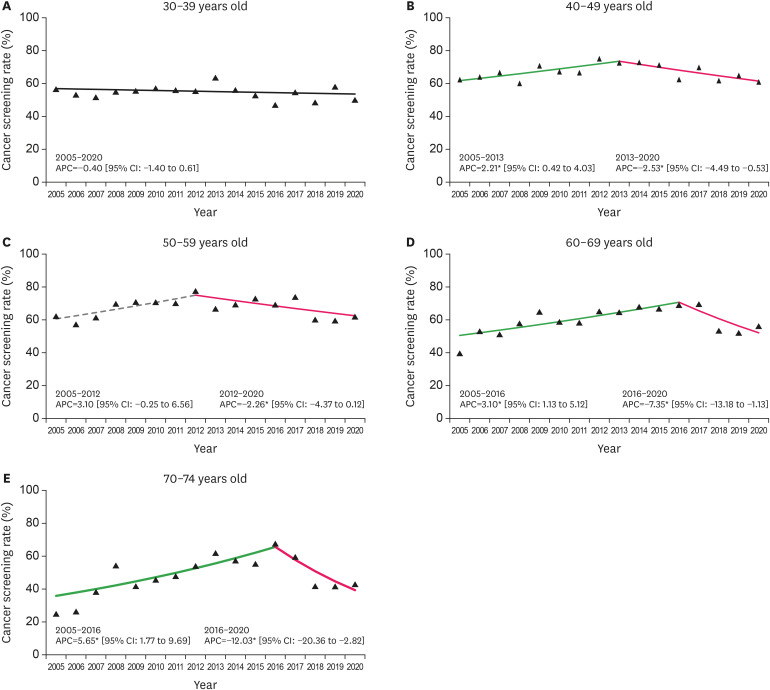
The cervical cancer screening rate was 56.0% in 2020. From 2005 to 2013, there was a rising trend in cervical cancer screening rates (APC=2.70%, 95% confidence interval [CI]:1.05 to 4.38), followed by a falling trend (APC=-2.67%, 95% CI:-4.3 to -1.01). The falling trend was significantly associated with age (≥40 years), education level (below the 15th grade), household income (below the middle-income level), and residence (all residential areas).
The recent falling trend was more common in women with a low socioeconomic status, which suggests that there is a socioeconomic gap in cervical cancer screening. Moreover, young women in their thirties had a low screening rate. Therefore, an active participation strategy for women vulnerable to cervical cancer is required.
本研究旨在分析韩国女性巴氏涂片检查宫颈癌筛查率(包括有组织筛查率和机会性筛查率)的变化趋势。
数据来自全国性、横断面的韩国国家癌症筛查调查。为了评估宫颈癌筛查率,我们采用了“定义为过去 2 年内根据韩国宫颈癌国家癌症筛查计划方案接受巴氏涂片检查的女性比例”的筛查方法。采用 Joinpoint 回归分析描述了 2005-2020 年 30-74 岁女性宫颈癌筛查率的年度百分比变化(APC)。
2020 年宫颈癌筛查率为 56.0%。2005-2013 年,宫颈癌筛查率呈上升趋势(APC=2.70%,95%可信区间[CI]:1.05-4.38),随后呈下降趋势(APC=-2.67%,95% CI:-4.3- -1.01)。下降趋势与年龄(≥40 岁)、教育程度(低于 15 年级)、家庭收入(低于中等收入水平)和居住地(所有居住地区)显著相关。
最近的下降趋势在社会经济地位较低的女性中更为常见,这表明宫颈癌筛查存在社会经济差距。此外,三十多岁的年轻女性筛查率较低。因此,需要针对易患宫颈癌的女性采取积极的参与策略。