
商业聚合超滤膜对结构相似酚酸的分离及其机制研究
A Study of the Mechanism and Separation of Structurally Similar Phenolic Acids by Commercial Polymeric Ultrafiltration Membranes.
作者信息
Wang Qinshi, Zhang Yun, Zhang Xianli, Li Qi, Huang Mingcong, Huang Shasha, Wu Qianlian, Tang Zhishu, Pan Linmei, Zhang Yue, Liu Hongbo, Li Bo, Zhu Huaxu
机构信息
Jiangsu Collaborative Innovation Center of Chinese Medicinal Resources Industrialization, Nanjing University of Chinese Medicine, Nanjing 210023, China.
Jiangsu Research Center of Botanical Medicine Refinement Engineering, Nanjing University of Chinese Medicine, Nanjing 210023, China.
出版信息
Membranes (Basel). 2022 Mar 1;12(3):285. doi: 10.3390/membranes12030285.
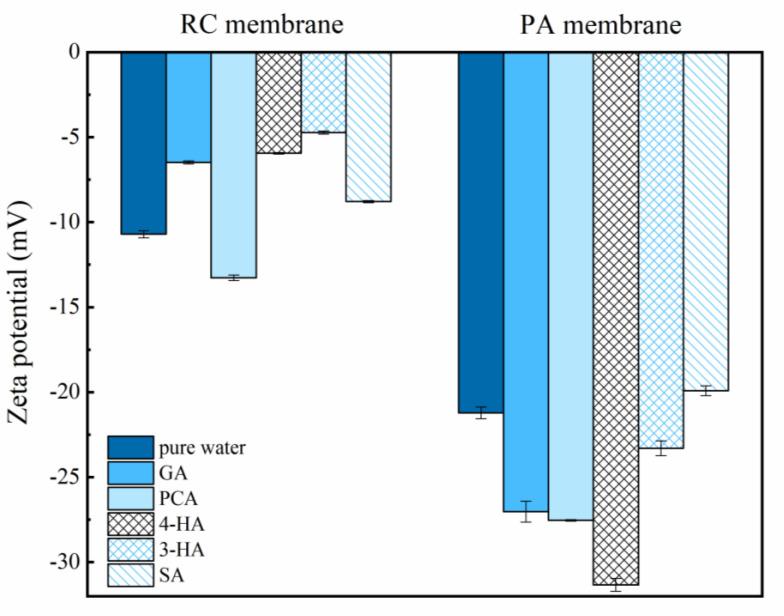
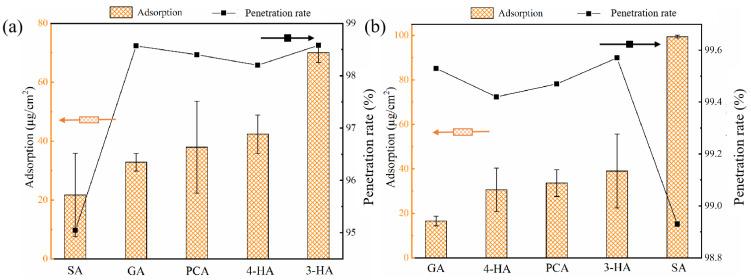
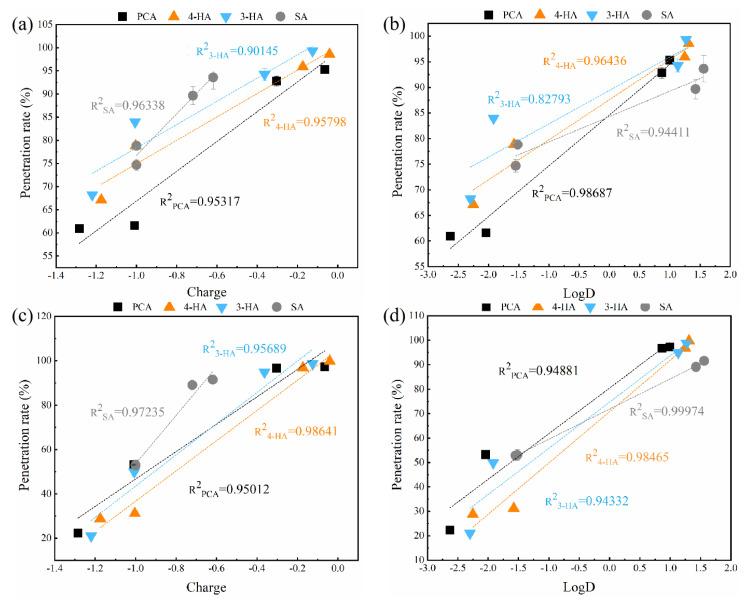
This study examined the behavior and penetration mechanisms of typical phenolic (benzoic) acids, which determine their observed penetration rates during membrane separation, focusing on the influence of electrostatic and hydrophobic solute/membrane interactions. To understand the effects of hydrophobicity and electrostatic interaction on membrane filtration, the observed penetration of five structurally similar phenolic acids was compared with regenerated cellulose (RC) and polyamide (PA) membranes at different solute concentrations and solution pHs. Variation partitioning analysis (VPA) was performed to calculate the relative contributions of electrostatic and hydrophobic effects. The penetration of phenolic acids was mainly influenced by the electrostatic interaction, with salicylic acid having the highest penetration. Penetration of phenolic acids through the PA membrane decreased from 98% at pH 3.0 to 30-50% at pH 7.4, indicating the dominance of the electrostatic interaction. Moreover, based on its hydrophobicity and greater surface charge, the PA membrane could separate binary mixtures of protocatechuic/salicylic acid and 4-hydroxybenzoic/salicylic acid at pH 9.0, with separation factors of 1.81 and 1.78, respectively. These results provide a greater understanding of solute/membrane interactions and their effect on the penetration of phenolic acids through polymeric ultrafiltration membranes.
本研究考察了典型酚(苯)酸的行为和渗透机制,这些机制决定了它们在膜分离过程中观察到的渗透速率,重点关注静电和疏水溶质/膜相互作用的影响。为了解疏水性和静电相互作用对膜过滤的影响,在不同溶质浓度和溶液pH值下,将五种结构相似的酚酸在再生纤维素(RC)膜和聚酰胺(PA)膜上的观察到的渗透率进行了比较。进行了变异分配分析(VPA)以计算静电和疏水效应的相对贡献。酚酸的渗透主要受静电相互作用影响,其中水杨酸的渗透率最高。酚酸通过PA膜的渗透率从pH 3.0时的98%降至pH 7.4时的30 - 50%,表明静电相互作用占主导。此外,基于其疏水性和更大的表面电荷,PA膜在pH 9.0时能够分离原儿茶酸/水杨酸和4 - 羟基苯甲酸/水杨酸的二元混合物,分离因子分别为1.81和1.78。这些结果有助于更深入地理解溶质/膜相互作用及其对酚酸通过聚合物超滤膜渗透的影响。







 Zotero 插件