Serra Elisa, Masu Gabriella, Chisu Valentina, Cappai Stefano, Masala Giovanna, Loi Federica, Piseddu Toni
OIE-National Reference Laboratory of Echinococcosis, Istituto Zooprofilattico Sperimentale della Sardegna, Via Vienna, 07100 Sassari, Italy.
Osservatorio Epidemiologico Veterinario Regionale della Sardegna, Istituto Zooprofilattico Sperimentale della Sardegna, Via XX Settembre, 09125 Cagliari, Italy.
Vet Sci. 2022 Mar 18;9(3):143. doi: 10.3390/vetsci9030143.
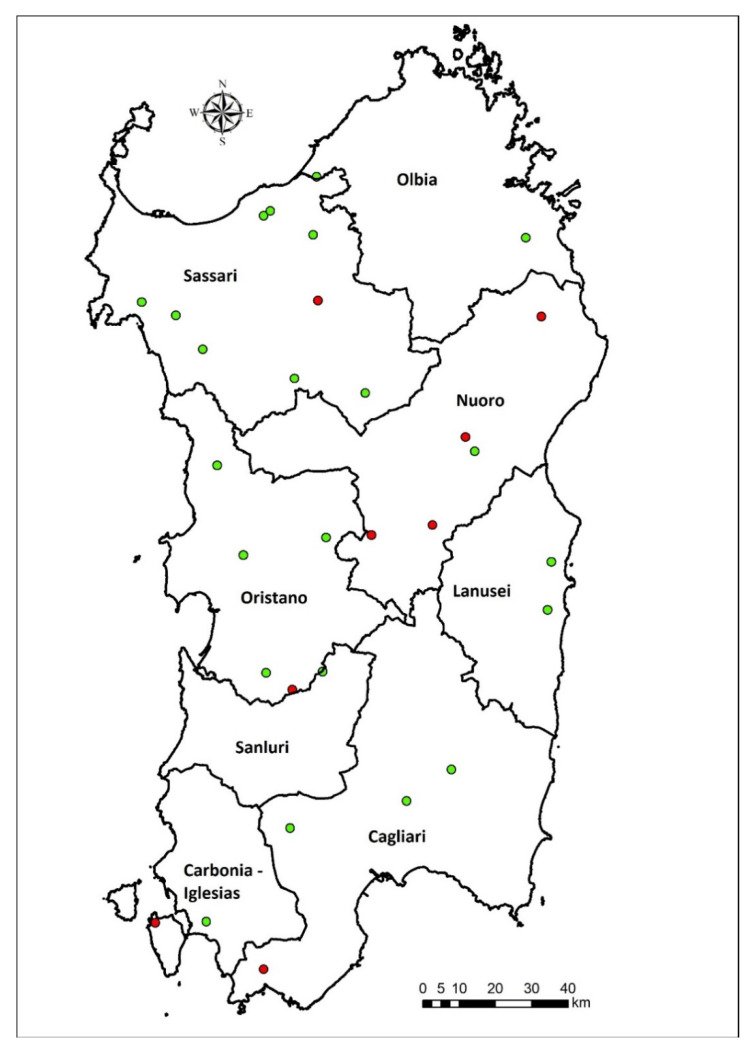
Cystic Echinococcosis (CE) is a severe zoonosis caused by the larval stage of the tapeworm . These parasites are naturally transmitted between canid definitive hosts that harbour the adult stage in the intestine, and mainly ungulate intermediate hosts, with larval cysts developing in their internal organs. The close coexistence between dog and sheep with incorrect hygiene management are the most important factors for the persistence of this parasitic pathology. The Educational Farms (EF) are farms and agritourisms suitably equipped to carry out training activities for people interested in farm practices and agricultural processing, in particular student groups. Public attendance of farms represents a new potential risk factor for the zoonoses transmission. Consumption of contaminated food and water in combination with contact or playing with domestic dogs () are possible routes of zoonoses human infection. In fact, spp. eggs may persist in the environment up to several months at low temperatures and moist conditions, having the chance of contaminating different matrices and surfaces. The aim of this investigation was to study environmental contamination by parasitic elements as a risk for zoonoses, such as spp. A total of 116 samples (35 of water, 33 of soil, 23 of vegetables, 25 of dog faeces) were collected in 30 EF in Sardinia. Samples were subjected to biomolecular investigation for the research of specific gene sequences of , and spp. The study allowed to identify eight positive EF due to the presence of in eight dog faeces samples and one positive EF due to the presence of spp. in a water sample. The work has allowed to develop and harmonise the diagnostic methods and operating protocols essential for controlling the spread of the CE to create "One Health" intervention plans in high endemic areas through the implementation of SOP (standard operating procedures) for monitoring the pathology in animals, humans and environment.
囊型包虫病(CE)是由绦虫幼虫阶段引起的一种严重人畜共患病。这些寄生虫在犬科终末宿主(其肠道内寄生着成虫阶段)和主要的有蹄类中间宿主之间自然传播,幼虫囊肿在中间宿主的内脏器官中发育。狗和羊的密切共存以及不正确的卫生管理是这种寄生虫病持续存在的最重要因素。教育农场(EF)是配备完善的农场和农业旅游场所,适合为对农场实践和农业加工感兴趣的人开展培训活动,特别是学生团体。公众参观农场是人畜共患病传播的一个新的潜在风险因素。食用受污染的食物和水,再加上与家犬接触或玩耍,是人类感染人畜共患病的可能途径。事实上,棘球绦虫属的虫卵在低温潮湿条件下可在环境中存活数月,有机会污染不同的基质和表面。本调查的目的是研究作为人畜共患病风险的寄生虫元素对环境的污染情况,例如棘球绦虫属。在撒丁岛的30个教育农场共采集了116份样本(35份水样、33份土壤样本、23份蔬菜样本、25份狗粪便样本)。对样本进行生物分子研究,以寻找棘球绦虫属、细粒棘球绦虫和多房棘球绦虫的特定基因序列。该研究发现,由于8份狗粪便样本中存在棘球绦虫属,有8个教育农场呈阳性,并且由于一份水样中存在多房棘球绦虫属,有一个教育农场呈阳性。这项工作有助于开发和统一控制囊型包虫病传播所需的诊断方法和操作规范,通过实施监测动物、人类和环境中该疾病的标准操作程序(SOP),在高流行地区制定“同一健康”干预计划。