Georgiev Dejan, Delalić Sentilija, Zupančič Križnar Nina, Socher Achinoam, Gurevich Tanya, Trošt Maja
Department of Neurology, University Medical Centre Ljubljana, 1000 Ljubljana, Slovenia.
Faculty of Computer and Information Sciences, University of Ljubljana, 1000 Ljubljana, Slovenia.
Brain Sci. 2022 Mar 2;12(3):343. doi: 10.3390/brainsci12030343.
Device-aided therapies (DAT), such as continuous subcutaneous apomorphine infusion (CSAI), levodopa-carbidopa intestinal gel infusion (LCIG), and deep brain stimulation of the subthalamic nucleus (STN-DBS), have markedly changed the treatment landscape of advanced Parkinson's disease (aPD). In some patients, it is necessary to switch or combine DATs for various reasons. The aim of this retrospective study was to explore the frequency and reasons for switching between or combining DATs in two movement disorders centres in Slovenia and Israel.
We collected and analysed demographic and clinical data from aPD patients who switched between or combined DATs. Motor and non-motor reasons, adverse events for switching/combining, and their frequency were examined, as was the effect of DAT using the Global Improvement subscale of the Clinical Global Impression Scale, Movement Disorders Society Unified Parkinson's Disease Rating Scale part III, Mini Mental State Examination, and Parkinson's Disease Questionnaire 39. Descriptive statistics and non-parametric tests were used to analyse the data.
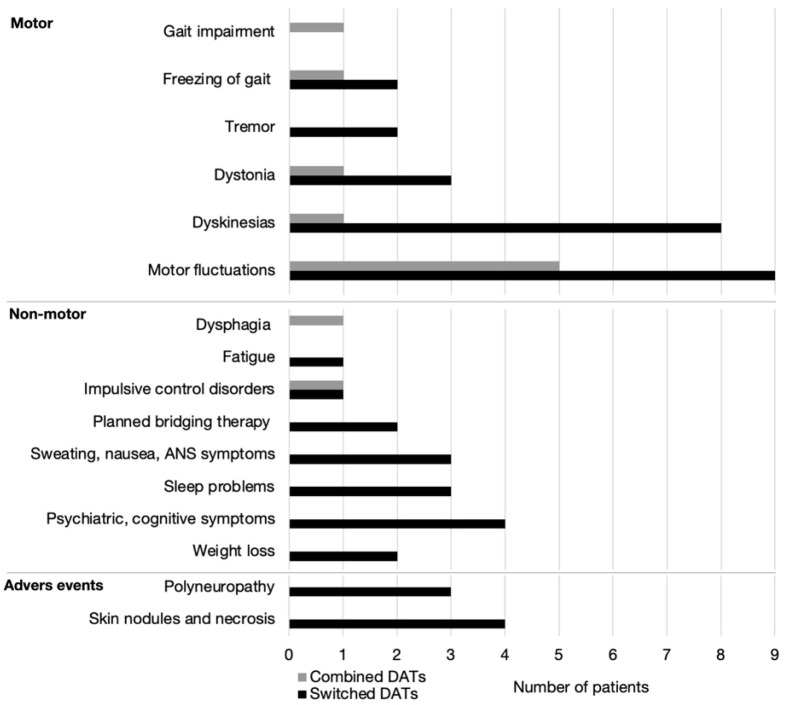
Of 505 aPD patients treated with DATs at both centres between January 2009 and June 2021, we identified in a total of 30 patients (6%) who either switched DAT ( = 24: 7 , 1 , 5 , 8 , 1 , 1 , and 1 ) or combined DATs ( = 6:5 and 1 ). In most of these patients, an inadequate control of motor symptoms was the main reason for switching or combining DATs, but non-motor reasons (related to the disease and/or DAT) were also identified.
Switching between and combining DATs is uncommon, but in some patients brings substantial clinical improvement and should be considered in those who have either inadequate symptom control on DAT treatment or have developed DAT-related complications.
设备辅助疗法(DAT),如皮下持续输注阿扑吗啡(CSAI)、左旋多巴 - 卡比多巴肠凝胶输注(LCIG)以及丘脑底核深部脑刺激(STN - DBS),显著改变了晚期帕金森病(aPD)的治疗格局。在一些患者中,出于各种原因有必要更换或联合使用DAT。这项回顾性研究的目的是探讨斯洛文尼亚和以色列的两个运动障碍中心更换DAT或联合使用DAT的频率及原因。
我们收集并分析了在DAT之间转换或联合使用DAT的aPD患者的人口统计学和临床数据。检查了运动和非运动原因、转换/联合使用的不良事件及其频率,以及使用临床总体印象量表的总体改善分量表、运动障碍协会统一帕金森病评定量表第三部分、简易精神状态检查表和帕金森病问卷39对DAT效果的评估。使用描述性统计和非参数检验分析数据。
在2009年1月至2021年6月期间,两个中心共有505例接受DAT治疗的aPD患者,我们共识别出30例(6%)患者,其中24例更换了DAT(分别为7例、1例、5例、8例、1例、1例和1例),6例联合使用了DAT(分别为5例和1例)。在这些患者中,大多数情况下,运动症状控制不佳是更换或联合使用DAT的主要原因,但也发现了非运动原因(与疾病和/或DAT相关)。
更换和联合使用DAT并不常见,但在一些患者中能带来显著的临床改善,对于DAT治疗症状控制不佳或出现DAT相关并发症的患者应予以考虑。