van Lent Liza G G, de Jonge Maja J A, van der Ham Mirte, van Mil Marjolein, Gort Eelke H, Hasselaar Jeroen, Oomen-de Hoop Esther, van der Rijt Carin C D, van Weert Julia C M, Lolkema Martijn P
Department of Medical Oncology, Erasmus MC Cancer Institute, Erasmus University Medical Center, 3015 GD Rotterdam, The Netherlands.
Department of Medical Oncology and Clinical Pharmacology, Antoni van Leeuwenhoek, The Netherlands Cancer Institute, 1066 CX Amsterdam, The Netherlands.
Cancers (Basel). 2022 Mar 15;14(6):1500. doi: 10.3390/cancers14061500.
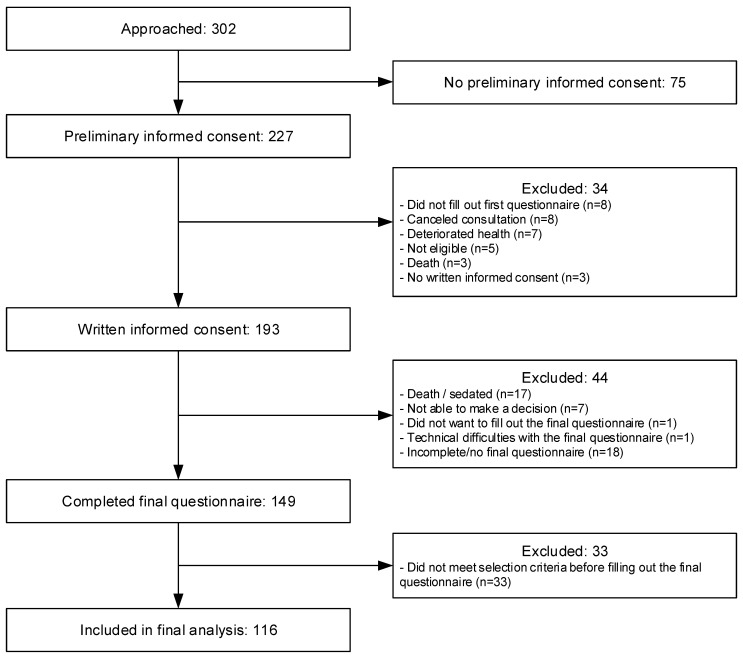
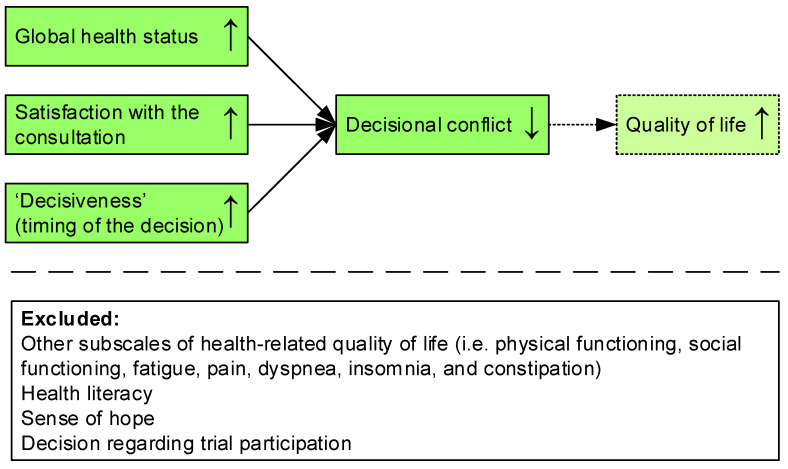
When standard treatment options are not available anymore, patients with advanced cancer may participate in early phase clinical trials. Improving this complex decision-making process may improve their quality of life. Therefore, this prospective multicenter study with questionnaires untangles several contributing factors to decisional conflict (which reflects the quality of decision-making) in patients with advanced cancer who recently decided upon early phase clinical trial participation (phase I or I/II). We hypothesized that health-related quality of life, health literacy, sense of hope, satisfaction with the consultation, timing of the decision, and the decision explain decisional conflict. Mean decisional conflict in 116 patients was 30.0 (SD = 16.9). Multivariate regression analysis showed that less decisional conflict was reported by patients with better global health status (β = −0.185, p = 0.018), higher satisfaction (β = −0.246, p = 0.002), and who made the decision before (β = −0.543, p < 0.001) or within a week after the consultation (β = −0.427, p < 0.001). These variables explained 37% of the variance in decisional conflict. Healthcare professionals should realize that patients with lower global health status and who need more time to decide may require additional support. Although altering such patient intrinsic characteristics is difficult, oncologists can impact the satisfaction with the consultation. Future research should verify whether effective patient-centered communication could prevent decisional conflict.
当不再有标准治疗方案可供选择时,晚期癌症患者可以参与早期临床试验。改善这一复杂的决策过程可能会提高他们的生活质量。因此,这项采用问卷调查的前瞻性多中心研究梳理了近期决定参与早期临床试验(I期或I/II期)的晚期癌症患者决策冲突(反映决策质量)的几个影响因素。我们假设健康相关生活质量、健康素养、希望感、对咨询的满意度、决策时间以及决策本身可以解释决策冲突。116名患者的平均决策冲突为30.0(标准差=16.9)。多变量回归分析显示,总体健康状况较好的患者(β=-0.185,p=0.018)、满意度较高的患者(β=-0.246,p=0.002)以及在咨询前(β=-0.543,p<0.001)或咨询后一周内做出决策的患者(β=-0.427,p<0.001)报告的决策冲突较少。这些变量解释了决策冲突中37%的方差。医疗保健专业人员应该认识到,总体健康状况较差且需要更多时间做出决策的患者可能需要额外的支持。虽然改变患者的这些内在特征很困难,但肿瘤学家可以影响患者对咨询的满意度。未来的研究应该验证以患者为中心的有效沟通是否可以预防决策冲突。