Süße Marie, Konen Franz Felix, Schwenkenbecher Philipp, Budde Kathrin, Nauck Matthias, Grothe Matthias, Hannich Malte Johannes, Skripuletz Thomas
Department of Neurology, University Medicine Greifswald, 17475 Greifswald, Germany.
Department of Neurology, Hannover Medical School, 30625 Hannover, Germany.
Diagnostics (Basel). 2022 Mar 16;12(3):720. doi: 10.3390/diagnostics12030720.
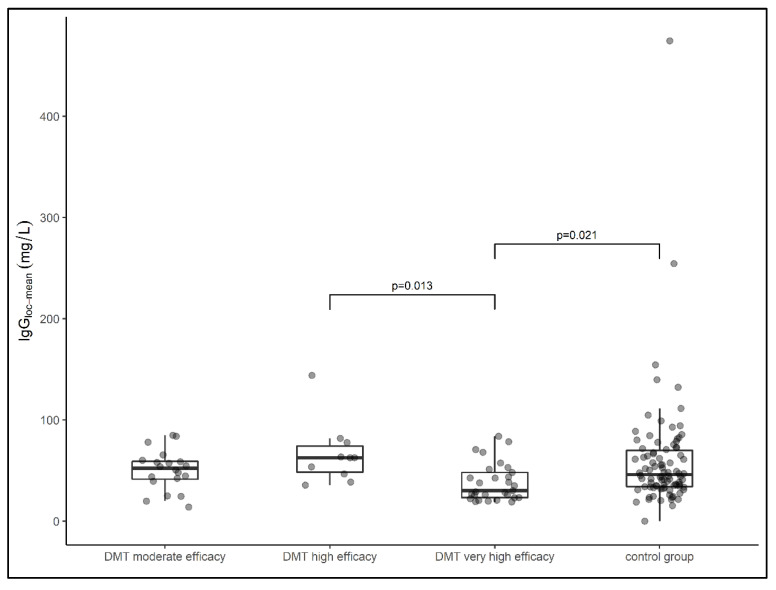
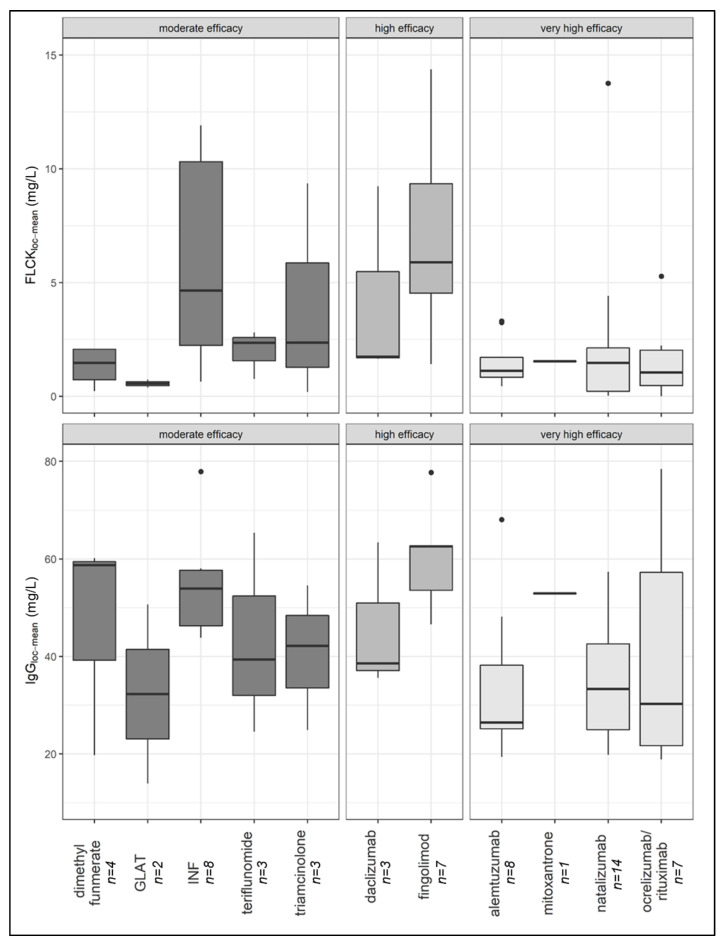
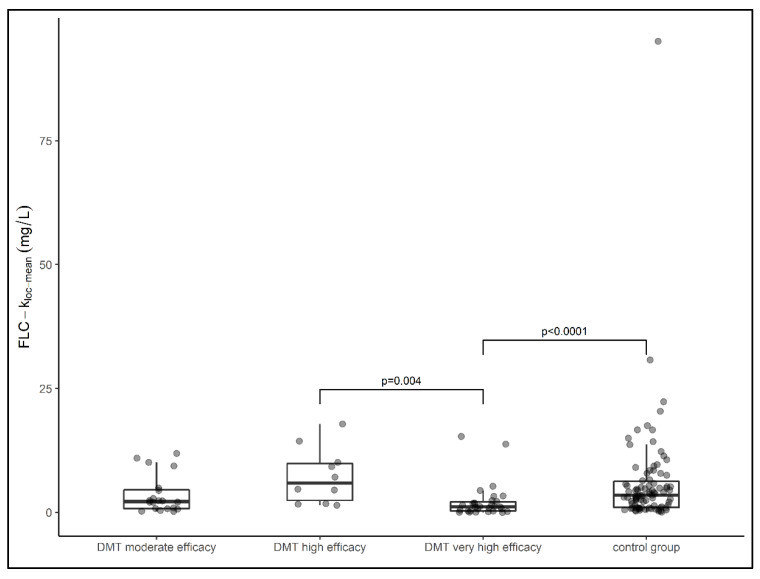
Free light chains kappa (FLCκ) in cerebrospinal fluid (CSF) are a part of the intrathecal immune response. This observational study was conducted to investigate the effects of different disease-modifying therapies (DMT) on the humoral intrathecal immune response in the CSF of patients with multiple sclerosis (MS). FLCκ were analyzed in CSF and serum samples from MS patients taking DMT (n = 60) and those in a control cohort of treatment-naïve MS patients (n = 90). DMT was classified as moderately effective (including INFß-1a, INFß-1b, glatiramer acetate, dimethyl fumarate, teriflunomide, triamcinolone); highly effective (including fingolimod, daclizumab) and very highly effective (alemtuzumab, natalizumab, rituximab/ocrelizumab, mitoxantrone). FLCκ were measured using a nephelometric FLCκ kit. Intrathecal FLCκ and IgG concentrations were assessed in relation to the hyperbolic reference range in quotient diagrams. Intrathecal FLCκ concentrations and IgG concentrations were significantly lower in samples from the cohort of MS patients taking very highly effective DMT than in samples from the cohort of MS patients taking highly effective DMT and in the treatment-naïve cohort (FLCκ: p = 0.004, p < 0.0001 respectively/IgG: p = 0.013; p = 0.021). The reduction in FLCκ could contribute to an anti-inflammatory effect in the CNS through this mechanism. There was no difference in the appearance of CSF-specific oligoclonal bands (p = 0.830). Longitudinal analyses are required to confirm these results.
脑脊液(CSF)中的游离κ轻链(FLCκ)是鞘内免疫反应的一部分。本观察性研究旨在调查不同疾病修正疗法(DMT)对多发性硬化症(MS)患者脑脊液中体液鞘内免疫反应的影响。对接受DMT治疗的MS患者(n = 60)和未经治疗的MS患者对照组(n = 90)的脑脊液和血清样本中的FLCκ进行了分析。DMT被分类为中等疗效(包括INFβ-1a、INFβ-1b、醋酸格拉替雷、富马酸二甲酯、特立氟胺、曲安奈德);高效(包括芬戈莫德、达利珠单抗)和非常高效(阿仑单抗、那他珠单抗、利妥昔单抗/奥瑞珠单抗、米托蒽醌)。使用散射比浊法FLCκ试剂盒测量FLCκ。在商图中根据双曲线参考范围评估鞘内FLCκ和IgG浓度。接受非常高效DMT治疗的MS患者队列样本中的鞘内FLCκ浓度和IgG浓度显著低于接受高效DMT治疗的MS患者队列样本和未经治疗的队列(FLCκ:p = 0.004,p分别< 0.0001/IgG:p = 0.013;p = 0.021)。FLCκ的降低可能通过这种机制对中枢神经系统产生抗炎作用。脑脊液特异性寡克隆带的出现没有差异(p = 0.830)。需要进行纵向分析以证实这些结果。