Monday Happy Nkanta, Li Jianping, Nneji Grace Ugochi, Nahar Saifun, Hossin Md Altab, Jackson Jehoiada, Ejiyi Chukwuebuka Joseph
School of Computer Science and Engineering, University of Electronic Science and Technology of China, Chengdu 611731, China.
School of Information and Software Engineering, University of Electronic Science and Technology of China, Chengdu 611731, China.
Diagnostics (Basel). 2022 Mar 18;12(3):741. doi: 10.3390/diagnostics12030741.
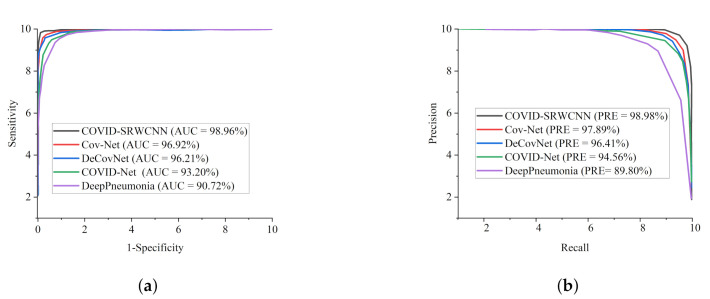
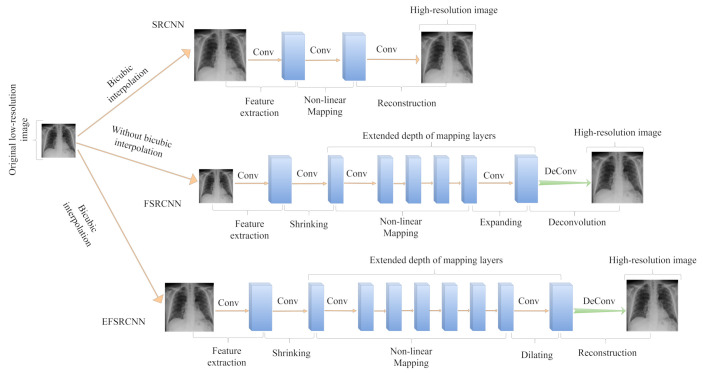
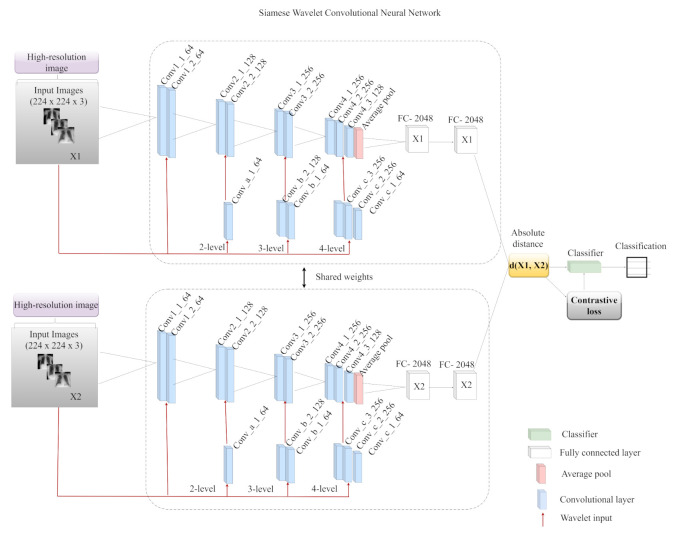
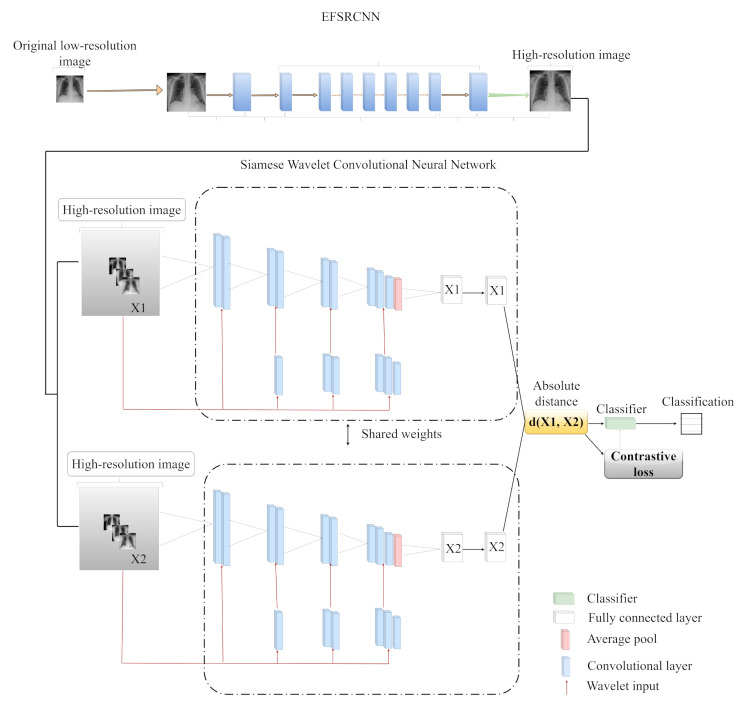
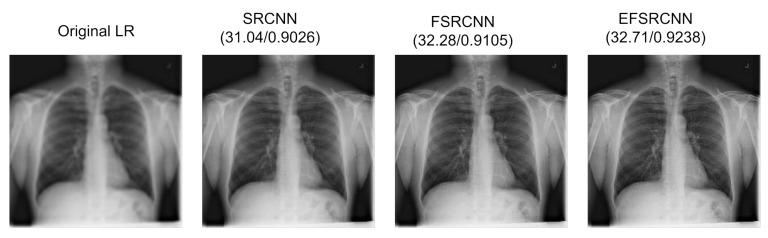
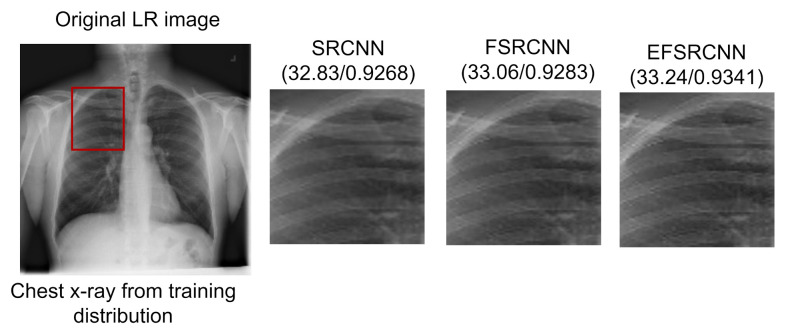
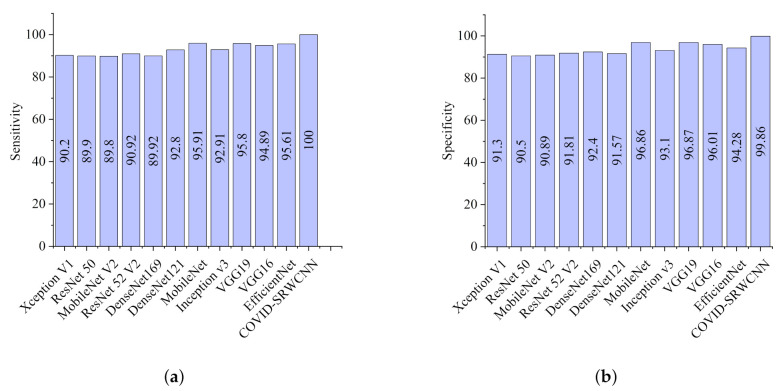
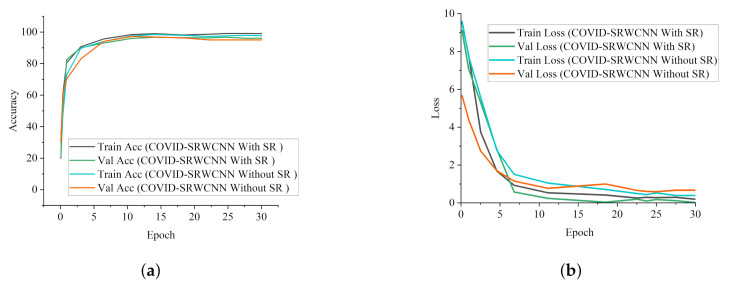
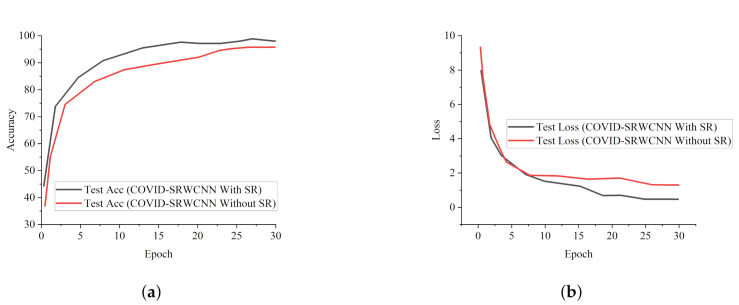
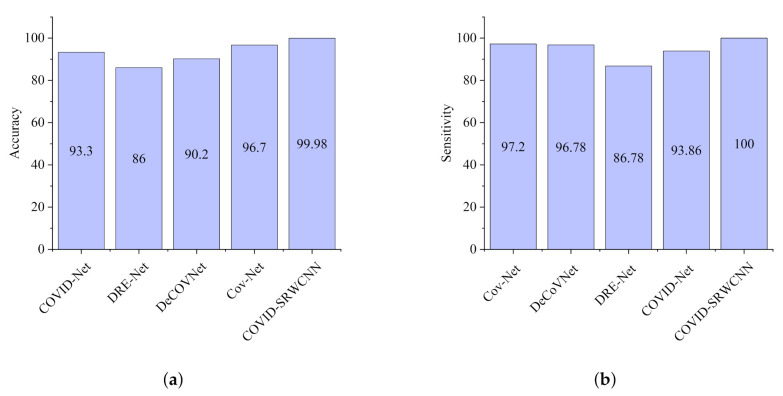
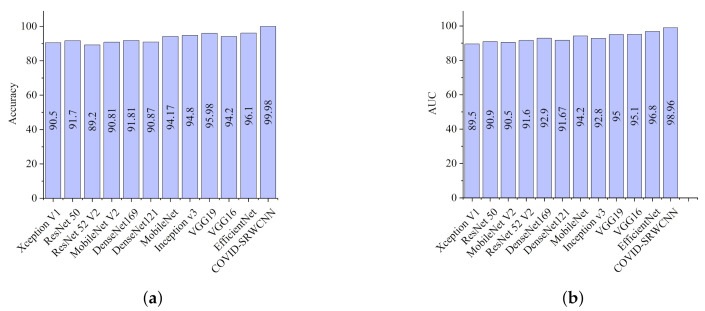
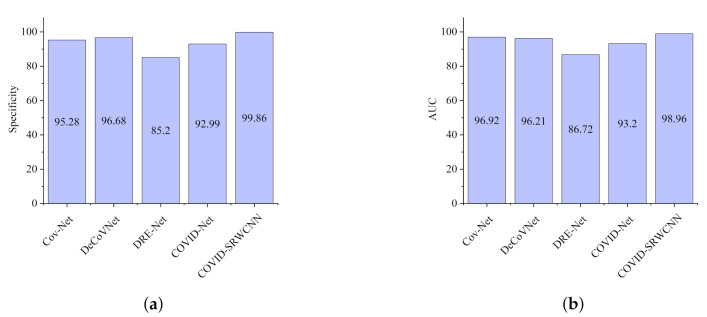
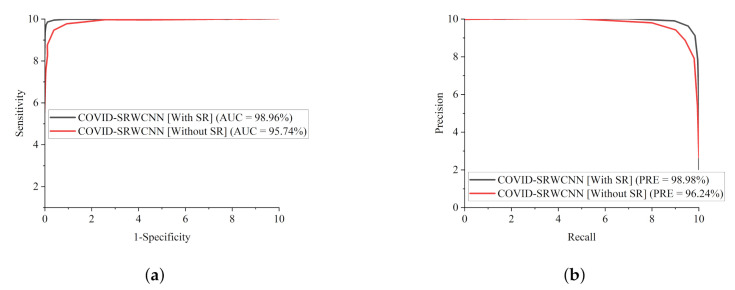
Chest X-ray (CXR) is becoming a useful method in the evaluation of coronavirus disease 19 (COVID-19). Despite the global spread of COVID-19, utilizing a computer-aided diagnosis approach for COVID-19 classification based on CXR images could significantly reduce the clinician burden. There is no doubt that low resolution, noise and irrelevant annotations in chest X-ray images are a major constraint to the performance of AI-based COVID-19 diagnosis. While a few studies have made huge progress, they underestimate these bottlenecks. In this study, we propose a super-resolution-based Siamese wavelet multi-resolution convolutional neural network called COVID-SRWCNN for COVID-19 classification using chest X-ray images. Concretely, we first reconstruct high-resolution (HR) counterparts from low-resolution (LR) CXR images in order to enhance the quality of the dataset for improved performance of our model by proposing a novel enhanced fast super-resolution convolutional neural network (EFSRCNN) to capture texture details in each given chest X-ray image. Exploiting a mutual learning approach, the HR images are passed to the proposed Siamese wavelet multi-resolution convolutional neural network to learn the high-level features for COVID-19 classification. We validate the proposed COVID-SRWCNN model on public-source datasets, achieving accuracy of 98.98%. Our screening technique achieves 98.96% AUC, 99.78% sensitivity, 98.53% precision, and 98.86% specificity. Owing to the fact that COVID-19 chest X-ray datasets are low in quality, experimental results show that our proposed algorithm obtains up-to-date performance that is useful for COVID-19 screening.
胸部X光(CXR)正成为评估新型冠状病毒肺炎(COVID-19)的一种有用方法。尽管COVID-19在全球传播,但利用基于CXR图像的计算机辅助诊断方法对COVID-19进行分类可以显著减轻临床医生的负担。毫无疑问,胸部X光图像中的低分辨率、噪声和无关注释是基于人工智能的COVID-19诊断性能的主要限制因素。虽然一些研究已经取得了巨大进展,但它们低估了这些瓶颈。在本研究中,我们提出了一种基于超分辨率的暹罗小波多分辨率卷积神经网络,称为COVID-SRWCNN,用于使用胸部X光图像进行COVID-19分类。具体而言,我们首先从低分辨率(LR)CXR图像重建高分辨率(HR)对应图像,以通过提出一种新颖的增强快速超分辨率卷积神经网络(EFSRCNN)来捕获每个给定胸部X光图像中的纹理细节,从而提高数据集质量以提升我们模型的性能。利用相互学习方法,将HR图像传递到所提出的暹罗小波多分辨率卷积神经网络中,以学习用于COVID-19分类的高级特征。我们在公共源数据集上验证了所提出的COVID-SRWCNN模型,准确率达到98.98%。我们的筛查技术实现了98.96%的曲线下面积(AUC)、99.78%的灵敏度、98.53%的精确率和98.86%的特异性。由于COVID-19胸部X光数据集质量较低,实验结果表明我们提出的算法获得了对COVID-19筛查有用的最新性能。