MOA Key Lab of Pest Monitoring and Green Management, Department of Plant Pathology, College of Plant Protection, China Agricultural University, Beijing 100193, China.
College of Plant Protection, Nanjing Agricultural University, Nanjing 210095, China.
Int J Mol Sci. 2022 Mar 9;23(6):2937. doi: 10.3390/ijms23062937.
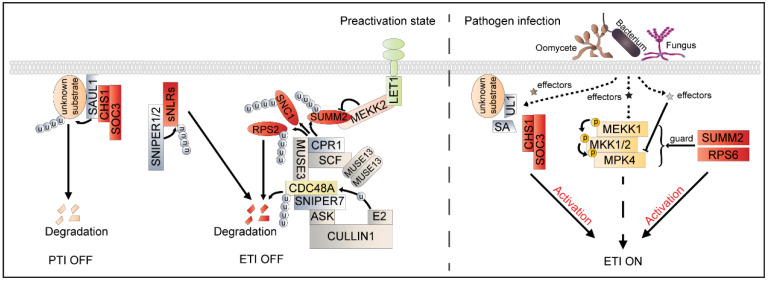
Sessile plants are constantly exposed to myriads of unfavorable invading organisms with different lifestyles. To survive, plants have evolved plasma membrane-resident pattern recognition receptors (PRRs) and intracellular nucleotide-binding domain leucine-rich repeat receptors (NLRs) to initiate sophisticated downstream immune responses. Ubiquitination serves as one of the most important and prevalent posttranslational modifications (PTMs) to fine-tune plant immune responses. Over the last decade, remarkable progress has been made in delineating the critical roles of ubiquitination in plant immunity. In this review, we highlight recent advances in the understanding of ubiquitination in the modulation of plant immunity, with a particular focus on ubiquitination in the regulation of receptorsomes, and discuss how ubiquitination and other PTMs act in concert to ensure rapid, proper, and robust immune responses.
固着植物不断暴露在无数具有不同生活方式的不利入侵生物中。为了生存,植物进化出了驻留在质膜上的模式识别受体 (PRRs) 和细胞内核苷酸结合域富含亮氨酸重复受体 (NLRs),以启动复杂的下游免疫反应。泛素化是精细调节植物免疫反应的最重要和最普遍的翻译后修饰 (PTM) 之一。在过去的十年中,人们在阐明泛素化在植物免疫中的关键作用方面取得了显著进展。在这篇综述中,我们强调了最近在理解泛素化在植物免疫调节中的作用方面的进展,特别关注泛素化在受体体调节中的作用,并讨论了泛素化和其他 PTM 如何协同作用以确保快速、适当和强大的免疫反应。