Centre de Recherche en Reproduction, Développement et Santé Intergénérationnelle, Département des Sciences Animales, Faculté des Sciences de l'Agriculture et de l'Alimentation, Université Laval, Quebec, QC G1V 0A6, Canada.
Department of Animal Production, National Agronomic Institute of Tunisia, University of Carthage, Mahrajène 1082, Tunisia.
Int J Mol Sci. 2022 Mar 10;23(6):2988. doi: 10.3390/ijms23062988.
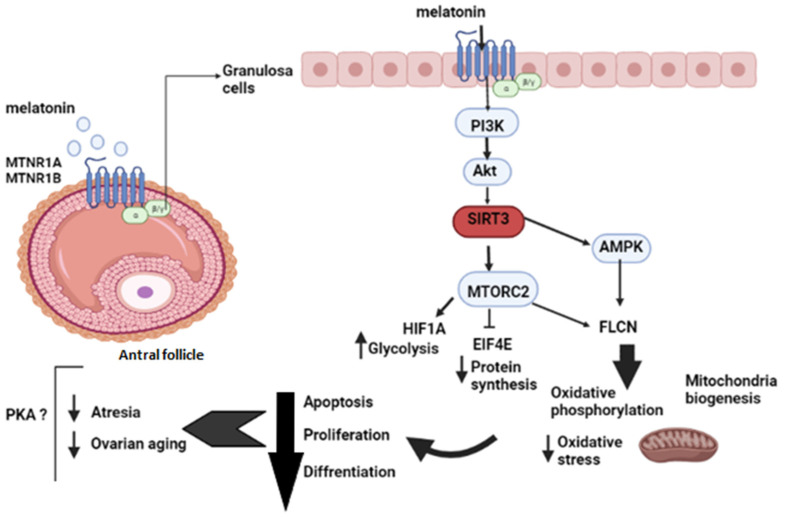
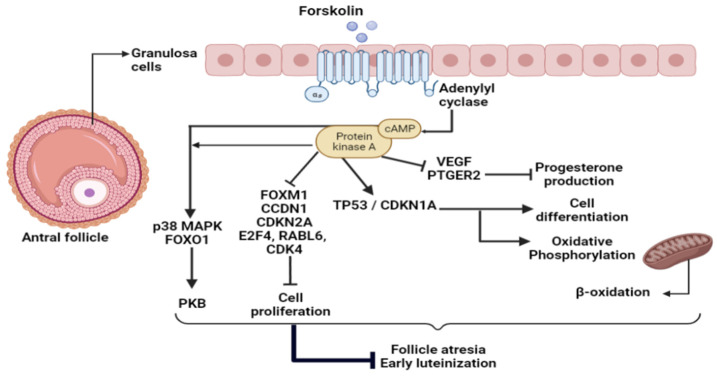
Female reproduction depends on the metabolic status, especially during the period of folliculogenesis. Even though it is believed that melatonin can improve oocyte competence, there is still limited knowledge of how it can modulate metabolic processes during folliculogenesis and which signaling pathways are involved in regulating gene expression. To investigate the effects of melatonin on metabolic signals during the antral stage of follicular development, human granulosa-like tumor cells (KGN) were treated with melatonin or forskolin, and gene expression was analyzed with RNA-seq technology. Following appropriate normalization and the application of a fold change cut-off of 1.5 (FC 1.5, ≤ 0.05), 1009 and 922 genes were identified as differentially expressed in response to melatonin and forskolin, respectively. Analysis of major upstream regulators suggested that melatonin may activate PKB/mTOR signaling pathways to program the metabolism of KGN cells to support slower growth and differentiation and to prevent follicular atresia. Similarly, PKA activation through stimulation of cAMP synthesis with FSK seemed to exert the same effects as melatonin in reducing follicular growth and regulating differentiation. This study suggests that melatonin may act through PKA and PKB simultaneously in human granulosa cells to prevent follicular atresia and early luteinization at the antral stage.
女性生殖依赖于代谢状态,尤其是在卵泡发生期。尽管人们认为褪黑素可以提高卵母细胞的活力,但对于它如何调节卵泡发生过程中的代谢过程以及涉及哪些信号通路来调节基因表达,人们的了解仍然有限。为了研究褪黑素对卵泡发育窦状期代谢信号的影响,用人颗粒细胞样肿瘤细胞(KGN)用褪黑素或 forskolin 处理,并用 RNA-seq 技术分析基因表达。经过适当的归一化和 1.5 倍变化(FC 1.5,≤0.05)的倍数变化截止值的应用,分别鉴定出 1009 个和 922 个基因对褪黑素和 forskolin 有差异表达。主要上游调节剂的分析表明,褪黑素可能通过激活 PKB/mTOR 信号通路来调节 KGN 细胞的代谢,以支持更缓慢的生长和分化,并防止卵泡闭锁。同样,通过用 FSK 刺激 cAMP 合成来激活 PKA,似乎与褪黑素一样,具有减少卵泡生长和调节分化的相同作用。这项研究表明,褪黑素可能通过 PKA 和 PKB 同时作用于人类颗粒细胞,以防止窦状期卵泡闭锁和早期黄体化。