Ackerman Ilana N, Skou Søren T, Roos Ewa M, Barton Christian J, Kemp Joanne L, Crossley Kay M, Liew Danny, Ademi Zanfina
School of Public Health and Preventive Medicine, Monash University, Melbourne, Australia.
Research Unit for Musculoskeletal Function and Physiotherapy, Department of Sports Science and Clinical Biomechanics, University of Southern Denmark, Odense, Denmark.
Osteoarthr Cartil Open. 2020 May 6;2(3):100070. doi: 10.1016/j.ocarto.2020.100070. eCollection 2020 Sep.
To model potential cost savings associated with implementing a first-line management program for moderate-severe knee osteoarthritis (OA) at a national level in Australia.
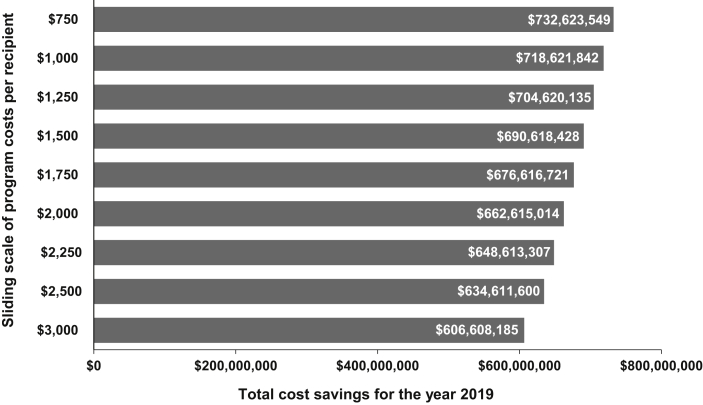
A budget impact analysis was undertaken using published trial data and publically available data. Australian population projections and OA prevalence data were used to forecast likely need for total knee replacement (TKR) surgery for 2019-2029. Published data were sourced on TKR avoidance following a 12-week non-surgical knee OA management program (exercise therapy, education, insoles, dietary advice, analgesia) and cost per TKR in Australia. The cost of providing the first-line program was estimated on a sliding scale ($AUD750-$3000), with a base case of $AUD1,500. These inputs were used to model potential annual savings associated with national implementation of the program.
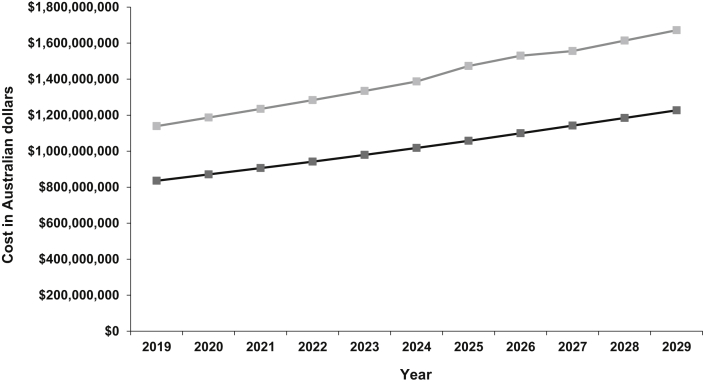
The number of people in Australia with moderate-severe knee OA requiring TKR was estimated to be 56,007 in 2019, rising to 69,038 by 2029. Avoidance of TKR by 34%-68% of people after the first-line management program could translate to savings of $AUD303million-690 million in 2019. Successively lowering the proportion of people who avoided TKR demonstrated that only 1 in 12 program recipients would need to avoid surgery for the program to generate savings.
National implementation of a first-line OA management program as an alternative to TKR could produce substantial cost savings for the Australian healthcare system. Longer term data on TKR avoidance is needed to establish whether cost savings are realised or simply shifted to later years.
在澳大利亚全国范围内建立一个与实施中重度膝骨关节炎(OA)一线管理项目相关的潜在成本节约模型。
使用已发表的试验数据和公开可得数据进行预算影响分析。利用澳大利亚人口预测数据和OA患病率数据预测2019 - 2029年全膝关节置换术(TKR)手术的可能需求。获取已发表的关于为期12周的非手术膝骨关节炎管理项目(运动疗法、教育、鞋垫、饮食建议、镇痛)后TKR避免情况的数据以及澳大利亚TKR的每项成本数据。提供一线项目的成本按滑动比例估算(750澳元 - 3000澳元),基础情况为1500澳元。这些输入数据用于建立与该项目在全国实施相关的潜在年度节约成本模型。
估计2019年澳大利亚中重度膝OA需要进行TKR的人数为56,007人,到2029年将增至69,038人。一线管理项目后34% - 68%的人避免进行TKR,这可能在2019年节省3.03亿澳元 - 6.9亿澳元。依次降低避免进行TKR的人群比例表明,该项目每12名接受者中只需有1人避免手术就能实现节约成本。
在全国实施一线OA管理项目以替代TKR可为澳大利亚医疗系统大幅节约成本。需要关于TKR避免情况的长期数据来确定节约成本是否得以实现,还是仅仅转移到了后续年份。