Wang Xi, Benagiano Giuseppe, Liu Xishi, Guo Sun-Wei
Shanghai Obstetrics and Gynecology Hospital, Fudan University, Shanghai 200011, China.
Faculty of Medicine and Dentistry, Sapienza, University of Rome, 00161 Rome, Italy.
J Clin Med. 2022 Mar 21;11(6):1744. doi: 10.3390/jcm11061744.
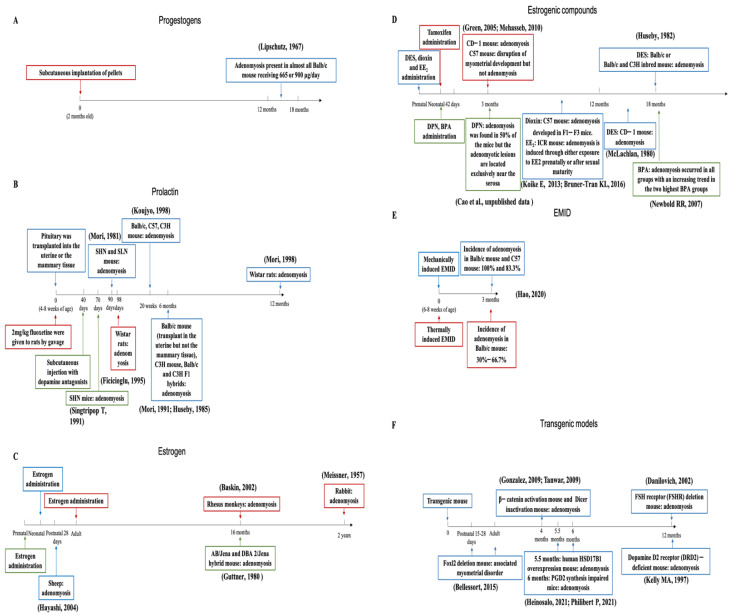
Adenomyosis is a common gynecological disorder traditionally viewed as "elusive". Several excellent review papers have been published fairly recently on its pathogenesis, and several theories have been proposed. However, the falsifiability, explanatory power, and predictivity of these theories are often overlooked. Since adenomyosis can occur spontaneously in rodents and many other species, the animal models may help us unveil the pathogenesis of adenomyosis. This review critically tallies experimentally induced models published so far, with a particular focus on their relevance to epidemiological findings, their possible mechanisms of action, and their explanatory and predictive power.
PubMed was exhaustively searched using the phrase "adenomyosis and animal model", "adenomyosis and experimental model", "adenomyosis and mouse", and "adenomyosis and rat", and the resultant papers were retrieved, carefully read, and the resultant information distilled. All the retrieved papers were then reviewed in a narrative manner.
Among all published animal models of adenomyosis, the mouse model of adenomyosis induced by endometrial-myometrial interface disruption (EMID) seems to satisfy the requirements of falsifiability and has the predictive capability and also Hill's causality criteria. Other theories only partially satisfy Hill's criteria of causality. In particular, animal models of adenomyosis induced by hyperestrogenism, hyperprolactinemia, or long-term exposure to progestogens without much epidemiological documentation and adenomyosis is usually not the exclusive uterine pathology consequent to those induction procedures. Regardless, uterine disruption appears to be a necessary but not sufficient condition for causing adenomyosis.
EMID is, however, unlikely the sole cause for adenomyosis. Future studies, including animal studies, are warranted to understand how and why in utero and/or prenatal exposure to elevated levels of estrogen or estrogenic compounds increases the risk of developing adenomyosis in adulthood, to elucidate whether prolactin plays any role in its pathogenesis, and to identify sufficient condition(s) that cause adenomyosis.
子宫腺肌病是一种常见的妇科疾病,传统上被视为“难以捉摸”。最近有几篇优秀的综述文章发表,探讨了其发病机制,并提出了几种理论。然而,这些理论的可证伪性、解释力和预测性常常被忽视。由于子宫腺肌病可在啮齿动物和许多其他物种中自发发生,动物模型可能有助于我们揭示子宫腺肌病的发病机制。本综述批判性地梳理了迄今为止发表的实验诱导模型,特别关注它们与流行病学研究结果的相关性、可能的作用机制以及它们的解释力和预测力。
在PubMed中使用“子宫腺肌病与动物模型”“子宫腺肌病与实验模型”“子宫腺肌病与小鼠”以及“子宫腺肌病与大鼠”等短语进行全面检索,检索到的论文被仔细阅读并提炼出相关信息。然后以叙述的方式对所有检索到的论文进行综述。
在所有已发表的子宫腺肌病动物模型中,由子宫内膜 - 肌层界面破坏(EMID)诱导的子宫腺肌病小鼠模型似乎满足可证伪性要求,具有预测能力,并且符合希尔因果标准。其他理论仅部分满足希尔因果标准。特别是,由高雌激素血症、高催乳素血症或长期暴露于孕激素诱导的子宫腺肌病动物模型,缺乏足够的流行病学记录,而且子宫腺肌病通常不是这些诱导程序导致的唯一子宫病变。尽管如此,子宫破坏似乎是导致子宫腺肌病的必要但非充分条件。
然而,EMID不太可能是子宫腺肌病的唯一病因。未来的研究,包括动物研究,有必要了解子宫内和/或产前暴露于高水平雌激素或雌激素化合物如何以及为何会增加成年后患子宫腺肌病的风险,阐明催乳素在其发病机制中是否起作用,并确定导致子宫腺肌病的充分条件。