Guo Zijun, Tian Shuxin, Wang Weijun, Zhang Yanbin, Li Jing, Lin Rong
Department of Gastroenterology, Union Hospital, Tongji Medical College, Huazhong University of Science and Technology, Wuhan, China.
Department of Gastroenterology, The First Affiliated Hospital, Shihezi University, Shihezi, China.
Front Microbiol. 2022 Mar 7;13:861626. doi: 10.3389/fmicb.2022.861626. eCollection 2022.
The antimicrobial resistance of () in most countries and regions has increased significantly. It has not been fully confirmed whether the detection of resistance gene mutation can replace antibiotic drug sensitivity test to guide the clinical personalized treatment. The objective of this study was to assess and compare the efficacy of different antimicrobial resistance-guided quadruple therapies in refractory -infected individuals who had undergone unsuccessful prior eradication treatments.
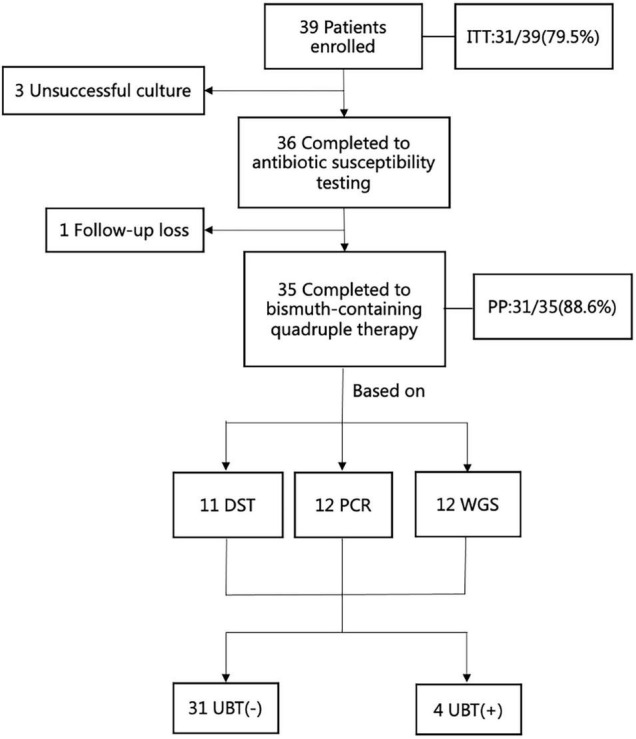
From January 2019 to February 2020, genotypic and phenotypic resistances were determined by polymerase chain reaction (PCR), whole genome sequencing (WGS) and broth microdilution test, respectively, in 39 -infected patients who have failed eradication for at least twice. The patients were retreated with bismuth quadruple therapy for 14 days according to individual antibiotic resistance results. Eradication status was determined by the C-urea breath test.
The overall eradication rate was 79.5% (31/39, 95% CI 64.2-89.5%) in the intention-to-treat (ITT) analysis and 88.6% (31/35, 95% CI 73.5-96.1%) in the per- protocol analysis (PP) analysis. The presence of amoxicillin resistance (OR, 15.60; 95% CI, 1.34-182.09; = 0.028), female sex (OR, 12.50; 95% CI, 1.10-142.31; = 0.042) and no less than 3 prior eradication treatments (OR, 20.25; 95% CI, 1.67-245.44; = 0.018), but not the methods for guiding therapy ( > 0.05) were associated with treatment failure. Resistance-guided therapy achieved eradication rates of more than 80% in these patients. The eradication rate of in the phenotypic resistance-guided group was correlated well with genotype resistance-guided groups, including PCR and WGS.
Culture or molecular method guiding therapy can enable personalized, promise salvage treatments, and achieve comparably high eradication rates in patients with refractory infection. The detection of resistance mutations has a good clinical application prospect.
[clinicaltrials.gov], identifier [ChiCTR1800020009].
大多数国家和地区()的抗菌药物耐药性显著增加。耐药基因突变检测能否替代抗生素药敏试验以指导临床个体化治疗尚未得到充分证实。本研究的目的是评估和比较不同抗菌药物耐药性指导的四联疗法在先前根除治疗失败的难治性感染个体中的疗效。
2019年1月至2020年2月,分别通过聚合酶链反应(PCR)、全基因组测序(WGS)和肉汤稀释试验对39例根除治疗至少失败两次的感染患者进行基因型和表型耐药性检测。根据个体抗生素耐药结果,患者接受铋剂四联疗法治疗14天。通过C-尿素呼气试验确定根除状态。
意向性分析(ITT)中总体根除率为79.5%(31/39,95%CI 64.2-89.5%),符合方案分析(PP)中为88.6%(31/35,95%CI 73.5-96.1%)。阿莫西林耐药(比值比,15.60;95%CI,1.34-182.09;P = 0.028)、女性(比值比,12.50;95%CI,1.10-142.31;P = 0.042)以及至少3次先前根除治疗(比值比,20.25;95%CI,1.67-245.44;P = 0.018)与治疗失败相关,但指导治疗的方法(P>0.05)与治疗失败无关。耐药性指导治疗在这些患者中的根除率超过80%。表型耐药性指导组的根除率与包括PCR和WGS在内的基因型耐药性指导组相关性良好。
培养或分子方法指导治疗可实现个体化,有望进行挽救性治疗,并在难治性感染患者中实现相当高的根除率。耐药突变检测具有良好的临床应用前景。
[clinicaltrials.gov],标识符[ChiCTR1800020009]