Pérez de Llano Luis, Dacal Rivas David, Marina Malanda Nuria, Plaza Moral Vicente, Gullón Blanco José Antonio, Muñoz-Esquerre Mariana, García-Moguel Ismael, Díaz Campos Rocío M, Martínez-Moragón Eva, Harbenau Mena Alicia, Cosío Borja G, Padilla Galo Alicia, Cisneros Serrano Carolina
Pneumology Service, Hospital Lucus Augusti, EOXI Lugo, Cervo e Monforte, Lugo, Spain.
Pneumology Service, Hospital Universitario de Cruces, Barakaldo, Bizkaia, Spain.
J Asthma Allergy. 2022 Mar 18;15:363-369. doi: 10.2147/JAA.S338467. eCollection 2022.
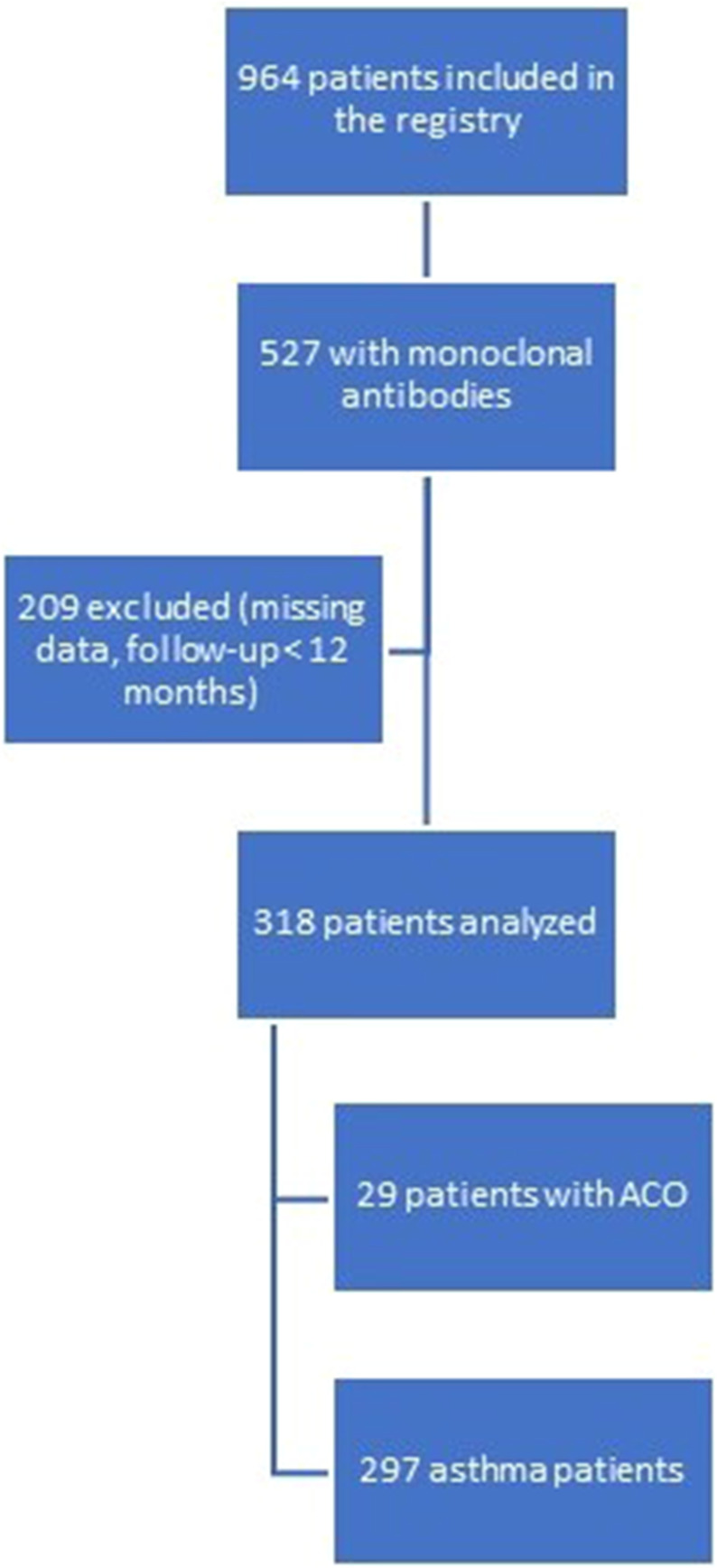
Although biologics have demonstrated to be effective in T2-high asthma patients, there is little experience with these drugs in asthma-COPD overlap (ACO). The aim of this study was to compare the effectiveness of biologics in these two conditions. We included 318 patients (24 ACO and 297 asthma) treated with monoclonal antibodies and followed for at least 12 months. Omalizumab was the most frequently employed biologic agent both in patients with ACO and asthma. Asthma control test (ACT) scores after at least 12 months of biologic therapy were not significantly different between groups. The percentage of patients with ≥1 exacerbation and ≥1 corticosteroid burst was significantly higher in ACO patients (70.8 vs 27.3 and 83.3% vs 37.5%, respectively), whereas the percentage of "controlled" patients (with no exacerbations, no need for corticosteroids and ACT ≥ 20) was significantly lower (16.7% vs 39.7%). In conclusion, this report suggests that patients with ACO treated with biologics reach worse outcomes than asthma patients.
尽管生物制剂已被证明对T2高反应性哮喘患者有效,但在哮喘-慢性阻塞性肺疾病重叠综合征(ACO)中使用这些药物的经验很少。本研究的目的是比较生物制剂在这两种情况下的有效性。我们纳入了318例接受单克隆抗体治疗且随访至少12个月的患者(24例ACO患者和297例哮喘患者)。奥马珠单抗是ACO患者和哮喘患者中最常用的生物制剂。生物治疗至少12个月后的哮喘控制测试(ACT)评分在两组之间无显著差异。ACO患者中发生≥1次加重和≥1次全身性糖皮质激素冲击治疗的患者百分比显著更高(分别为70.8%对27.3%和83.3%对37.5%),而“控制良好”的患者(无加重、无需使用糖皮质激素且ACT≥20)百分比显著更低(16.7%对39.7%)。总之,本报告表明,接受生物制剂治疗的ACO患者的结局比哮喘患者更差。