Department of Anesthesiology, The Third People's Hospital of Tongzhou District, Nantong City, 226311, Jiangsu Province, China.
Department of Pain Management, Shanghai Jiao Tong University Affiliated Sixth People's Hospital, Shanghai, 200233, China.
BMC Anesthesiol. 2022 Mar 24;22(1):78. doi: 10.1186/s12871-022-01622-8.
To observe whether ultrasound-guided stellate ganglion block (SGB) can effectively relieve migraine pain and improve the quality of migraine patients' life.
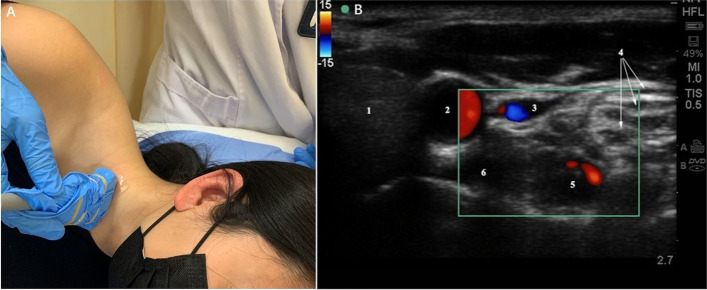
81 patients with migraines were enrolled in this study. The patients received SGB with 6 ml of 0.15% ropivacaine once every week for four times. Migraine was assessed with the Migraine Disability Assessment Scale (MIDAS) at baseline and three-months follow-up (Tm). The numerical rating scale (NRS) score at baseline, one day after treatment (Td) and Tm, the frequency of analgesic use in 3 months and the side effects were also recorded at the same time.
The NRS score of migraine subjects decreased significantly from 7.0 (2.0) to 3.0 (1.0) at Td and 2.0 (2.0) at Tm (vs baseline, P < 0.01). The MIDAS total scores were 14.0 (10.5) at baseline and 7.0 (4.5) at Tm (P < 0.001). During the three months, the frequency of analgesic consumption was decreased from 6.2 ± 2.8 to 1.9 ± 1.8. There were no serious side effects.
This study confirmed that ultrasound-guided SGB is an effective method to treat migraines. This technique can reduce pain and disability and then improve the quality of life of patients with migraines.
观察超声引导星状神经节阻滞(SGB)是否能有效缓解偏头痛疼痛并改善偏头痛患者的生活质量。
本研究纳入了 81 例偏头痛患者。患者每周接受一次 0.15%罗哌卡因 6ml 的 SGB,共 4 次。在基线和 3 个月随访(Tm)时使用偏头痛残疾评估量表(MIDAS)评估偏头痛,记录基线、治疗后 1 天(Td)和 Tm 时的数字评分量表(NRS)评分、3 个月内镇痛药物使用频率以及同时记录不良反应。
偏头痛患者的 NRS 评分从基线时的 7.0(2.0)显著降低至 Td 时的 3.0(1.0)和 Tm 时的 2.0(2.0)(与基线相比,P < 0.01)。MIDAS 总分从基线时的 14.0(10.5)降至 Tm 时的 7.0(4.5)(P < 0.001)。在 3 个月内,镇痛药物的使用频率从 6.2±2.8 降至 1.9±1.8。无严重不良反应。
本研究证实超声引导 SGB 是治疗偏头痛的有效方法。该技术可减轻疼痛和残疾,从而改善偏头痛患者的生活质量。