Department of Orthopedics, Xuanwu Hospital, Capital Medical University, No. 45 Changchun Street, Xicheng District, Beijing, China.
National Clinical Research Center for Geriatric Diseases, No. 45 Changchun Street, Xicheng District, Beijing, China.
J Orthop Surg Res. 2022 Mar 24;17(1):178. doi: 10.1186/s13018-022-03070-z.
Wound complications are associated with worse satisfaction and additional costs in patients undergoing posterior lumbar fusion (PLF) surgery, and the relationship between enhanced recovery after surgery (ERAS) pathway and wound complications remains poorly characterized.
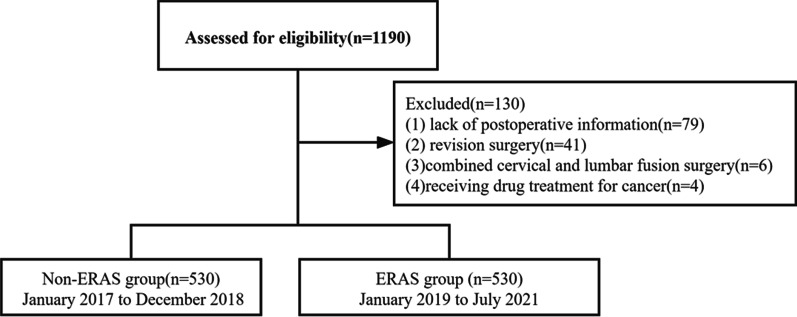
In this retrospective single-center study, we compared 530 patients receiving ERAS pathway care with previous 530 patients in non-ERAS group. The primary aim of our study was to identify the relationship between the ERAS program and the incidence of postoperative wound-related complications and other complications following PLF surgery; other outcomes included the length of stay (LOS), 90-day hospital and rehabilitation center readmission.
The average patient age was 65 yr. More patients with old cerebral infarction were in ERAS group (p < 0.01), and other demographics and comorbidities were similar between groups. Patients in the ERAS group had a lower incidence of postoperative wound-related complications than the non-ERAS group (12.4 vs. 17.8%, p = 0.02). The non-ERAS group had a significantly higher rate of wound dehiscence or poor wound healing (6% vs. 3%, p = 0.02). ERAS group had a lower incidence of severe postoperative hypoalbuminemia (serum albumin less than 30 g/L) (15.8% vs. 9.0% p < 0.01). Additionally, ERAS patients had shorter postoperative LOS (8.0 ± 1.5 vs. 9.5 ± 1.7, p < 0.01), lower rate of readmission within 90 days (1.9% vs. 6.4%, p < 0.01) and discharge to rehabilitation center (4.2% vs. 1.0%, p < 0.01).
ERAS pathway might help decrease the rates of postoperative wound complications and severe hypoalbuminemia following PLF surgery; additionally, it demonstrated that ERAS pathway was also associated with shorter LOS and lower rate of readmissions within 90 days.
在接受后路腰椎融合术(PLF)的患者中,伤口并发症与满意度降低和额外费用相关,术后加速康复(ERAS)方案与伤口并发症之间的关系仍未得到充分描述。
在这项回顾性单中心研究中,我们比较了接受 ERAS 方案治疗的 530 例患者和之前非 ERAS 组的 530 例患者。本研究的主要目的是确定 ERAS 方案与 PLF 术后与伤口相关的术后并发症发生率和其他并发症之间的关系;其他结果包括住院时间(LOS)、90 天内的医院和康复中心再入院率。
患者的平均年龄为 65 岁。ERAS 组中有更多的陈旧性脑梗死患者(p<0.01),两组间其他人口统计学和合并症情况相似。ERAS 组患者术后与伤口相关的并发症发生率低于非 ERAS 组(12.4%比 17.8%,p=0.02)。非 ERAS 组的伤口裂开或愈合不良发生率显著更高(6%比 3%,p=0.02)。ERAS 组术后严重低白蛋白血症(血清白蛋白<30g/L)发生率较低(15.8%比 9.0%,p<0.01)。此外,ERAS 患者的术后 LOS 较短(8.0±1.5 比 9.5±1.7,p<0.01)、90 天内再入院率较低(1.9%比 6.4%,p<0.01)、出院至康复中心率较低(4.2%比 1.0%,p<0.01)。
ERAS 方案可能有助于降低 PLF 术后伤口并发症和严重低白蛋白血症的发生率;此外,它还表明 ERAS 方案与较短的 LOS 和 90 天内再入院率较低相关。