Evaluation of Technologies for Neonates in Africa (ETNA), Nairobi, Kenya.
Centre for International Child Health, 305 - 4088 Cambie Street, Vancouver, BC, V5Z 2X8, Canada.
J Clin Monit Comput. 2022 Dec;36(6):1869-1879. doi: 10.1007/s10877-022-00840-2. Epub 2022 Mar 25.
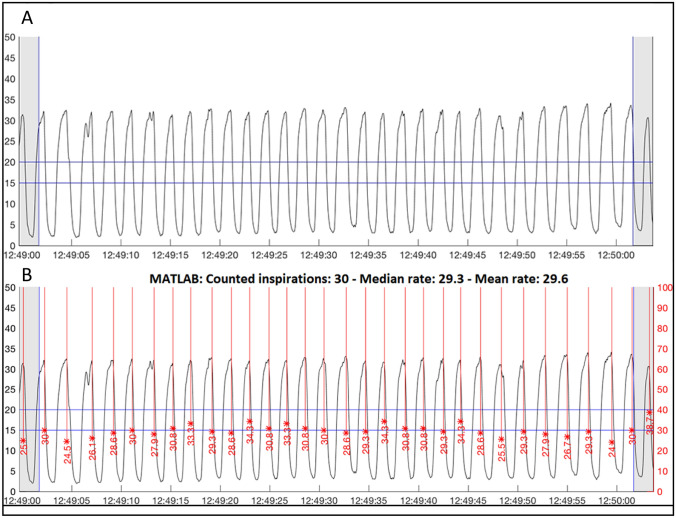
Accurate measurement of respiratory rate (RR) in neonates is challenging due to high neonatal RR variability (RRV). There is growing evidence that RRV measurement could inform and guide neonatal care. We sought to quantify neonatal RRV during a clinical study in which we compared multiparameter continuous physiological monitoring (MCPM) devices. Measurements of capnography-recorded exhaled carbon dioxide across 60-s epochs were collected from neonates admitted to the neonatal unit at Aga Khan University-Nairobi hospital. Breaths were manually counted from capnograms and using an automated signal detection algorithm which also calculated mean and median RR for each epoch. Outcome measures were between- and within-neonate RRV, between- and within-epoch RRV, and 95% limits of agreement, bias, and root-mean-square deviation. Twenty-seven neonates were included, with 130 epochs analysed. Mean manual breath count (MBC) was 48 breaths per minute. Median RRV ranged from 11.5% (interquartile range (IQR) 6.8-18.9%) to 28.1% (IQR 23.5-36.7%). Bias and limits of agreement for MBC vs algorithm-derived breath count, MBC vs algorithm-derived median breath rate, MBC vs algorithm-derived mean breath rate were - 0.5 (- 2.7, 1.66), - 3.16 (- 12.12, 5.8), and - 3.99 (- 11.3, 3.32), respectively. The marked RRV highlights the challenge of performing accurate RR measurements in neonates. More research is required to optimize the use of RRV to improve care. When evaluating MCPM devices, accuracy thresholds should be less stringent in newborns due to increased RRV. Lastly, median RR, which discounts the impact of extreme outliers, may be more reflective of the underlying physiological control of breathing.
由于新生儿呼吸频率(RR)变化较大,因此准确测量新生儿 RR 具有一定挑战性。越来越多的证据表明,RR 变化可用于指导新生儿护理。我们试图在一项比较多参数连续生理监测(MCPM)设备的临床研究中量化新生儿 RR 变化。在肯尼亚内罗毕 Aga Khan 大学医院新生儿病房中,从接受监测的新生儿处采集了 60 秒呼气末二氧化碳描记图记录的呼吸测量值。通过手动和自动信号检测算法分别从呼气末二氧化碳描记图中计算呼吸次数,自动信号检测算法还计算了每个时间段的平均和中位数 RR。主要结局为新生儿内和新生儿间 RR 变化、时间段内和时间段间 RR 变化、95%一致性界限、偏差和均方根差。共纳入 27 例新生儿,分析了 130 个时间段的数据。手动计算的平均呼吸次数(MBC)为 48 次/分钟。中位数 RR 范围为 11.5%(四分位距 [IQR] 6.8-18.9%)至 28.1%(IQR 23.5-36.7%)。MBC 与算法衍生呼吸计数、MBC 与算法衍生中位数呼吸率、MBC 与算法衍生平均呼吸率之间的偏差和一致性界限分别为-0.5(-2.7,1.66)、-3.16(-12.12,5.8)和-3.99(-11.3,3.32)。RR 变化较大,提示在新生儿中准确测量 RR 具有挑战性。需要进一步研究以优化 RR 变化的使用,从而改善护理。在评估 MCPM 设备时,由于 RR 变化较大,新生儿的准确性阈值应更宽松。最后,中位数 RR 排除了极端离群值的影响,可能更能反映呼吸的生理控制情况。