W. Harry Feinstone Department of Molecular Microbiology and Immunology, Johns Hopkins Bloomberg School of Public Health, Baltimore, Maryland, USA.
Gut Microbes. 2022 Jan-Dec;14(1):2055944. doi: 10.1080/19490976.2022.2055944.
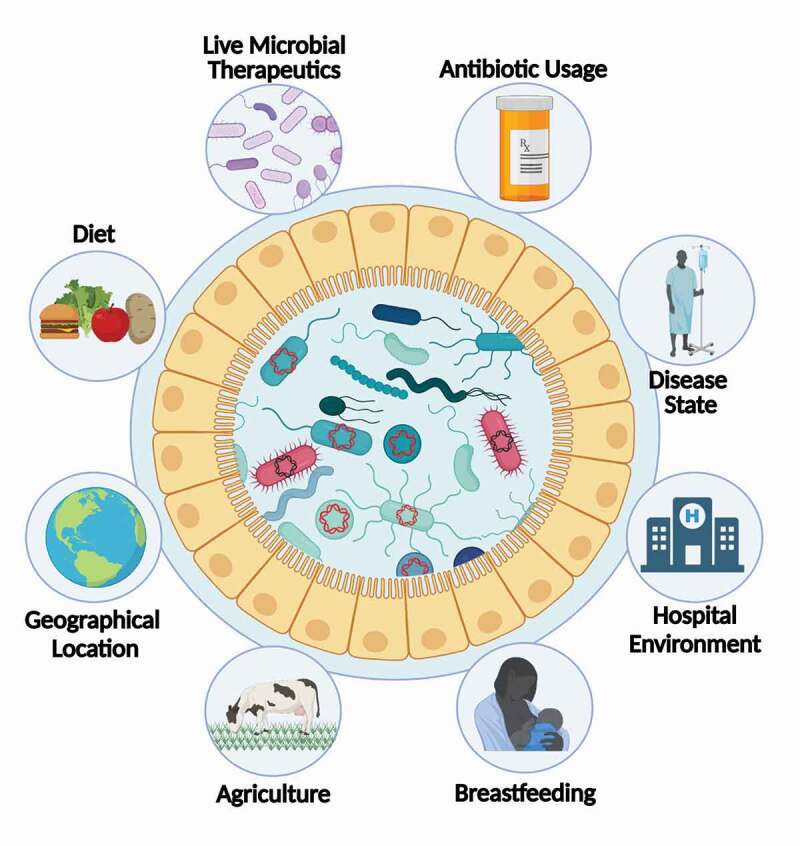
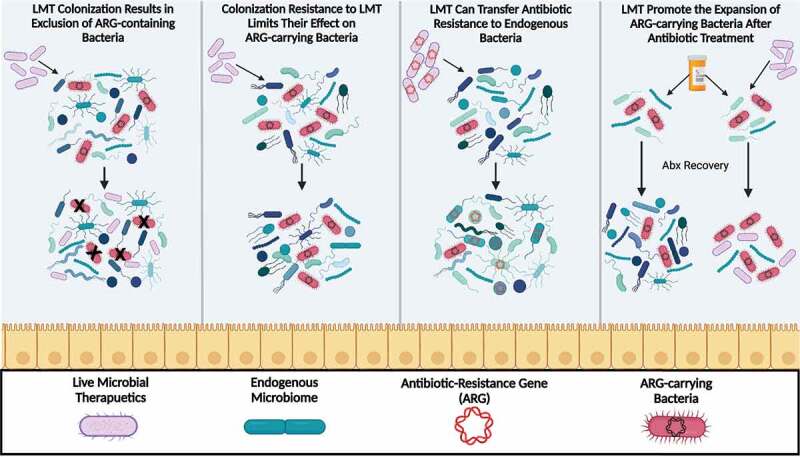
A global rise in antimicrobial resistance among pathogenic bacteria has proved to be a major public health threat, with the rate of multidrug-resistant bacterial infections increasing over time. The gut microbiome has been studied as a reservoir of antibiotic resistance genes (ARGs) that can be transferred to bacterial pathogens via horizontal gene transfer (HGT) of conjugative plasmids and mobile genetic elements (the gut resistome). Advances in metagenomic sequencing have facilitated the identification of resistome modulators, including live microbial therapeutics such as probiotics and fecal microbiome transplantation that can either expand or reduce the abundances of ARG-carrying bacteria in the gut. While many different gut microbes encode for ARGs, they are not uniformly distributed across, or transmitted by, various members of the microbiome, and not all are of equal clinical relevance. Both experimental and theoretical approaches in microbial ecology have been applied to understand differing frequencies of ARG horizontal transfer between commensal microbes as well as between commensals and pathogens. In this commentary, we assess the evidence for the role of commensal gut microbes in encoding antimicrobial resistance genes, the degree to which they are shared both with other commensals and with pathogens, and the host and environmental factors that can impact resistome dynamics. We further discuss novel sequencing-based approaches for identifying ARGs and predicting future transfer events of clinically relevant ARGs from commensals to pathogens.
全球范围内,病原菌对抗生素的耐药性不断上升,已成为主要的公共卫生威胁,且多重耐药菌感染的发生率也在随时间不断增加。肠道微生物组被认为是抗生素耐药基因(ARGs)的储存库,这些基因可以通过水平基因转移(HGT)的方式从接合质粒和移动遗传元件(肠道耐药组)转移到细菌病原体。宏基因组测序技术的进步促进了耐药组调节剂的鉴定,包括益生菌等活体微生物治疗剂和粪便微生物移植,它们可以增加或减少肠道中携带 ARG 的细菌的丰度。虽然许多不同的肠道微生物都能编码 ARGs,但它们在肠道微生物组的不同成员中并不是均匀分布的,也不是通过它们进行传播的,而且并非所有 ARGs 都具有同等的临床相关性。微生物生态学中的实验和理论方法都被应用于理解共生微生物之间以及共生微生物与病原体之间 ARG 水平转移的不同频率。在本评论中,我们评估了共生肠道微生物在编码抗菌药物耐药基因方面的作用的证据,以及它们与其他共生微生物和病原体共享的程度,以及宿主和环境因素如何影响耐药组的动态。我们还进一步讨论了基于测序的新方法,用于鉴定 ARGs 并预测从共生微生物到病原体的临床相关 ARG 的未来转移事件。