Applied Physiology and Nutrition Research Group, School of Physical Education and Sport, Faculdade de Medicina, Universidade de São Paulo, São Paulo, Brazil.
Hospital das Clínicas, Faculdade de Medicina, Universidade de São Paulo, São Paulo, Brazil.
Am J Physiol Heart Circ Physiol. 2022 Jun 1;322(6):H906-H913. doi: 10.1152/ajpheart.00026.2022. Epub 2022 Mar 25.
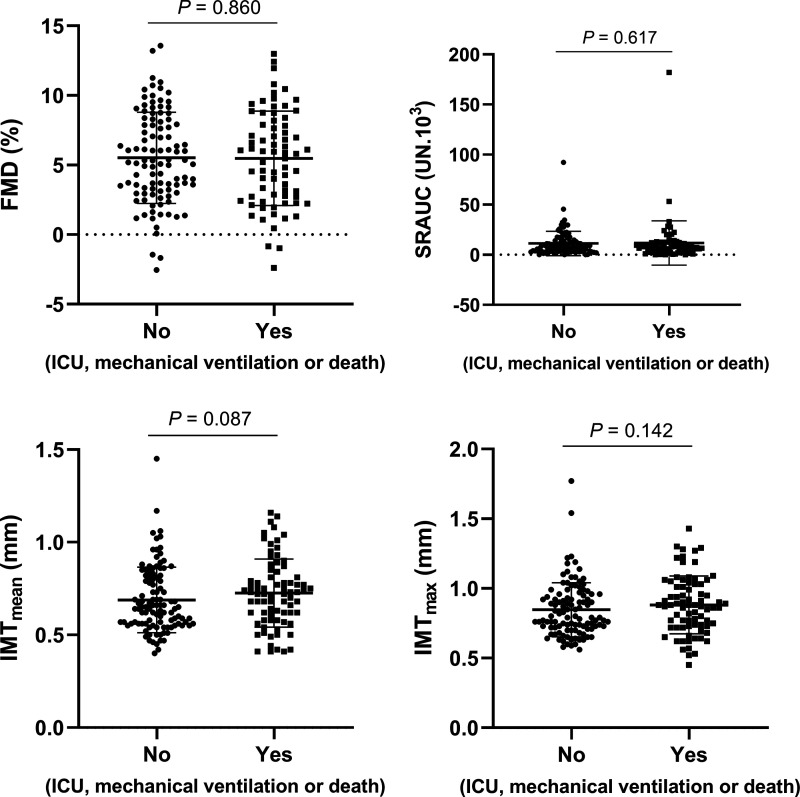
Studies have suggested a potential role of endothelial dysfunction and atherosclerosis in the pathophysiology of COVID-19. Herein, we tested whether brachial flow-mediated dilation (FMD) and carotid intima-media thickness (cIMT) measured upon hospital admission are associated with acute in-hospital outcomes in patients hospitalized with COVID-19. A total of 211 patients hospitalized with COVID-19 were submitted to assessments of FMD and mean and maximum cIMT (cIMT and cIMT) within the first 72 h of hospital admission. Study primary outcome was a composite of intensive care unit admission, mechanical ventilation, or death during the hospitalization. These outcomes were also considered independently. Thrombotic events were included as a secondary outcome. Odds ratios (ORs) and confidence intervals (CIs) were calculated using unadjusted and adjusted multivariable logistic regression models. Eighty-eight (42%) participants demonstrated at least one of the composite outcomes. cIMT and cIMT were predictors of mortality and thrombotic events in the univariate analysis (cIMT and mortality: unadjusted OR 12.71 [95% CI 1.71-94.48]; = 0.014; cIMT and thrombotic events: unadjusted OR 11.94 [95% CI 1.64-86.79]; = 0.015; cIMT and mortality: unadjusted OR 8.47 [95% CI 1.41-51.05]; = 0.021; cIMT and thrombotic events: unadjusted OR 12.19 [95% CI 2.03-73.09]; = 0.007). However, these associations were no longer present after adjustment for potential confounders ( > 0.05). In addition, FMD% was not associated with any outcome. In conclusion, cIMT and FMD are not independent predictors of clinical outcomes in patients hospitalized with COVID-19. These results suggest that subclinical atherosclerosis and endothelial dysfunction may not be the main drivers of COVID-19 complications in patients hospitalized with COVID-19. Studies have suggested a role of endothelial dysfunction and atherosclerosis in COVID-19 pathophysiology. In this prospective cohort study, we assessed the prognostic value of carotid intima-media thickness (IMT) and flow-mediated dilation (FMD) in patients with COVID-19. Carotid IMT and FMD were not independent predictors of major outcomes. These results suggest that other risk factors may be the main drivers of clinical outcomes in patients with COVID-19.
研究表明内皮功能障碍和动脉粥样硬化在 COVID-19 的病理生理学中起潜在作用。在此,我们检测了在 COVID-19 住院患者入院时测量的肱动脉血流介导的扩张(FMD)和颈动脉内膜中层厚度(cIMT)是否与急性住院结局相关。共有 211 名因 COVID-19 住院的患者在入院后 72 小时内接受了 FMD 和平均及最大 cIMT(cIMT 和 cIMT)的评估。研究的主要结局是重症监护病房入院、机械通气或住院期间死亡的综合指标。这些结果也分别考虑。血栓形成事件被作为次要结局包括在内。使用未调整和调整后的多变量逻辑回归模型计算比值比(OR)和置信区间(CI)。88(42%)名参与者至少出现了复合结局之一。在单变量分析中,cIMT 和 cIMT 是死亡和血栓形成事件的预测因素(cIMT 和死亡率:未调整的 OR 12.71 [95%CI 1.71-94.48]; = 0.014;cIMT 和血栓形成事件:未调整的 OR 11.94 [95%CI 1.64-86.79]; = 0.015;cIMT 和死亡率:未调整的 OR 8.47 [95%CI 1.41-51.05]; = 0.021;cIMT 和血栓形成事件:未调整的 OR 12.19 [95%CI 2.03-73.09]; = 0.007)。然而,在调整了潜在混杂因素后,这些关联不再存在(> 0.05)。此外,FMD%与任何结局均无关。总之,cIMT 和 FMD 不是 COVID-19 住院患者临床结局的独立预测因素。这些结果表明,亚临床动脉粥样硬化和内皮功能障碍可能不是 COVID-19 住院患者 COVID-19 并发症的主要驱动因素。
研究表明内皮功能障碍和动脉粥样硬化在 COVID-19 病理生理学中起作用。在这项前瞻性队列研究中,我们评估了 COVID-19 患者颈动脉内膜中层厚度(IMT)和血流介导的扩张(FMD)的预后价值。颈动脉 IMT 和 FMD 不是主要结局的独立预测因素。这些结果表明,其他危险因素可能是 COVID-19 患者临床结局的主要驱动因素。