From the Shanghai Chest Hospital, Jiao Tong University, Shanghai.
Affiliated Tumor Hospital of Harbin Medical University, Harbin, China.
Cancer J. 2022;28(2):96-104. doi: 10.1097/PPO.0000000000000583.
This study assessed the effects of tislelizumab, a programmed cell death protein 1 inhibitor, in combination with chemotherapy versus chemotherapy alone as first-line treatment on health-related quality of life (HRQoL) in patients with advanced nonsquamous non-small cell lung cancer (nSQ-NSCLC).
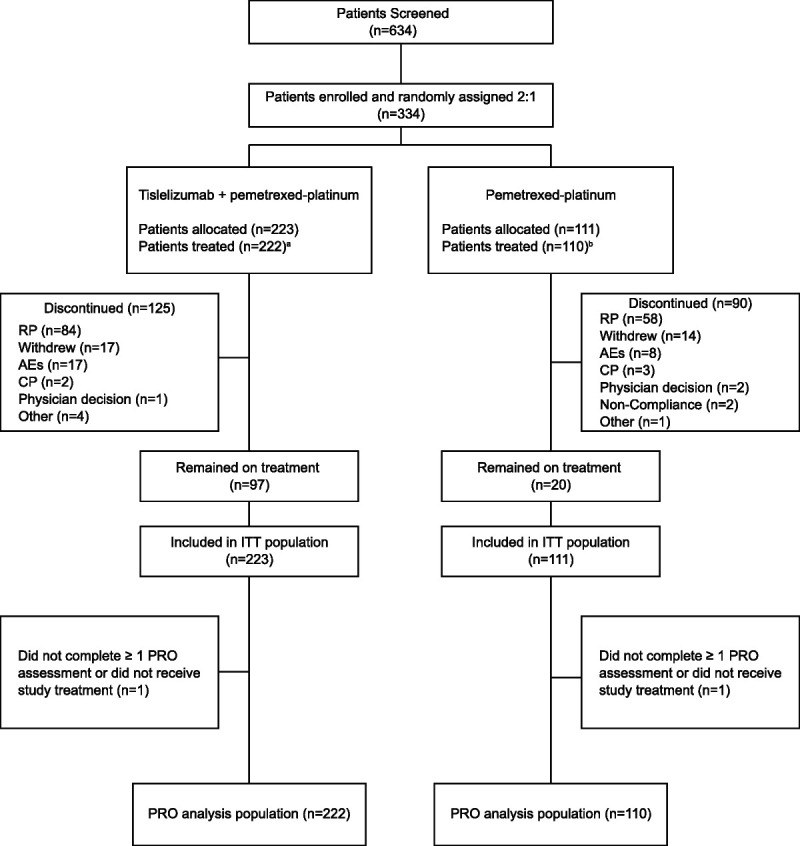
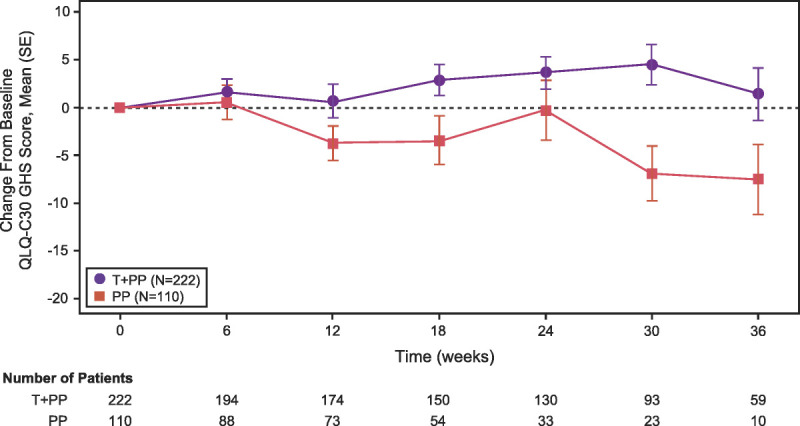
Patients in this randomized, open-label, multicenter phase III study RATIONALE 304 (NCT03663205) with histologically confirmed stage IIIB/IV nSQ-NSCLC were randomized 2:1 to tislelizumab plus platinum-pemetrexed (arm T + PP) or platinum-pemetrexed alone (arm PP). Health-related QoL was measured using the European Organization for Research and Treatment of Cancer Quality of Life Questionnaire Core 30 items and the European Organization for Research and Treatment of Cancer Quality of Life Questionnaire-Lung Cancer. Key patient-reported outcome endpoints include mean score change from baseline at weeks 12 (during chemotherapy) and 18 (following chemotherapy) in the 30-item Quality of Life Questionnaire Core's global health status/quality of life (GHS/QoL) and time to deterioration in GHS/QoL.
Three hundred thirty-two patients received at least 1 dose of study drug and completed at least 1 HRQoL assessment. Global health status/QoL score improved in arm T + PP at week 18 (between-group least square mean difference, 5.7; 95% confidence interval [CI], 1.0-10.5; P = 0.018). Patients in arm T + PP experienced greater reduction in coughing (-5.9; 95% CI, -11.6 to -0.1; P = 0.044), dyspnea (-3.8; 95% CI, -7.8 to 0.1; P = 0.059), chest pain (-6.2; 95% CI, -10.8 to -1.6; P = 0.008), and peripheral neuropathy (-2.6; 95% CI, -5.5 to 0.2; P = 0.066). Median time to deterioration in GHS/QoL was not achieved for either arm.
The addition of tislelizumab to platinum-based chemotherapy was associated with improvements in nSQ-NSCLC patients' HRQoL as well as the important disease-specific symptoms of coughing, chest pain, and dyspnea.ClinicalTrials.gov Identifier: NCT03663205.
本研究评估了程序性死亡蛋白 1 抑制剂替雷利珠单抗联合化疗与单纯化疗作为晚期非鳞状非小细胞肺癌(nSQ-NSCLC)一线治疗对健康相关生活质量(HRQoL)的影响。
这项随机、开放标签、多中心 III 期 RATIONALE 304 研究(NCT03663205)纳入了组织学证实的 IIIB/IV 期 nSQ-NSCLC 患者,按照 2:1 的比例随机分配至替雷利珠单抗联合铂类-培美曲塞(T + PP 组)或铂类-培美曲塞单药治疗(PP 组)。使用欧洲癌症研究与治疗组织生活质量问卷核心 30 项和欧洲癌症研究与治疗组织肺癌生活质量问卷评估 HRQoL。主要患者报告结局终点包括化疗期间第 12 周(基线时)和第 18 周(化疗结束后) 30 项生活质量问卷核心的全球健康状况/生活质量(GHS/QoL)的平均评分变化,以及 GHS/QoL 恶化的时间。
332 例患者至少接受了 1 剂研究药物治疗,并完成了至少 1 次 HRQoL 评估。T + PP 组在第 18 周时的全球健康状况/QoL 评分有所改善(组间最小二乘均数差值,5.7;95%置信区间[CI],1.0-10.5;P = 0.018)。T + PP 组患者咳嗽(-5.9;95%CI,-11.6 至 -0.1;P = 0.044)、呼吸困难(-3.8;95%CI,-7.8 至 0.1;P = 0.059)、胸痛(-6.2;95%CI,-10.8 至 -1.6;P = 0.008)和周围神经病变(-2.6;95%CI,-5.5 至 0.2;P = 0.066)的缓解程度更大。两个治疗组均未达到 GHS/QoL 恶化的中位时间。
替雷利珠单抗联合铂类化疗可改善 nSQ-NSCLC 患者的 HRQoL,并改善咳嗽、胸痛和呼吸困难等重要的疾病特异性症状。
NCT03663205。