Department of Radiology, Tongji Hospital, Tongji Medical College, Huazhong University of Science and Technology, Wuhan, Hubei, China.
Department of Radiology, Beijing Jishuitan Hospital, Beijing, China.
Br J Radiol. 2022 Jun 1;95(1134):20210371. doi: 10.1259/bjr.20210371. Epub 2022 May 5.
Although sarcopenia and osteoporosis are inter-related conditions that are common with advancing age, few studies have explored relationships between muscle quality and bone mineral density (BMD). We investigated age- and sex-specific paraspinal muscle fat infiltration (MFI), muscle cross-sectional area (CSA), and spine volumetric BMD (vBMD) in healthy Chinese adults.
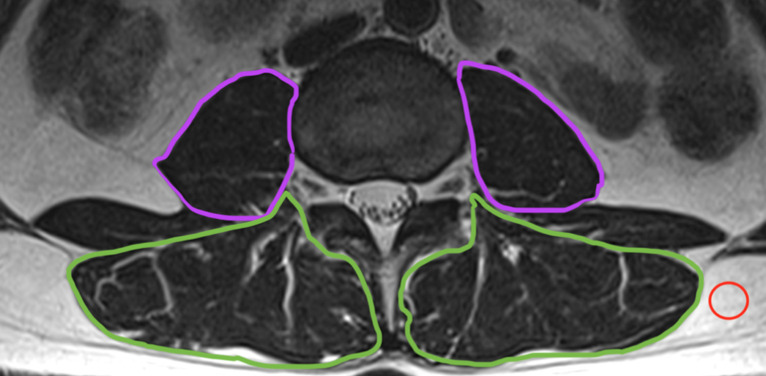
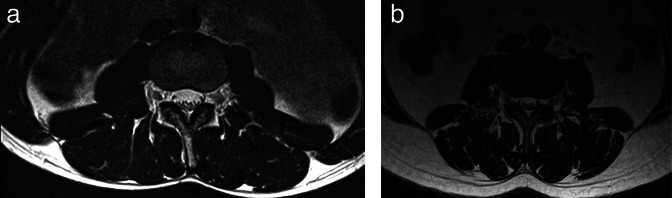
605 healthy adults aged 20-59 years (340 women, mean age 39.2 years; 265 men, mean age 38.8 years) had axial WI MRI imaging of the lumbar spine and CSA (cm) and MFI (%) were measured in the psoas and multifidus and erector spinae (MF-ES) muscles (L3-L4). MFI measurements were calibrated against a region of interest in an adjacent area of subcutaneous pure fat. L2-L4 vBMD was measured by quantitative CT. Age- and sex-specific subgroups were compared using the Mann-Whitney test. Multiple regression was used to test independent associations of MFI and CSA with vBMD.
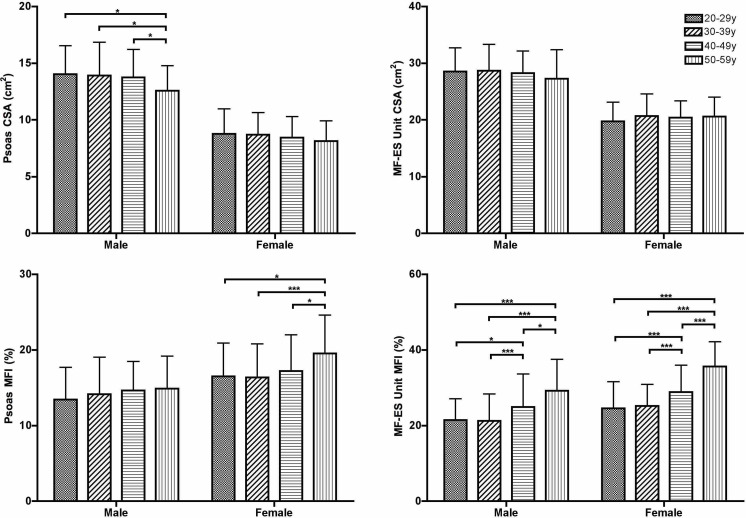
Females had lower CSA and higher MFI than males in both the psoas and MF-ES muscles ( < 0.001). In females and males, MF-ES MFI increased with age ( < 0.001) and in females age-related increases were observed for the psoas muscles ( < 0.05). Greater fat infiltration of the MS-ES muscle unit was associated with lower vBMD in both sexes ( < 0.001) but not with CSA. Following adjustment for demographic variables and CSA, MS-ES MFI remained predictive of vBMD (β = -0.408 to -0.157, < 0.001).
We have demonstrated that, independent of CSA and demographic variables, MFI of the MF-ES muscles is predictive of lower lumbar spine vBMD in both sexes.
This is the first study to demonstrate that, independent of muscle size and demographic variables, MFI of the paraspinal MF-ES muscles is predictive of lower lumbar spine vBMD in both sexes.
尽管肌肉减少症和骨质疏松症是随着年龄增长而相互关联的常见病症,但很少有研究探讨肌肉质量与骨密度(BMD)之间的关系。我们调查了健康中国成年人的年龄和性别特异性脊柱旁肌肉脂肪浸润(MFI)、肌肉横截面积(CSA)和脊柱容积 BMD(vBMD)。
605 名 20-59 岁的健康成年人(340 名女性,平均年龄 39.2 岁;265 名男性,平均年龄 38.8 岁)进行了腰椎轴向 WI MRI 成像,测量了腰大肌和多裂肌(MF-ES)肌肉的 CSA(cm)和 MFI(%)(L3-L4)。MFI 测量值与相邻皮下纯脂肪区域的感兴趣区域进行校准。通过定量 CT 测量 L2-L4 vBMD。使用 Mann-Whitney 检验比较年龄和性别特异性亚组。使用多元回归检验 MFI 和 CSA 与 vBMD 的独立关联。
女性的腰大肌和 MF-ES 肌肉的 CSA 均低于男性,MFI 均高于男性(<0.001)。在女性和男性中,MF-ES MFI 随年龄增长而增加(<0.001),在女性中,腰大肌也观察到与年龄相关的增加(<0.05)。MS-ES 肌肉单位的脂肪浸润越多,两性的 vBMD 越低(<0.001),但与 CSA 无关。在校正人口统计学变量和 CSA 后,MS-ES MFI 仍然可以预测 vBMD(β=-0.408 至-0.157,<0.001)。
我们已经证明,独立于 CSA 和人口统计学变量,MF-ES 肌肉的 MFI 可预测两性的腰椎 vBMD 较低。
这是第一项表明,独立于肌肉大小和人口统计学变量,脊柱旁 MF-ES 肌肉的 MFI 可预测两性的腰椎 vBMD 较低的研究。