Fucaloro Stephen P, Yacoubian Vahe S, Piltch-Loeb Rachael, Harriman Nigel Walsh, Burmaz Tea, Hadji-Janev Metodi, Savoia Elena
Emergency Preparedness Research Evaluation & Practice Program, Harvard T.H. Chan School of Public Health, 90 Smith Street, Boston, MA 02115, USA.
Department of Biostatistics, Harvard T.H. Chan School of Public Health, 677 Huntington Avenue, Boston, MA 02115, USA.
Vaccines (Basel). 2022 Feb 23;10(3):348. doi: 10.3390/vaccines10030348.
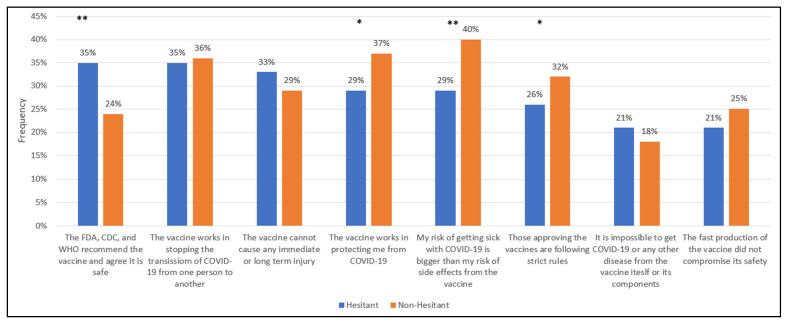
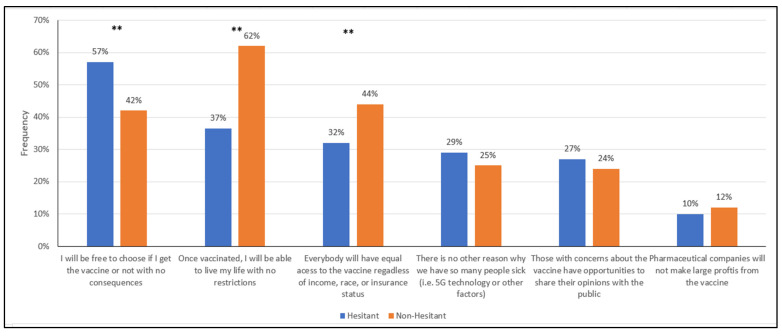
The COVID-19 pandemic has resulted in over 5.2 million deaths. Vaccine hesitancy remains a public health challenge, especially in Eastern Europe. Our study used a sample of essential workers living in the Republic of North Macedonia to: (1) Describe rates of vaccine hesitancy and risk perception of COVID-19; (2) Explore predictors of vaccine hesitancy; and (3) Describe the informational needs of hesitant and non-hesitant workers. A phone survey was administered in North Macedonia from 4−16 May 2021. Logistic regression explored associations of COVID-19 vaccine hesitancy with sociodemographic characteristics, non-COVID-19 vaccine hesitancy, previous diagnosis of COVID-19, and individual risk perception of contracting COVID-19. Chi-squared analyses compared differences in informational needs by hesitancy status. Of 1003 individuals, 44% were very likely to get the vaccine, and 56% reported some level of hesitancy. Older age, Albanian ethnicity, increased education, previous COVID-19 diagnosis, acceptance of other vaccines, and increased risk perception of COVID-19 infection were negatively associated with vaccine hesitancy. Results indicated significant differences in top informational needs by hesitancy status. The top informational needs of the hesitant were the freedom to choose to be vaccinated without consequences (57% vs. 42%, p < 0.01) and that all main international agencies recommended the vaccine (35% vs. 24%, p < 0.01).
新冠疫情已导致超过520万人死亡。疫苗犹豫仍然是一项公共卫生挑战,在东欧地区尤为如此。我们的研究以居住在北马其顿共和国的一线工作者为样本,旨在:(1)描述疫苗犹豫率以及对新冠病毒的风险认知;(2)探究疫苗犹豫的预测因素;(3)描述犹豫和不犹豫的工作者的信息需求。2021年5月4日至16日在北马其顿进行了电话调查。逻辑回归分析探讨了新冠疫苗犹豫与社会人口统计学特征、非新冠疫苗犹豫、既往新冠病毒诊断以及个人感染新冠病毒的风险认知之间的关联。卡方分析比较了不同犹豫状态下信息需求的差异。在1003名受访者中,44%的人非常有可能接种疫苗,56%的人表示有一定程度的犹豫。年龄较大、阿尔巴尼亚族裔、受教育程度提高、既往有新冠病毒诊断、接受其他疫苗以及对感染新冠病毒的风险认知增加与疫苗犹豫呈负相关。结果表明,不同犹豫状态下的首要信息需求存在显著差异。犹豫者的首要信息需求是有选择接种疫苗而无需承担后果的自由(57%对42%,p<0.01)以及所有主要国际机构都推荐该疫苗(35%对24%,p<0.01)。