• 文献检索
  • 文档翻译
  • 深度研究
  • 学术资讯
  • Suppr Zotero 插件Zotero 插件
  • 邀请有礼
  • 套餐&价格
  • 历史记录
应用&插件
Suppr Zotero 插件Zotero 插件浏览器插件Mac 客户端Windows 客户端微信小程序
定价
高级版会员购买积分包购买API积分包
服务
文献检索文档翻译深度研究API 文档MCP 服务
关于我们
关于 Suppr公司介绍联系我们用户协议隐私条款
关注我们

Suppr 超能文献

核心技术专利:CN118964589B侵权必究
粤ICP备2023148730 号-1Suppr @ 2026

文献检索

告别复杂PubMed语法,用中文像聊天一样搜索,搜遍4000万医学文献。AI智能推荐,让科研检索更轻松。

立即免费搜索

文件翻译

保留排版,准确专业,支持PDF/Word/PPT等文件格式,支持 12+语言互译。

免费翻译文档

深度研究

AI帮你快速写综述,25分钟生成高质量综述,智能提取关键信息,辅助科研写作。

立即免费体验

关于中国东部癌症患者对 COVID-19 疫苗的了解、态度、接受程度及其接种意愿的预测因素:一项横断面调查。

Knowledge about, attitude and acceptance towards, and predictors of intention to receive the COVID-19 vaccine among cancer patients in Eastern China: A cross-sectional survey.

机构信息

School of Traditional Chinese Medicine, Naval Medical University, Shanghai 200433, China; Department of Integrative Oncology, Changhai Hospital, Naval Medical University, Shanghai 200433, China.

Department of Integrative Oncology, Changhai Hospital, Naval Medical University, Shanghai 200433, China.

出版信息

J Integr Med. 2022 Jan;20(1):34-44. doi: 10.1016/j.joim.2021.10.004. Epub 2021 Oct 26.

DOI:10.1016/j.joim.2021.10.004
PMID:34774463
原文链接:https://pmc.ncbi.nlm.nih.gov/articles/PMC8559872/
Abstract

OBJECTIVE

The coronavirus disease 2019 (COVID-19) pandemic has had a serious impact on health all over the world. Cancer patient, whose immunity is often compromised, faces a huge challenge. Currently, some COVID-19 vaccines are being developed and applied on general population; however, whether cancer patients should take COVID-19 vaccine remains unknown. Our study aimed to explore the knowledge, attitude, acceptance, and predictors of intention to receive the COVID-19 vaccine among cancer patients in Eastern China.

METHODS

A cross-sectional study was conducted in Eastern China from June 17th to September 3rd, 2021. Patients were selected using a convenience sampling method. A self-report questionnaire was developed to assess knowledge about the COVID-19 vaccine, attitude towards the vaccine and acceptance of the vaccine; following a review of similar studies previously published in the scientific literature, multivariate logistic regression analysis was used to determine the predictors associated with COVID-19 vaccine acceptance.

RESULTS

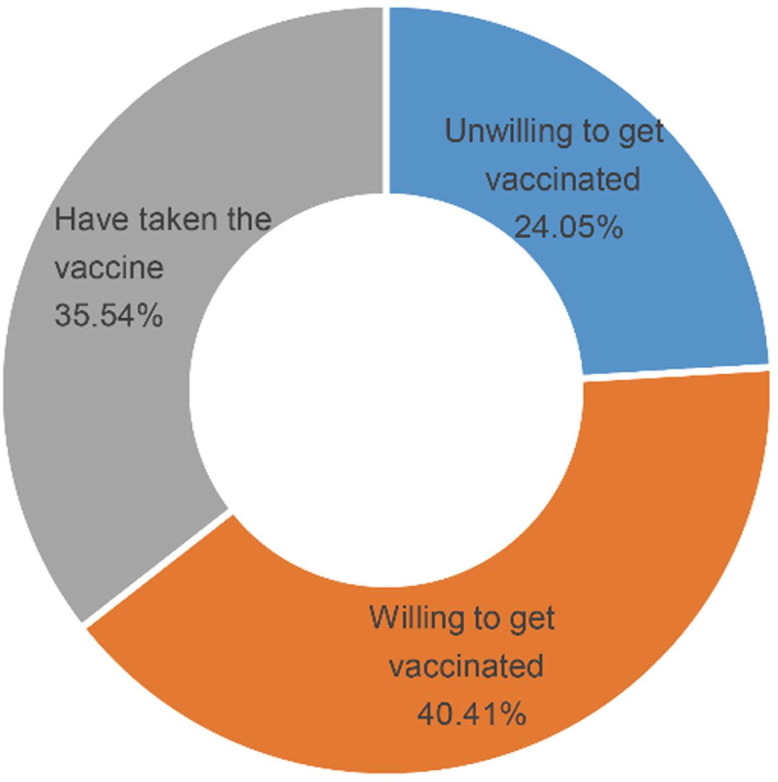
A total of 2158 cancer patients were enrolled in this study. The rate of vaccine hesitancy was 24.05% (519/2158); further, among the participants of vaccine acceptance, 767 had taken COVID-19 vaccine (35.54%), and 872 were willing to get vaccinated (40.01%). A total of 24 variables including demographic characteristics, clinical status of cancer, impact of COVID-19 pandemic on study participants, patients' knowledge about the COVID-19 vaccine, and attitude towards the vaccine, had significant differences between the "vaccine hesitancy" population and "vaccine acceptance" population. Multivariate logistic regression analysis indicated that parameters including alcohol consumption (odds ratio [OR] = 1.849; 95% confidence interval [CI]: 1.375-2.488; P-reference [P-Ref] < 0.001 vs non-drinkers), income impacted by COVID-19 pandemic (OR = 1.930, 2.037 and 2.688 for mild, moderate, and severe impact, respectively; all P-Ref < 0.01 vs no impact), knowledge of how the vaccine was developed (OR = 1.616; 95% CI: 1.126-2.318; P-Ref = 0.009 vs unknown), believing in the safety of the vaccine (OR = 1.502; 95% CI: 1.024-2.203; P-Ref = 0.038 vs denying the safety of vaccine), willingness to pay for the vaccine (OR = 3.042; 95% CI: 2.376-3.894; P-Ref < 0.001 vs unwilling), and willingness to recommend families and friends to get vaccinated (OR = 2.744; 95% CI: 1.759-4.280; P-Ref < 0.001 vs do not recommend) were contributors to vaccine acceptance. While such as being retired (OR = 0.586; 95% CI: 0.438-0.784; P-Ref < 0.001 vs unemployed), undergoing multiple therapies of cancer (OR = 0.408; 95% CI: 0.221-0.753; P-Ref = 0.004 vs no ongoing treatment), and worrying that the vaccine might deteriorate the prognosis of cancer (OR = 0.393; 95% CI: 0.307-0.504; P-Ref < 0.001 vs might not) were contributors to vaccine hesitancy.

CONCLUSION

This study provided preliminary estimates of the rates of vaccine acceptance and vaccine hesitancy among cancer patients in Eastern China. The intention to receive the COVID-19 vaccine was impacted by factors such as patient occupation, alcohol consumption, and some parts of knowledge about and attitude towards COVID-19 vaccine. It is recommended to develop individualized vaccination plans that meet the healthcare needs of cancer patients.

摘要

目的

2019 年冠状病毒病(COVID-19)大流行对全球健康造成了严重影响。癌症患者的免疫力通常较弱,面临着巨大的挑战。目前,一些 COVID-19 疫苗正在开发并应用于普通人群;然而,癌症患者是否应该接种 COVID-19 疫苗仍不清楚。我们的研究旨在探索中国东部地区癌症患者对 COVID-19 疫苗的知识、态度、接受程度和接种意愿的预测因素。

方法

2021 年 6 月 17 日至 9 月 3 日,在中国东部进行了一项横断面研究。采用便利抽样法选择患者。制定了一份自我报告问卷,以评估患者对 COVID-19 疫苗的知识、对疫苗的态度和对疫苗的接受程度;在回顾了先前发表在科学文献中的类似研究后,采用多变量逻辑回归分析来确定与 COVID-19 疫苗接种接受程度相关的预测因素。

结果

共纳入 2158 例癌症患者。疫苗犹豫率为 24.05%(519/2158);在接受疫苗接种的参与者中,767 人已接种 COVID-19 疫苗(35.54%),872 人愿意接种疫苗(40.01%)。共有 24 个变量,包括人口统计学特征、癌症临床状况、COVID-19 大流行对研究参与者的影响、患者对 COVID-19 疫苗的知识和对疫苗的态度,在“疫苗犹豫”人群和“疫苗接受”人群之间存在显著差异。多变量逻辑回归分析表明,包括饮酒(比值比 [OR] = 1.849;95%置信区间 [CI]:1.375-2.488;P-参考值 [P-Ref] <0.001 与不饮酒者相比)、受 COVID-19 大流行影响的收入(轻度、中度和重度影响的 OR 分别为 1.930、2.037 和 2.688;所有 P-Ref <0.01 与无影响相比)、对疫苗研发过程的了解(OR = 1.616;95%CI:1.126-2.318;P-Ref = 0.009 与未知相比)、相信疫苗的安全性(OR = 1.502;95%CI:1.024-2.203;P-Ref = 0.038 与否认疫苗的安全性相比)、愿意支付疫苗费用(OR = 3.042;95%CI:2.376-3.894;P-Ref <0.001 与不愿意相比)和愿意推荐家人和朋友接种疫苗(OR = 2.744;95%CI:1.759-4.280;P-Ref <0.001 与不推荐相比)是接受疫苗的原因。而退休(OR = 0.586;95%CI:0.438-0.784;P-Ref <0.001 与失业相比)、接受多种癌症治疗(OR = 0.408;95%CI:0.221-0.753;P-Ref = 0.004 与无治疗相比)和担心疫苗可能恶化癌症预后(OR = 0.393;95%CI:0.307-0.504;P-Ref <0.001 与可能不会相比)是疫苗犹豫的原因。

结论

本研究初步估计了中国东部地区癌症患者对 COVID-19 疫苗的接种意愿和疫苗犹豫率。接受 COVID-19 疫苗的意愿受到患者职业、饮酒和对 COVID-19 疫苗的部分知识和态度等因素的影响。建议制定满足癌症患者医疗保健需求的个体化疫苗接种计划。
https://cdn.ncbi.nlm.nih.gov/pmc/blobs/5dfb/8559872/2ede90eec25a/gr2_lrg.jpg
https://cdn.ncbi.nlm.nih.gov/pmc/blobs/5dfb/8559872/d351b00e77fd/gr1_lrg.jpg
https://cdn.ncbi.nlm.nih.gov/pmc/blobs/5dfb/8559872/2ede90eec25a/gr2_lrg.jpg
https://cdn.ncbi.nlm.nih.gov/pmc/blobs/5dfb/8559872/d351b00e77fd/gr1_lrg.jpg
https://cdn.ncbi.nlm.nih.gov/pmc/blobs/5dfb/8559872/2ede90eec25a/gr2_lrg.jpg

相似文献

1
Knowledge about, attitude and acceptance towards, and predictors of intention to receive the COVID-19 vaccine among cancer patients in Eastern China: A cross-sectional survey.关于中国东部癌症患者对 COVID-19 疫苗的了解、态度、接受程度及其接种意愿的预测因素:一项横断面调查。
J Integr Med. 2022 Jan;20(1):34-44. doi: 10.1016/j.joim.2021.10.004. Epub 2021 Oct 26.
2
Factors Influencing COVID-19 Vaccination Intentions Among College Students: A Cross-Sectional Study in India.影响印度大学生 COVID-19 疫苗接种意愿的因素:一项横断面研究。
Front Public Health. 2021 Dec 15;9:735902. doi: 10.3389/fpubh.2021.735902. eCollection 2021.
3
COVID-19 Vaccine Acceptance in a Sample From the United Arab Emirates General Adult Population: A Cross-Sectional Survey, 2020.2020 年,阿联酋普通成年人群体抽样的 COVID-19 疫苗接种接受情况:一项横断面调查。
Front Public Health. 2021 Jul 26;9:614499. doi: 10.3389/fpubh.2021.614499. eCollection 2021.
4
Knowledge about, attitudes toward and acceptance and predictors of intention to receive the mpox vaccine among cancer patients in China: A cross-sectional survey.中国癌症患者对猴痘疫苗的了解、态度、接受程度及接种意愿的预测因素:一项横断面调查
Hum Vaccin Immunother. 2024 Dec 31;20(1):2337157. doi: 10.1080/21645515.2024.2337157. Epub 2024 Apr 21.
5
Determinants of COVID-19 Vaccine Acceptance and Hesitancy: A Health Care Student-Based Online Survey in Northwest China.中国西北地区基于医疗学生的在线调查:COVID-19 疫苗接受和犹豫的决定因素。
Front Public Health. 2022 Jan 6;9:777565. doi: 10.3389/fpubh.2021.777565. eCollection 2021.
6
COVID-19 vaccination intention and hesitancy: Mistrust on COVID-19 vaccine benefit a major driver for vaccine hesitancy among healthcare workers; a cross-sectional study in North India.COVID-19 疫苗接种意愿和犹豫:对 COVID-19 疫苗益处的不信任是医护人员疫苗犹豫的主要驱动因素;印度北部的一项横断面研究。
J Prev Med Hyg. 2022 Jul 31;63(2):E219-E230. doi: 10.15167/2421-4248/jpmh2022.63.2.1952. eCollection 2022 Jun.
7
Acceptance and attitude towards the traditional chinese medicine among asymptomatic COVID-19 patients in Shanghai Fangcang hospital.上海方仓医院无症状 COVID-19 患者对中医药的接受度和态度。
BMC Complement Med Ther. 2023 Mar 30;23(1):97. doi: 10.1186/s12906-023-03922-z.
8
Vaccination coverage among COVID-19 prevention and control management teams at primary healthcare facilities in China and their attitudes towards COVID-19 vaccine: a cross-sectional online survey.中国基层医疗卫生机构新冠疫情防控管理团队的疫苗接种率及其对新冠疫苗的态度:一项横断面在线调查。
BMJ Open. 2022 Apr 7;12(4):e056345. doi: 10.1136/bmjopen-2021-056345.
9
COVID-19 vaccine acceptance, hesitancy, and determinants among physicians in a university-based teaching hospital in Thailand.泰国一所大学附属医院医生对 COVID-19 疫苗的接受度、犹豫和决定因素。
BMC Infect Dis. 2021 Nov 22;21(1):1174. doi: 10.1186/s12879-021-06863-5.
10
COVID-19 Vaccine Hesitancy and Acceptance Among Individuals With Cancer, Autoimmune Diseases, or Other Serious Comorbid Conditions: Cross-sectional, Internet-Based Survey.COVID-19 疫苗犹豫和接受情况在癌症、自身免疫性疾病或其他严重合并症患者中的调查:基于互联网的横断面研究。
JMIR Public Health Surveill. 2022 Jan 5;8(1):e29872. doi: 10.2196/29872.

引用本文的文献

1
Safety, Immunogenicity, and Efficacy of COVID-19 Vaccines in Radiation-Oncology Patients: A Systematic Review and Meta-Analysis.COVID-19疫苗在放射肿瘤学患者中的安全性、免疫原性和有效性:一项系统评价和荟萃分析
Vaccines (Basel). 2025 Jun 30;13(7):715. doi: 10.3390/vaccines13070715.
2
Assessment of COVID-19 Vaccine Knowledge, Attitude and Practice among the General Population in Duhok Province, Kurdistan Region of Iraq: A Retrospective Cross-Sectional Study.伊拉克库尔德地区杜胡克省普通人群对新冠疫苗的知识、态度和实践评估:一项回顾性横断面研究
Arch Razi Inst. 2024 Dec 31;79(6):1241-1248. doi: 10.32592/ARI.2024.79.6.1241. eCollection 2024 Dec.
3
COVID-19 vaccine hesitancy in Chinese residents: A national cross-sectional survey in the community setting.
中国居民对新冠病毒疫苗的犹豫态度:一项社区环境下的全国横断面调查。
Hum Vaccin Immunother. 2025 Dec;21(1):2481003. doi: 10.1080/21645515.2025.2481003. Epub 2025 Mar 28.
4
A Systematic Review of the Attitudes, Beliefs, and Acceptance of the COVID-19 Vaccine in the Western and Eastern Hemispheres.对西半球和东半球对新冠疫苗的态度、信念及接受情况的系统评价
Cureus. 2024 Nov 6;16(11):e73161. doi: 10.7759/cureus.73161. eCollection 2024 Nov.
5
Is COVID-19 Vaccination Beneficial for Tumor Patients: A Cross-Sectional Investigation in China.新冠病毒疫苗接种对肿瘤患者有益吗?来自中国的一项横断面研究。
Immun Inflamm Dis. 2024 Nov;12(11):e70069. doi: 10.1002/iid3.70069.
6
Hesitation towards COVID-19 booster vaccination among dialysis patients: a cross-sectional study in Taizhou, China.中国泰州一项横断面研究显示,透析患者对接种 COVID-19 加强针犹豫不决。
BMC Infect Dis. 2024 Oct 2;24(1):1095. doi: 10.1186/s12879-024-09917-6.
7
Acceptance of COVID-19 Vaccination and Vaccine Hesitancy Among People with Chronic Diseases in Thailand: Role of Attitudes and Vaccine Literacy Towards Future Implications.泰国慢性病患者对新冠疫苗的接受情况及疫苗犹豫态度:态度和疫苗知识对未来影响的作用
Patient Prefer Adherence. 2024 Sep 5;18:1815-1828. doi: 10.2147/PPA.S462014. eCollection 2024.
8
Immune response of COVID-19 vaccines in solid cancer patients: A meta-analysis.COVID-19 疫苗在实体瘤患者中的免疫应答:一项荟萃分析。
Hum Vaccin Immunother. 2024 Dec 31;20(1):2357424. doi: 10.1080/21645515.2024.2357424. Epub 2024 May 24.
9
Knowledge about, attitudes toward and acceptance and predictors of intention to receive the mpox vaccine among cancer patients in China: A cross-sectional survey.中国癌症患者对猴痘疫苗的了解、态度、接受程度及接种意愿的预测因素:一项横断面调查
Hum Vaccin Immunother. 2024 Dec 31;20(1):2337157. doi: 10.1080/21645515.2024.2337157. Epub 2024 Apr 21.
10
Predictors of willingness to accept COVID-19 vaccine among adults.成年人中接受新冠病毒疫苗意愿的预测因素
Front Epidemiol. 2023 Oct 27;3:1240557. doi: 10.3389/fepid.2023.1240557. eCollection 2023.