• 文献检索
  • 文档翻译
  • 深度研究
  • 学术资讯
  • Suppr Zotero 插件Zotero 插件
  • 邀请有礼
  • 套餐&价格
  • 历史记录
应用&插件
Suppr Zotero 插件Zotero 插件浏览器插件Mac 客户端Windows 客户端微信小程序
定价
高级版会员购买积分包购买API积分包
服务
文献检索文档翻译深度研究API 文档MCP 服务
关于我们
关于 Suppr公司介绍联系我们用户协议隐私条款
关注我们

Suppr 超能文献

核心技术专利:CN118964589B侵权必究
粤ICP备2023148730 号-1Suppr @ 2026

文献检索

告别复杂PubMed语法,用中文像聊天一样搜索,搜遍4000万医学文献。AI智能推荐,让科研检索更轻松。

立即免费搜索

文件翻译

保留排版,准确专业,支持PDF/Word/PPT等文件格式,支持 12+语言互译。

免费翻译文档

深度研究

AI帮你快速写综述,25分钟生成高质量综述,智能提取关键信息,辅助科研写作。

立即免费体验

用于传热应用的二维二硫化钼基乙二醇纳米流体的流变学和热导率研究

Rheological and Thermal Conductivity Study of Two-Dimensional Molybdenum Disulfide-Based Ethylene Glycol Nanofluids for Heat Transfer Applications.

作者信息

Shah Syed Nadeem Abbas, Shahabuddin Syed, Khalid Mohammad, Mohd Sabri Mohd Faizul, Mohd Salleh Mohd Faiz, Muhamad Sarih Norazilawati, Rahman Saidur

机构信息

Department of Mechanical Engineering (Main Campus Lahore), University of Engineering, and Technology, Lahore 54890, Pakistan.

Department of Science, School of Technology, Pandit Deendayal Energy University, Knowledge Corridor, Raisan Village, Gandhinagar 382007, Gujarat, India.

出版信息

Nanomaterials (Basel). 2022 Mar 21;12(6):1021. doi: 10.3390/nano12061021.

DOI:10.3390/nano12061021
PMID:35335835
原文链接:https://pmc.ncbi.nlm.nih.gov/articles/PMC8954611/
Abstract

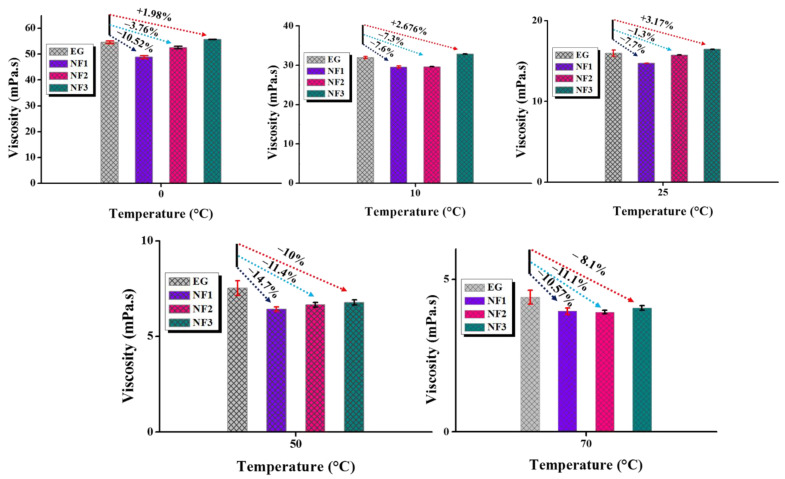
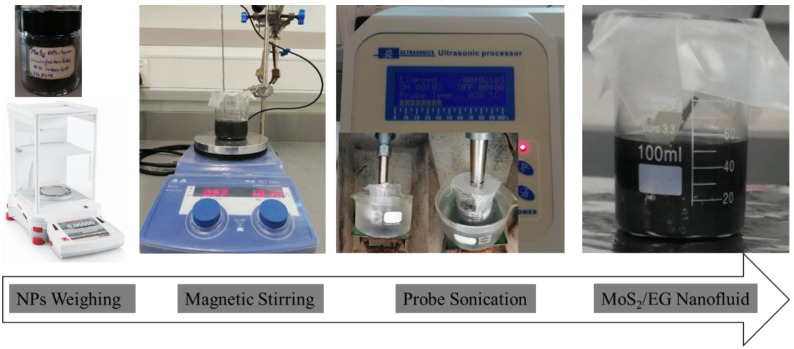
The rheological behavior of two-dimensional (2D) MoS-based ethylene glycol (EG) nanofluids (NFs) was investigated at low volume concentrations (0.005%, 0.0075%, and 0.01%) in a wide temperature range of 0-70 °C and at atmospheric pressure. A conventional two-step method was followed to prepare NFs at desired volume concentrations. Based on the control rotational (0.1-1000 s shear rate) and oscillation (0.01-1000% strain) methods, the viscoelastic flow curves and thixotropic (3ITT (three interval thixotropic) and hysteresis loop) characteristics of NFs were examined. Shear flow behavior revealed a remarkable reduction (1.3~14.7%) in apparent dynamic viscosity, which showed concentration and temperature dependency. Such remarkable viscosity results were assigned to the change in activation energy of the ethylene glycol with the addition of MoS. However, the nanofluids exhibited Newtonian behavior at all temperatures for concentrations below 0.01% between 10 and 1000 s. On the other hand, strain sweep (@1Hz) indicated the viscoelastic nature of NFs with yielding, which varied with concentration and temperature. Besides, 3ITT and hysteresis loop analysis was evident of non-thixotropic behavior of NFs. Among all tested concentrations, 0.005% outperformed at almost all targeted temperatures. At the same time, ~11% improvement in thermal conductivity can be considered advantageous on top of the improved rheological properties. In addition, viscosity enhancement and reduction mechanisms were also discussed.

摘要

研究了二维(2D)MoS基乙二醇(EG)纳米流体(NFs)在0.005%、0.0075%和0.01%的低体积浓度下,在0至70°C的宽温度范围内及大气压下的流变行为。采用传统的两步法制备所需体积浓度的纳米流体。基于控制旋转(0.1 - 1000 s剪切速率)和振荡(0.01 - 1000%应变)方法,研究了纳米流体的粘弹性流动曲线和触变性(3ITT(三区间触变性)和滞后回线)特性。剪切流动行为表明表观动态粘度显著降低(1.3%~14.7%),这表现出浓度和温度依赖性。这种显著的粘度结果归因于添加MoS后乙二醇活化能的变化。然而,对于浓度低于0.01%且在10至1000 s之间的情况,纳米流体在所有温度下均表现出牛顿流体行为。另一方面,应变扫描(@1Hz)表明纳米流体具有屈服的粘弹性性质,其随浓度和温度而变化。此外,3ITT和滞后回线分析表明纳米流体具有非触变性行为。在所有测试浓度中,0.005%在几乎所有目标温度下表现最佳。同时,在改善流变性能的基础上,热导率提高约11%可被视为有利。此外,还讨论了粘度增强和降低的机制。
https://cdn.ncbi.nlm.nih.gov/pmc/blobs/5825/8954611/77497f97f6a8/nanomaterials-12-01021-g016.jpg
https://cdn.ncbi.nlm.nih.gov/pmc/blobs/5825/8954611/db612f36a1ac/nanomaterials-12-01021-g001.jpg
https://cdn.ncbi.nlm.nih.gov/pmc/blobs/5825/8954611/6043ebe6900b/nanomaterials-12-01021-g002.jpg
https://cdn.ncbi.nlm.nih.gov/pmc/blobs/5825/8954611/227439d9293d/nanomaterials-12-01021-g003.jpg
https://cdn.ncbi.nlm.nih.gov/pmc/blobs/5825/8954611/0d4788c657b8/nanomaterials-12-01021-g004.jpg
https://cdn.ncbi.nlm.nih.gov/pmc/blobs/5825/8954611/f749044cda66/nanomaterials-12-01021-g005.jpg
https://cdn.ncbi.nlm.nih.gov/pmc/blobs/5825/8954611/5bf1ca165e03/nanomaterials-12-01021-g006.jpg
https://cdn.ncbi.nlm.nih.gov/pmc/blobs/5825/8954611/a915097418cd/nanomaterials-12-01021-g007.jpg
https://cdn.ncbi.nlm.nih.gov/pmc/blobs/5825/8954611/8d75ea41b613/nanomaterials-12-01021-g008.jpg
https://cdn.ncbi.nlm.nih.gov/pmc/blobs/5825/8954611/63b2d3f65803/nanomaterials-12-01021-g009.jpg
https://cdn.ncbi.nlm.nih.gov/pmc/blobs/5825/8954611/5e25cba3f43a/nanomaterials-12-01021-g010.jpg
https://cdn.ncbi.nlm.nih.gov/pmc/blobs/5825/8954611/2071a64c7f5a/nanomaterials-12-01021-g011.jpg
https://cdn.ncbi.nlm.nih.gov/pmc/blobs/5825/8954611/7de8ad0e0141/nanomaterials-12-01021-g012.jpg
https://cdn.ncbi.nlm.nih.gov/pmc/blobs/5825/8954611/186537c18c00/nanomaterials-12-01021-g013.jpg
https://cdn.ncbi.nlm.nih.gov/pmc/blobs/5825/8954611/a7a9308b6bee/nanomaterials-12-01021-g014.jpg
https://cdn.ncbi.nlm.nih.gov/pmc/blobs/5825/8954611/db7669d9a94f/nanomaterials-12-01021-g015.jpg
https://cdn.ncbi.nlm.nih.gov/pmc/blobs/5825/8954611/77497f97f6a8/nanomaterials-12-01021-g016.jpg
https://cdn.ncbi.nlm.nih.gov/pmc/blobs/5825/8954611/db612f36a1ac/nanomaterials-12-01021-g001.jpg
https://cdn.ncbi.nlm.nih.gov/pmc/blobs/5825/8954611/6043ebe6900b/nanomaterials-12-01021-g002.jpg
https://cdn.ncbi.nlm.nih.gov/pmc/blobs/5825/8954611/227439d9293d/nanomaterials-12-01021-g003.jpg
https://cdn.ncbi.nlm.nih.gov/pmc/blobs/5825/8954611/0d4788c657b8/nanomaterials-12-01021-g004.jpg
https://cdn.ncbi.nlm.nih.gov/pmc/blobs/5825/8954611/f749044cda66/nanomaterials-12-01021-g005.jpg
https://cdn.ncbi.nlm.nih.gov/pmc/blobs/5825/8954611/5bf1ca165e03/nanomaterials-12-01021-g006.jpg
https://cdn.ncbi.nlm.nih.gov/pmc/blobs/5825/8954611/a915097418cd/nanomaterials-12-01021-g007.jpg
https://cdn.ncbi.nlm.nih.gov/pmc/blobs/5825/8954611/8d75ea41b613/nanomaterials-12-01021-g008.jpg
https://cdn.ncbi.nlm.nih.gov/pmc/blobs/5825/8954611/63b2d3f65803/nanomaterials-12-01021-g009.jpg
https://cdn.ncbi.nlm.nih.gov/pmc/blobs/5825/8954611/5e25cba3f43a/nanomaterials-12-01021-g010.jpg
https://cdn.ncbi.nlm.nih.gov/pmc/blobs/5825/8954611/2071a64c7f5a/nanomaterials-12-01021-g011.jpg
https://cdn.ncbi.nlm.nih.gov/pmc/blobs/5825/8954611/7de8ad0e0141/nanomaterials-12-01021-g012.jpg
https://cdn.ncbi.nlm.nih.gov/pmc/blobs/5825/8954611/186537c18c00/nanomaterials-12-01021-g013.jpg
https://cdn.ncbi.nlm.nih.gov/pmc/blobs/5825/8954611/a7a9308b6bee/nanomaterials-12-01021-g014.jpg
https://cdn.ncbi.nlm.nih.gov/pmc/blobs/5825/8954611/db7669d9a94f/nanomaterials-12-01021-g015.jpg
https://cdn.ncbi.nlm.nih.gov/pmc/blobs/5825/8954611/77497f97f6a8/nanomaterials-12-01021-g016.jpg

相似文献

1
Rheological and Thermal Conductivity Study of Two-Dimensional Molybdenum Disulfide-Based Ethylene Glycol Nanofluids for Heat Transfer Applications.用于传热应用的二维二硫化钼基乙二醇纳米流体的流变学和热导率研究
Nanomaterials (Basel). 2022 Mar 21;12(6):1021. doi: 10.3390/nano12061021.
2
Two-Dimensional Tungsten Disulfide-Based Ethylene Glycol Nanofluids: Stability, Thermal Conductivity, and Rheological Properties.二维二硫化钨基乙二醇纳米流体:稳定性、热导率和流变特性
Nanomaterials (Basel). 2020 Jul 9;10(7):1340. doi: 10.3390/nano10071340.
3
Effect of nanoparticle on rheological properties of surfactant-based nanofluid for effective carbon utilization: capturing and storage prospects.纳米颗粒对基于表面活性剂的纳米流体流变性能的影响:有效碳利用的捕获和储存前景。
Environ Sci Pollut Res Int. 2021 Oct;28(38):53578-53593. doi: 10.1007/s11356-021-14570-6. Epub 2021 May 25.
4
Heat Transfer Capability of (Ethylene Glycol + Water)-Based Nanofluids Containing Graphene Nanoplatelets: Design and Thermophysical Profile.含石墨烯纳米片的(乙二醇+水)基纳米流体的传热能力:设计与热物理特性
Nanoscale Res Lett. 2017 Dec;12(1):53. doi: 10.1186/s11671-016-1806-x. Epub 2017 Jan 19.
5
Rheological non-Newtonian behaviour of ethylene glycol-based Fe2O3 nanofluids.基于乙二醇的 Fe2O3 纳米流体的流变非牛顿行为。
Nanoscale Res Lett. 2011 Oct 25;6(1):560. doi: 10.1186/1556-276X-6-560.
6
Investigation of the effect of particle stability on the transport properties and thermal behavior of ethylene glycol-water/[Formula: see text] binary nanofluids.颗粒稳定性对乙二醇 - 水/[化学式:见原文]二元纳米流体传输特性和热行为影响的研究
Nanotechnology. 2020 Apr 9;31(26):265404. doi: 10.1088/1361-6528/ab81c5. Epub 2020 Mar 20.
7
Experimental investigation of a biomass-derived nanofluid with enhanced thermal conductivity as a green, sustainable heat-transfer medium and qualitative comparison mathematical modelling.一种具有增强热导率的生物质衍生纳米流体作为绿色可持续传热介质的实验研究及与数学建模的定性比较
Nanoscale Adv. 2024 Jul 27;6(19):4944-55. doi: 10.1039/d4na00362d.
8
Experimental and Theoretical Investigation of the Thermophysical Properties of Cobalt Oxide (CoO) in Distilled Water (DW), Ethylene Glycol (EG), and DW-EG Mixture Nanofluids.氧化钴(CoO)在蒸馏水(DW)、乙二醇(EG)及DW-EG混合纳米流体中的热物理性质的实验与理论研究
Nanomaterials (Basel). 2022 Aug 13;12(16):2779. doi: 10.3390/nano12162779.
9
A Comparison of Empirical Correlations of Viscosity and Thermal Conductivity of Water-Ethylene Glycol-AlO Nanofluids.水-乙二醇-AlO纳米流体粘度与热导率的经验关联式比较
Nanomaterials (Basel). 2020 Jul 29;10(8):1487. doi: 10.3390/nano10081487.
10
Experimental study of thermal characteristics of ZrO/EG nanofluid for application of heat transfer.用于传热应用的ZrO/EG纳米流体热特性的实验研究
Environ Sci Pollut Res Int. 2023 Feb;30(10):25523-25531. doi: 10.1007/s11356-022-20134-z. Epub 2022 Apr 11.

本文引用的文献

1
Two-Dimensional Tungsten Disulfide-Based Ethylene Glycol Nanofluids: Stability, Thermal Conductivity, and Rheological Properties.二维二硫化钨基乙二醇纳米流体:稳定性、热导率和流变特性
Nanomaterials (Basel). 2020 Jul 9;10(7):1340. doi: 10.3390/nano10071340.
2
Darcy-Forchheimer hybrid (MoS, SiO) nanofluid flow with entropy generation.达西-福希海默混合(MoS,SiO)纳米流体流动与熵生成。
Comput Methods Programs Biomed. 2020 Mar;185:105152. doi: 10.1016/j.cmpb.2019.105152. Epub 2019 Oct 25.
3
Influence of Six Carbon-Based Nanomaterials on the Rheological Properties of Nanofluids.
六种碳基纳米材料对纳米流体流变特性的影响
Nanomaterials (Basel). 2019 Jan 24;9(2):146. doi: 10.3390/nano9020146.
4
Synthesis, properties, and optoelectronic applications of two-dimensional MoS and MoS-based heterostructures.二维 MoS 和 MoS 基异质结构的合成、性质及光电应用。
Chem Soc Rev. 2018 Aug 13;47(16):6101-6127. doi: 10.1039/c8cs00314a.