Barden John M, Barber Mike V
Faculty of Kinesiology and Health Studies, University of Regina, Regina, SK S4S 0A2, Canada.
Sensors (Basel). 2022 Mar 17;22(6):2324. doi: 10.3390/s22062324.
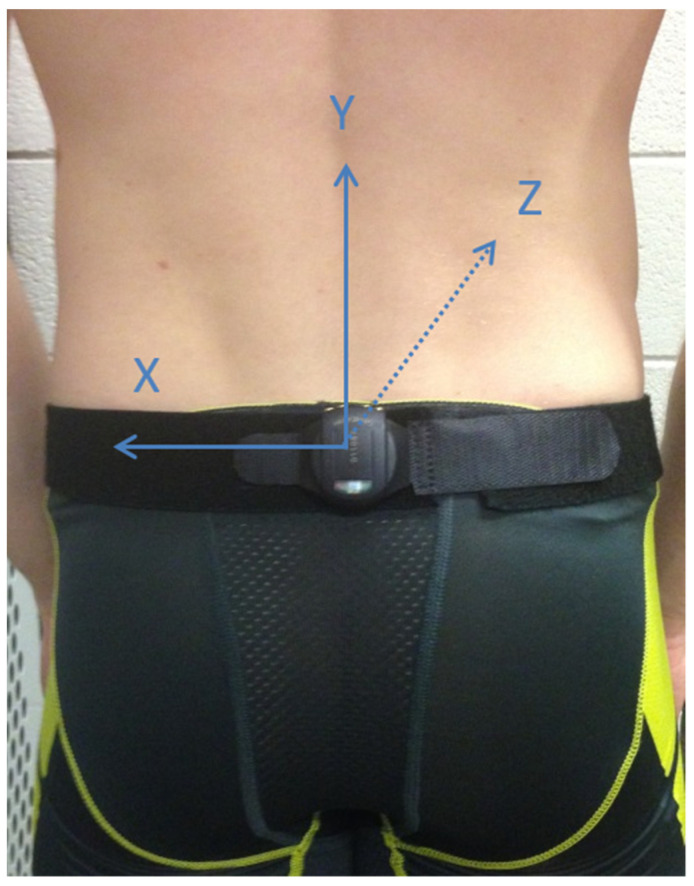
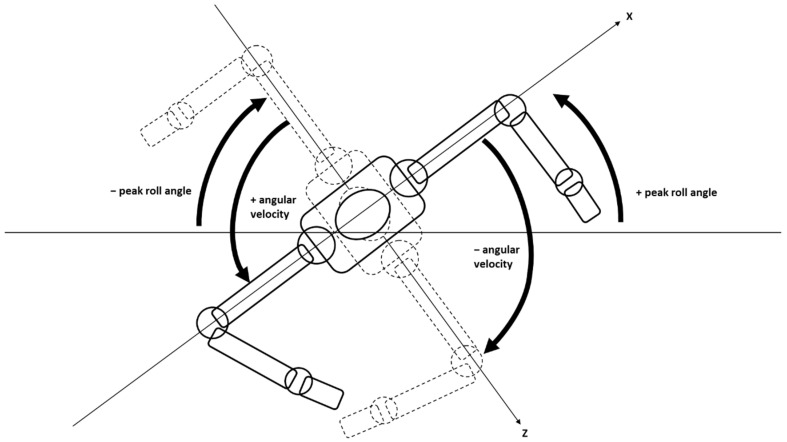
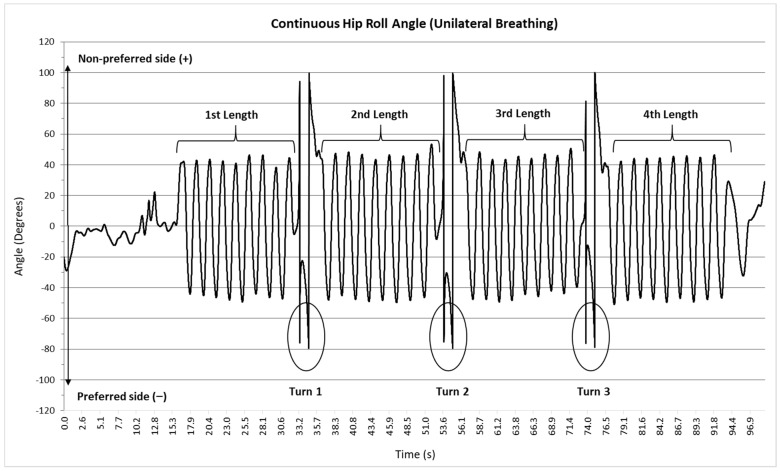
The purpose of this study was to determine the effect of breathing laterality on hip roll kinematics in submaximal front crawl swimming. Eighteen elite competitive swimmers performed three 100 m front crawl trials at a consistent sub-maximal speed (70% of seasonal best time) in a 25 m pool. Each trial was performed with one of three different breathing conditions: (1) unilateral breathing (preferred side), (2) bilateral breathing (alternating left/right-side every 3 strokes) and (3) simulated non-breathing using a swim snorkel. A waist-mounted triaxial accelerometer was used to determine continuous hip roll angle throughout the trial, from which peak hip roll angles (Ө) and average angular velocities (ω) were calculated. Two-way repeated measures ANOVAs were used to identify significant main effects for laterality (preferred vs. non-preferred breathing sides) and condition (unilateral, bilateral and snorkel breathing) for both Ө and ω. Peak hip roll to the preferred side was significantly greater (p < 0.001) in the unilateral condition, while ω to the non-preferred side was significantly greater in the unilateral (p < 0.01) and bilateral (p < 0.04) conditions. Significant same-side differences were also found between the different breathing conditions. The results demonstrate that breathing laterality affects hip roll kinematics at submaximal speeds, and that unilateral and snorkel breathing are associated with the least and most symmetric hip roll kinematics, respectively. The findings show that a snorkel effectively balances and controls bilateral hip rotation at submaximal speeds that are consistent with training, which may help to minimize and/or correct roll asymmetries that are the result of unilateral breathing.
本研究的目的是确定在次最大强度的自由泳中呼吸偏向对髋部转动运动学的影响。18名精英竞技游泳运动员在25米泳池中以一致的次最大速度(赛季最佳成绩的70%)进行了三次100米自由泳测试。每次测试在三种不同的呼吸条件之一进行:(1)单侧呼吸(偏好侧),(2)双侧呼吸(每3划交替左右侧),以及(3)使用呼吸管模拟不呼吸。使用腰部安装的三轴加速度计在整个测试过程中确定连续的髋部转动角度,由此计算出髋部转动峰值角度(Ө)和平均角速度(ω)。采用双向重复测量方差分析来确定对于Ө和ω,呼吸偏向(偏好与非偏好呼吸侧)和呼吸条件(单侧、双侧和呼吸管呼吸)的显著主效应。在单侧呼吸条件下,向偏好侧的髋部转动峰值显著更大(p < 0.001),而在单侧(p < 0.01)和双侧(p < 0.04)呼吸条件下,向非偏好侧的ω显著更大。在不同呼吸条件之间也发现了显著的同侧差异。结果表明,呼吸偏向在次最大速度下会影响髋部转动运动学,并且单侧呼吸和使用呼吸管呼吸分别与最小和最对称的髋部转动运动学相关。研究结果表明,呼吸管在与训练一致的次最大速度下有效地平衡和控制双侧髋部旋转,这可能有助于最小化和/或纠正由单侧呼吸导致的转动不对称。