School of Information Science and Technology, Dalian Maritime University, Dalian 116026, China.
Sensors (Basel). 2022 Mar 17;22(6):2326. doi: 10.3390/s22062326.
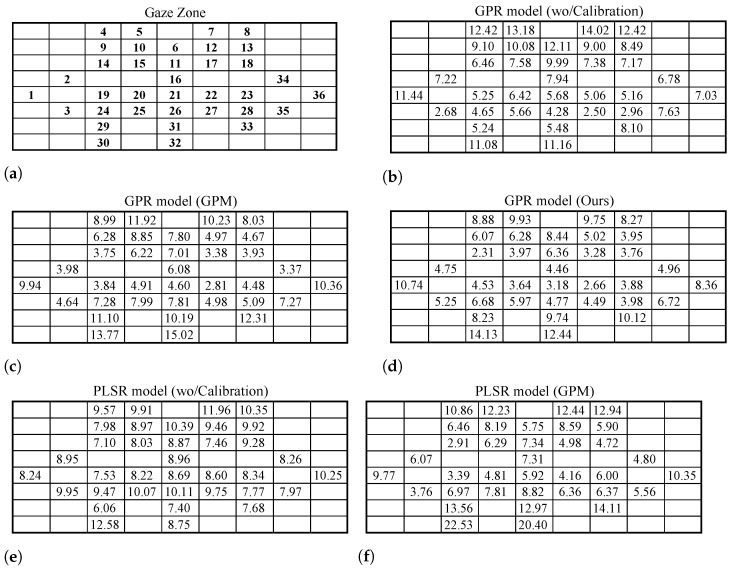
The human eye gaze plays a vital role in monitoring people's attention, and various efforts have been made to improve in-vehicle driver gaze tracking systems. Most of them build the specific gaze estimation model by pre-annotated data training in an offline way. These systems usually tend to have poor generalization performance during the online gaze prediction, which is caused by the estimation bias between the training domain and the deployment domain, making the predicted gaze points shift from their correct location. To solve this problem, a novel driver's eye gaze tracking method with non-linear gaze point refinement is proposed in a monitoring system using two cameras, which eliminates the estimation bias and implicitly fine-tunes the gaze points. Supported by the two-stage gaze point clustering algorithm, the non-linear gaze point refinement method can gradually extract the representative gaze points of the forward and mirror gaze zone and establish the non-linear gaze point re-mapping relationship. In addition, the Unscented Kalman filter is utilized to track the driver's continuous status features. Experimental results show that the non-linear gaze point refinement method outperforms several previous gaze calibration and gaze mapping methods, and improves the gaze estimation accuracy even on the cross-subject evaluation. The system can be used for predicting the driver's attention.
人眼注视在监测人们的注意力方面起着至关重要的作用,人们已经做出了各种努力来改进车内驾驶员注视跟踪系统。其中大多数通过离线方式使用预注释数据训练来构建特定的注视估计模型。这些系统在在线注视预测期间通常倾向于具有较差的泛化性能,这是由于训练域和部署域之间的估计偏差造成的,使得预测的注视点从其正确位置偏移。为了解决这个问题,提出了一种使用两个摄像机的监控系统中的具有非线性注视点细化的新型驾驶员眼睛注视跟踪方法,该方法消除了估计偏差并隐式地微调了注视点。在两阶段注视点聚类算法的支持下,非线性注视点细化方法可以逐步提取正向和镜像注视区域的有代表性的注视点,并建立非线性注视点重新映射关系。此外,利用无迹卡尔曼滤波器来跟踪驾驶员的连续状态特征。实验结果表明,非线性注视点细化方法优于几种先前的注视校准和注视映射方法,甚至在跨主体评估中也提高了注视估计精度。该系统可用于预测驾驶员的注意力。