
利用射频识别技术开发新型铁路定位系统
Development of a Novel Railway Positioning System Using RFID Technology.
作者信息
Olaby Osama, Hamadache Moussa, Soper David, Winship Phil, Dixon Roger
机构信息
Birmingham Centre for Railway Research and Education (BCRRE), School of Engineering, University of Birmingham, Birmingham B15 2TT, UK.
Network Rail, Asset Enhancement Team, Milton Keynes MK9 1EN, UK.
出版信息
Sensors (Basel). 2022 Mar 21;22(6):2401. doi: 10.3390/s22062401.
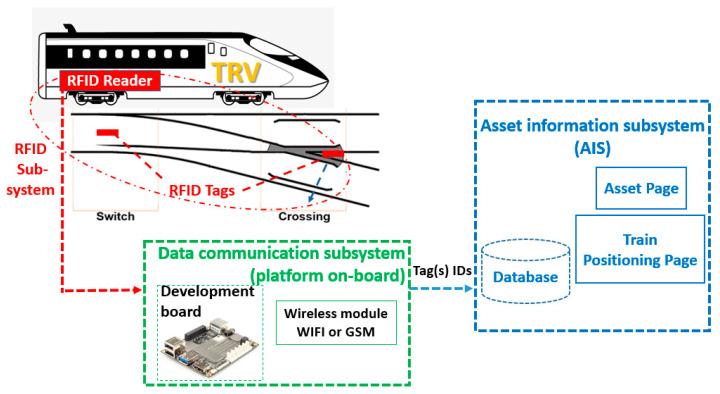
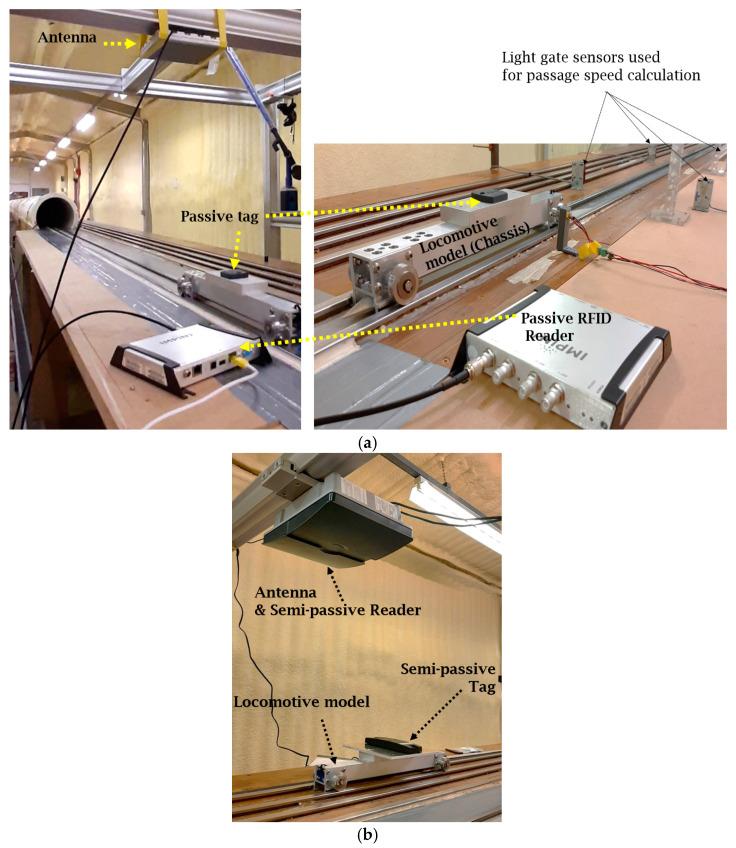
Currently, a number of positioning systems are in use to locate trains on the railway network; but these generally have limited precision. Thus, this paper focuses on testing and validating the suitability of radio frequency identification (RFID) technology, for aligning vehicles to switch and crossing (S&C) positions on the railway network. This offers the possibility of accurately knowing the position of vehicles equipped with monitoring equipment, such as the network rail track recording vehicle (TRV), and aligning the data with reference to the locations of the S&C (and ideally to key elements within a particular S&C). The concept is to install two tags, one on the switch-toe sleeper and the second on the crossing-nose sleeper, with an RFID reader that will be installed underneath the vehicle. Thus, the key features of the S&C, the switch toe and crossing nose, will be considered as a definitive reference point for the inspection vehicle's position. As a monitoring vehicle passes over a piece of S&C, the proposed positioning system will provide information about this S&C's ID, which is stored inside the RFID tags and will indicate the S&C's GPS coordinates. As part of the research in this paper, more than 400 tests have been performed to investigate two different RFID technologies, passive and semi-passive, tested in a variety of conditions: including different passage speeds, different distances between the RFID reader and the tags, and varied strength signal transmitted between the reader and the tags. Based on lab testing and analysis of the recorded data, it is concluded that passive RFID technology is the most suitable of the two technologies. The conclusions find that the proposed RFID-based solution can offer a more precise positioning solution to be a reference point for the train location within the network.
目前,铁路网络中使用了多种定位系统来确定列车位置;但这些系统的精度通常有限。因此,本文重点测试和验证射频识别(RFID)技术用于使车辆与铁路网络中的道岔和交叉设备(S&C)位置对齐的适用性。这使得准确了解配备监测设备的车辆位置成为可能,例如网络轨道记录车(TRV),并将数据与S&C的位置(理想情况下与特定S&C内的关键元件)进行对齐。其概念是在道岔尖轨枕木上安装一个标签,在辙叉心轨枕木上安装第二个标签,并在车辆下方安装一个RFID阅读器。因此,S&C的关键特征,即道岔尖轨和辙叉心,将被视为检查车辆位置的确定参考点。当监测车辆经过一段S&C时,所提出的定位系统将提供有关该S&C的ID的信息,该信息存储在RFID标签内,并将指示S&C的GPS坐标。作为本文研究的一部分,已经进行了400多次测试,以研究两种不同的RFID技术,即无源和半无源技术,在各种条件下进行测试:包括不同的通过速度、RFID阅读器与标签之间的不同距离以及阅读器与标签之间传输的不同强度信号。基于实验室测试和对记录数据的分析,得出结论:在这两种技术中,无源RFID技术是最合适的。结论发现,所提出的基于RFID的解决方案可以提供更精确的定位解决方案,作为网络内列车位置的参考点。





 Zotero 插件