Ramadan Khaled M A, Alharbi Maha Mohammed, Alenzi Asma Massad, El-Beltagi Hossam S, Darwish Doaa Bahaa Eldin, Aldaej Mohammed I, Shalaby Tarek A, Mansour Abdallah Tageldein, El-Gabry Yasser Abd El-Gawad, Ibrahim Mohamed F M
Central Laboratories, Department of Chemistry, King Faisal University, Al-Ahsa 31982, Saudi Arabia.
Biochemistry Department, Faculty of Agriculture, Ain Shams University, Cairo 11566, Egypt.
Plants (Basel). 2022 Mar 16;11(6):787. doi: 10.3390/plants11060787.
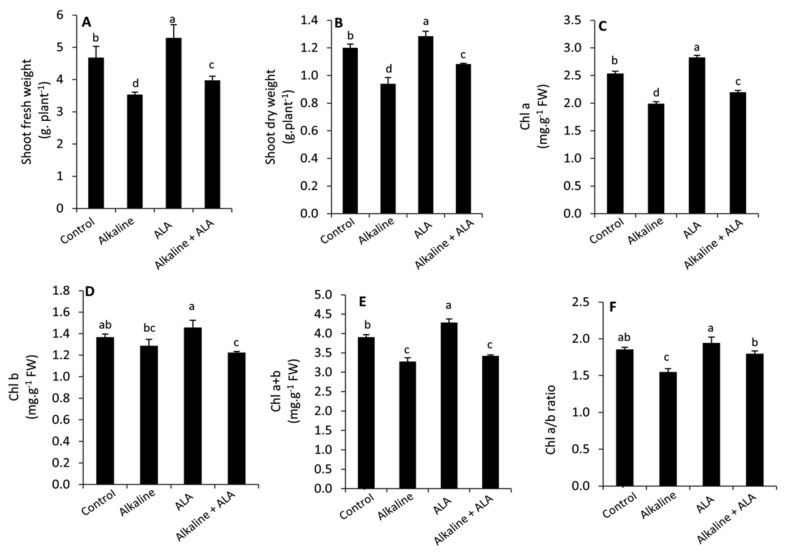
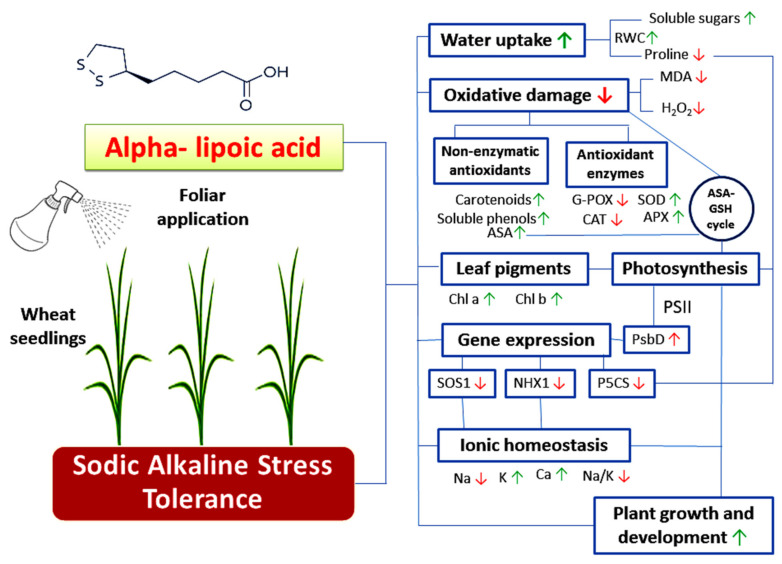
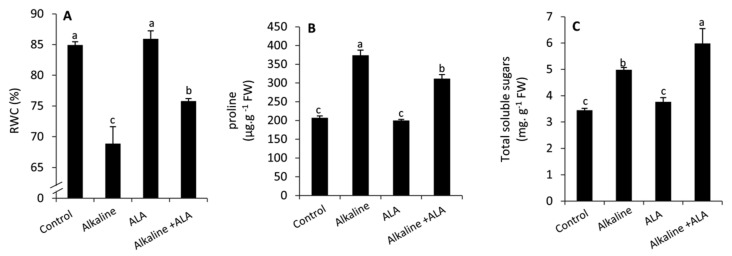
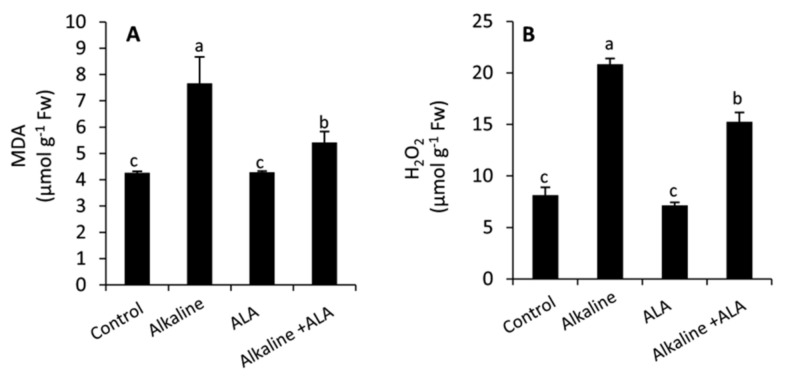
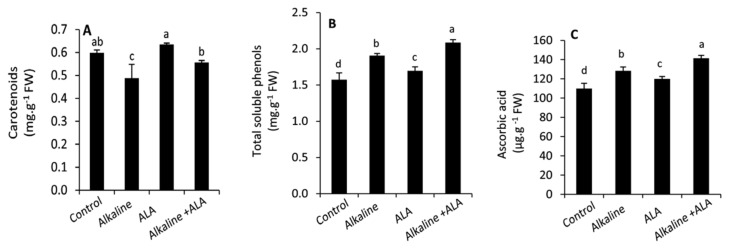
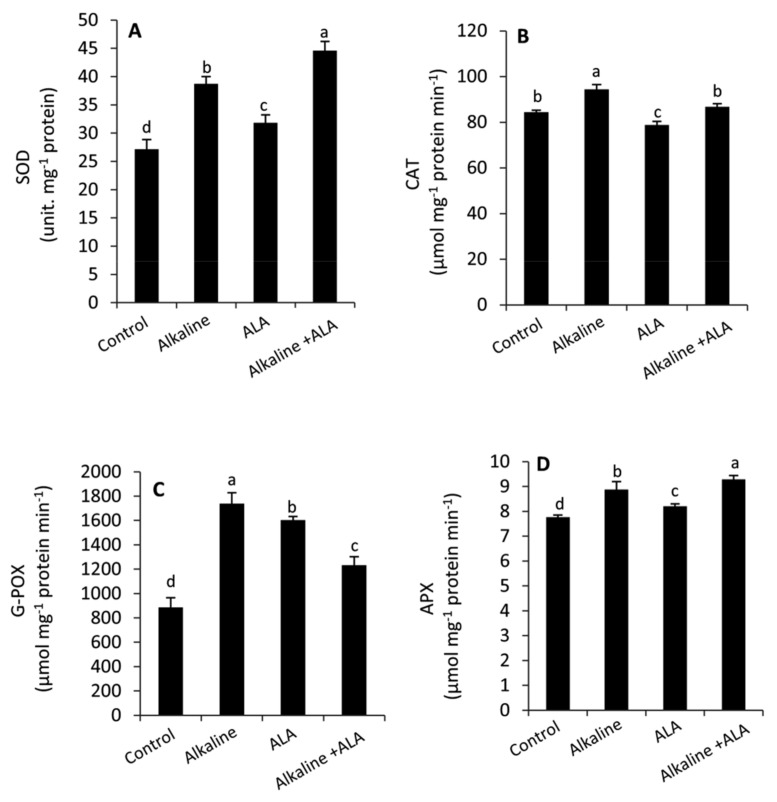
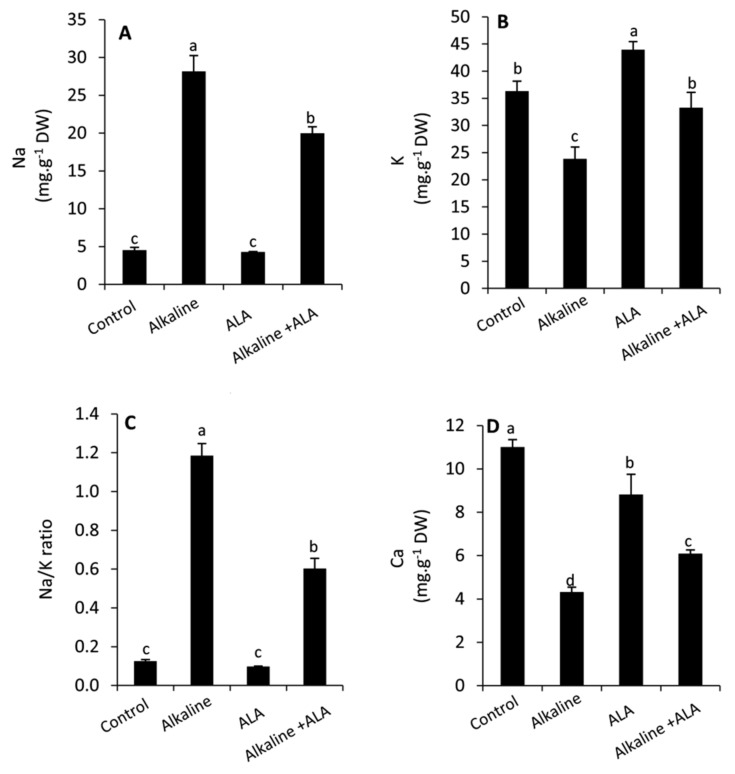
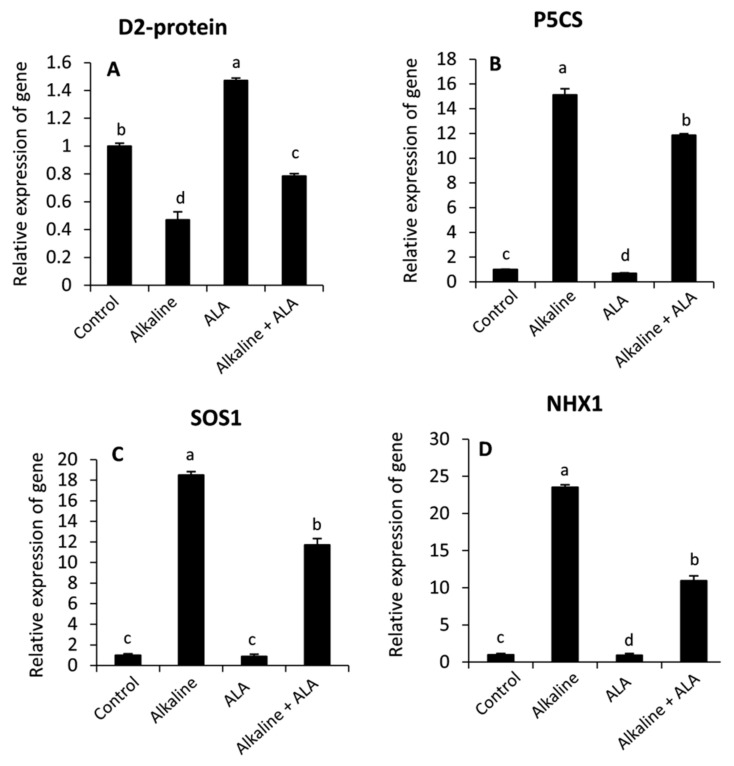
Recently, exogenous α-Lipoic acid (ALA) has been suggested to improve the tolerance of plants to a wide array of abiotic stresses. However, there is currently no definitive data on the role of ALA in wheat plants exposed to sodic alkaline stress. Therefore, this study was designed to evaluate the effects of foliar application by ALA at 0 (distilled water as control) and 20 µM on wheat seedlings grown under sodic alkaline stress (50 mM 1:1 NaHCO & NaCO; pH 9.7. Under sodic alkaline stress, exogenous ALA significantly ( ≤ 0.05) improved growth (shoot fresh and dry weight), chlorophyll (Chl) a, b and Chl a + b, while Chl a/b ratio was not affected. Moreover, leaf relative water content (RWC), total soluble sugars, carotenoids, total soluble phenols, ascorbic acid, K and Ca were significantly increased in the ALA-treated plants compared to the ALA-untreated plants. This improvement was concomitant with reducing the rate of lipid peroxidation (malondialdehyde, MDA) and HO. Superoxide dismutase (SOD) and ascorbate peroxidase (APX) demonstrated greater activity in the ALA-treated plants compared to the non-treated ones. Conversely, proline, catalase (CAT), guaiacol peroxidase (G-POX), Na and Na/K ratio were significantly decreased in the ALA-treated plants. Under sodic alkaline stress, the relative expression of photosystem II (D2 protein; PsbD) was significantly up-regulated in the ALA treatment (67% increase over the ALA-untreated plants); while Δ pyrroline-5-carboxylate synthase (P5CS), plasma membrane Na/H antiporter protein of salt overly sensitive gene (SOS1) and tonoplast-localized Na/H antiporter protein (NHX1) were down-regulated by 21, 37 and 53%, respectively, lower than the ALA-untreated plants. These results reveal that ALA may be involved in several possible mechanisms of alkalinity tolerance in wheat plants.
最近,有人提出外源α-硫辛酸(ALA)可以提高植物对多种非生物胁迫的耐受性。然而,目前尚无关于ALA在遭受盐碱胁迫的小麦植株中作用的确切数据。因此,本研究旨在评估在盐碱胁迫(50 mM 1:1 NaHCO₃ & Na₂CO₃;pH 9.7)下,叶面喷施0(蒸馏水作为对照)和20 µM ALA对小麦幼苗的影响。在盐碱胁迫下,外源ALA显著(P≤0.05)促进了生长(地上部鲜重和干重),提高了叶绿素(Chl)a、b以及Chl a + b的含量,而Chl a/b比值未受影响。此外,与未喷施ALA的植株相比,喷施ALA的植株叶片相对含水量(RWC)、总可溶性糖、类胡萝卜素、总可溶性酚、抗坏血酸、K和Ca含量均显著增加。这种改善伴随着脂质过氧化率(丙二醛,MDA)和H₂O₂的降低。与未处理植株相比,超氧化物歧化酶(SOD)和抗坏血酸过氧化物酶(APX)在喷施ALA的植株中表现出更高的活性。相反,喷施ALA的植株中脯氨酸、过氧化氢酶(CAT)、愈创木酚过氧化物酶(G-POX)、Na以及Na/K比值显著降低。在盐碱胁迫下,光系统II(D2蛋白;PsbD)的相对表达在ALA处理中显著上调(比未喷施ALA的植株增加67%);而Δ-吡咯啉-5-羧酸合成酶(P5CS)、盐过度敏感基因(SOS1)的质膜Na⁺/H⁺逆向转运蛋白以及液泡膜定位的Na⁺/H⁺逆向转运蛋白(NHX1)分别下调了21%、37%和53%,低于未喷施ALA的植株。这些结果表明,ALA可能参与了小麦植株耐碱性的多种潜在机制。