Triantafyllou Athanasios, Papagiannis Georgios, Stasi Sophia, Bakalidou Daphne, Kyriakidou Maria, Papathanasiou George, Papadopoulos Elias C, Papagelopoulos Panayiotis J, Koulouvaris Panayiotis
Orthopaedic Research and Education Center "P.N.Soukakos", Biomechanics and Gait Analysis Laboratory "Sylvia Ioannou", "Attikon" University Hospital, 1st Department of Orthopaedic Surgery, Medical School, National and Kapodistrian University of Athens, 12462 Athens, Greece.
Laboratory of Neuromuscular and Cardiovascular Study of Motion, Physiotherapy Department, Faculty of Health and Care Sciences, University of West Attica, 12243 Egaleo, Greece.
Biology (Basel). 2022 Mar 3;11(3):398. doi: 10.3390/biology11030398.
The recurrence rate of lumbar spine microdiscectomies (rLSMs) is estimated to be 5-15%. Lumbar spine flexion (LSF) of more than 10° is mentioned as the most harmful load to the intervertebral disc that could lead to recurrence during the first six postoperative weeks. The purpose of this study is to quantify LSFs, following LSM, at the period of six weeks postoperatively.
LSFs were recorded during the daily activities of 69 subjects for 24 h twice per week, using Inertial Measurement Units (IMU).
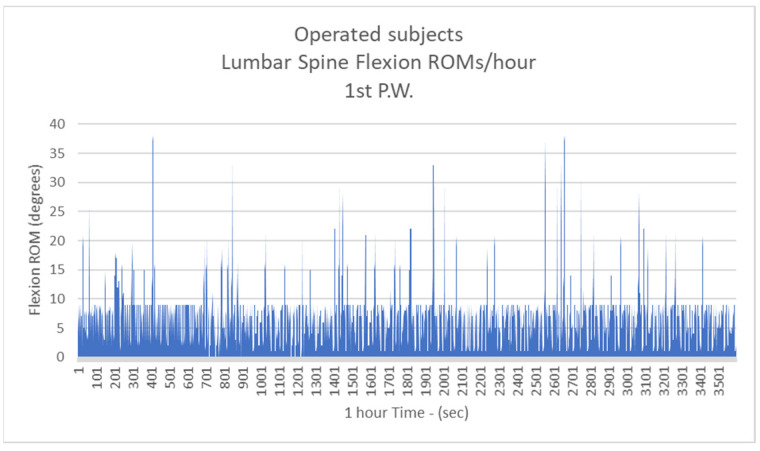
The mean number of more than 10 degrees of LSFs per hour were: 41.3/h during the 1st postoperative week (P.W.) (29.9% healthy subjects-H.S.), 2nd P.W. 60.1/h (43.5% H.S.), 3rd P.W. 74.2/h (53.7% H.S.), 4th P.W. 82.9/h (60% H.S.), 5th P.W. 97.3/h (70.4% H.S.) and 6th P.W. 105.5/h (76.4% H.S.).
LSFs constitute important risk factors for rLDH. Our study records the lumbar spine kinematic pattern of such patients for the first time during their daily activities. Patients' data report less sagittal plane movements than healthy subjects. In vitro studies should be carried out, replicating our results to identify if such a kinematic pattern could cause rLDH. Furthermore, IMU biofeedback capabilities could protect patients from such harmful movements.
腰椎显微椎间盘切除术(rLSMs)的复发率估计为5%-15%。腰椎前屈(LSF)超过10°被认为是对椎间盘最有害的负荷,可能导致术后六周内复发。本研究的目的是量化腰椎显微椎间盘切除术后六周时的腰椎前屈情况。
使用惯性测量单元(IMU),每周两次记录69名受试者24小时日常活动中的腰椎前屈情况。
术后第1周每小时超过10度的腰椎前屈平均次数为:41.3次/小时(29.9%为健康受试者-H.S.),术后第2周60.1次/小时(43.5%为健康受试者),术后第3周74.2次/小时(53.7%为健康受试者),术后第4周82.9次/小时(60%为健康受试者),术后第5周97.3次/小时(70.4%为健康受试者),术后第6周105.5次/小时(76.4%为健康受试者)。
腰椎前屈是复发性腰椎间盘突出症的重要危险因素。我们的研究首次记录了此类患者日常活动中的腰椎运动模式。患者数据显示矢状面运动比健康受试者少。应进行体外研究,复制我们的结果,以确定这种运动模式是否会导致复发性腰椎间盘突出症。此外,IMU的生物反馈功能可以保护患者免受此类有害运动的影响。