Department of Epidemiology and Biostatistics, Michigan State University, 909 Wilson Road, East Lansing, MI, 48824, USA.
Department of Human Development and Family Studies, Michigan State University, 552 W Circle Drive, East Lansing, MI, 48824, USA.
Appetite. 2022 Jul 1;174:106009. doi: 10.1016/j.appet.2022.106009. Epub 2022 Mar 22.
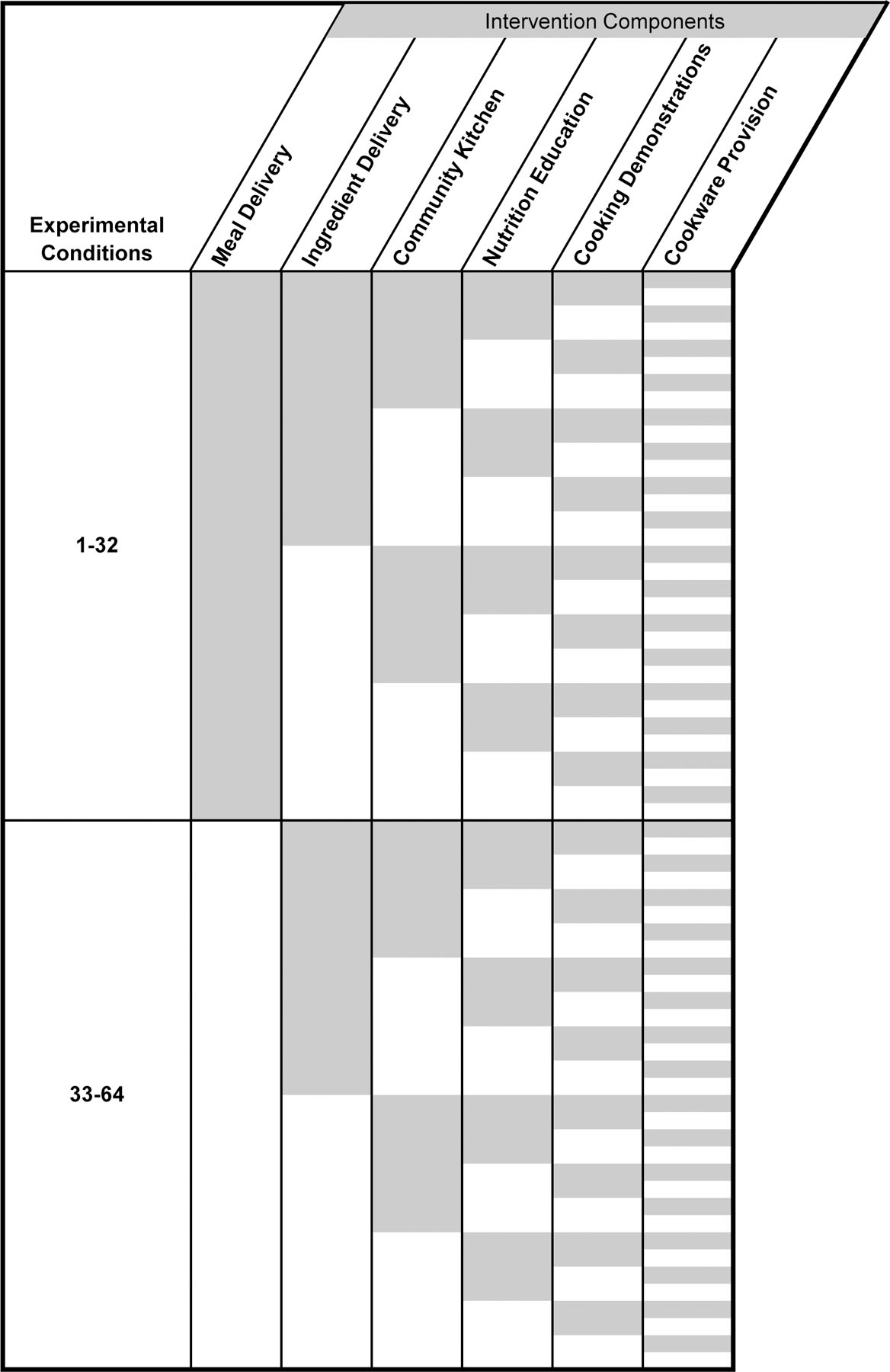
We aimed to test main, additive, interactive effects, and feasibility of all possible combinations of six intervention components implemented for 8 weeks (Cooking/Serving Resources; Meal Delivery; Ingredient Delivery; Community Kitchen; Nutrition Education; Cooking Demonstrations). Primary outcomes were family meal frequency and preschoolers' dietary quality; secondary outcomes included family meal preparation type, meal preparation barriers, family functioning, and kitchen inventory adequacy. All possible intervention combinations were tested using a randomized factorial trial design in the first phase of a Multiphase Optimization Strategy (MOST). Feasibility was assessed via attendance, delivery logs, and satisfaction. Parent-reported data collection included: socio-demographics, frequency and type of family meals; preschooler dietary intake; perceived barriers to meal planning and preparation; assessment of family functioning; and a kitchen inventory of materials generally needed for meal preparation. Participants (n = 499) were recruited at two Head Start agencies in mid-Michigan with data collection and delivery of some intervention components in participants' homes. Promising intervention bundles were identified by evaluating pre-to post-intervention effect sizes. The combination of Cooking/Serving Resources and Meal Delivery increased family meal frequency (Cohen's d = 0.17), cooking dinner from scratch (d = 0.21), prioritization of family meals (d = 0.23), and kitchen inventory (d = 0.46) and decreased use/consumption of ready-made (d = -0.18) and fast foods (d = -0.23). Effects on diet quality were in the expected direction but effect sizes were negligible. Community Kitchen, Nutrition Education, and Cooking Demonstration showed poor feasibility due to low attendance while Ingredient Delivery was infeasible due to staffing challenges related to its labor intensity. Additionally, although not one of our pre-specified outcomes, Cooking/Serving Resources (RR = 0.74) and Meal Delivery (RR = 0.73) each decreased food insecurity. Cooking/Serving Resources combined with Meal Delivery showed promise as a strategy for increasing family meal frequency.
我们旨在检验实施 8 周的六种干预成分(烹饪/服务资源;送餐;食材配送;社区厨房;营养教育;烹饪示范)的主要、附加、交互作用和可行性。主要结果是家庭用餐频率和学龄前儿童的饮食质量;次要结果包括家庭用餐准备类型、用餐准备障碍、家庭功能和厨房用品充足度。在多阶段优化策略(MOST)的第一阶段,使用随机因子试验设计测试了所有可能的干预组合。通过出勤率、交付记录和满意度评估可行性。家长报告数据收集包括:社会人口统计学、家庭用餐频率和类型;学龄前儿童饮食摄入;对膳食计划和准备的感知障碍;家庭功能评估;以及一般用于准备膳食的厨房用品清单。参与者(n=499)在密歇根州中部的两个 Head Start 机构招募,在参与者家中进行部分干预成分的数据收集和交付。通过评估干预前后的效应大小来确定有前途的干预组合。烹饪/服务资源和送餐的组合增加了家庭用餐频率(Cohen's d=0.17)、从零开始烹饪晚餐(d=0.21)、优先考虑家庭用餐(d=0.23)和厨房用品充足度(d=0.46),并减少了使用/消费预制食品(d=-0.18)和快餐(d=-0.23)。饮食质量的影响符合预期,但效应大小微不足道。由于出勤率低,社区厨房、营养教育和烹饪示范的可行性较差,而由于与劳动强度相关的人员配备挑战,成分配送不可行。此外,尽管不是我们预先指定的结果之一,但烹饪/服务资源(RR=0.74)和送餐(RR=0.73)都降低了食物不安全感。烹饪/服务资源与送餐相结合显示出增加家庭用餐频率的策略有希望。