College of Medicine, Alfaisal University, Riyadh, Saudi Arabia.
Department of Cardiac Sciences, King Fahad Cardiac Center, King Saud University Medical City, Riyadh, Saudi Arabia.
Clin Microbiol Infect. 2022 Aug;28(8):1066-1075. doi: 10.1016/j.cmi.2022.03.021. Epub 2022 Mar 23.
Many postmortem studies address the cardiovascular effects of COVID-19 and provide valuable information, but are limited by their small sample size.
The aim of this systematic review is to better understand the various aspects of the cardiovascular complications of COVID-19 by pooling data from a large number of autopsy studies.
We searched the online databases Ovid EBM Reviews, Ovid Embase, Ovid Medline, Scopus, and Web of Science for concepts of autopsy or histopathology combined with COVID-19, published between database inception and February 2021. We also searched for unpublished manuscripts using the medRxiv services operated by Cold Spring Harbor Laboratory.
Articles were considered eligible for inclusion if they reported human postmortem cardiovascular findings among individuals with a confirmed SARS coronavirus type 2 (CoV-2) infection.
Confirmed COVID-19 patients with post-mortem cardiovascular findings.
None.
Studies were individually assessed for risk of selection, detection, and reporting biases. The median prevalence of different autopsy findings with associated interquartile ranges (IQRs).
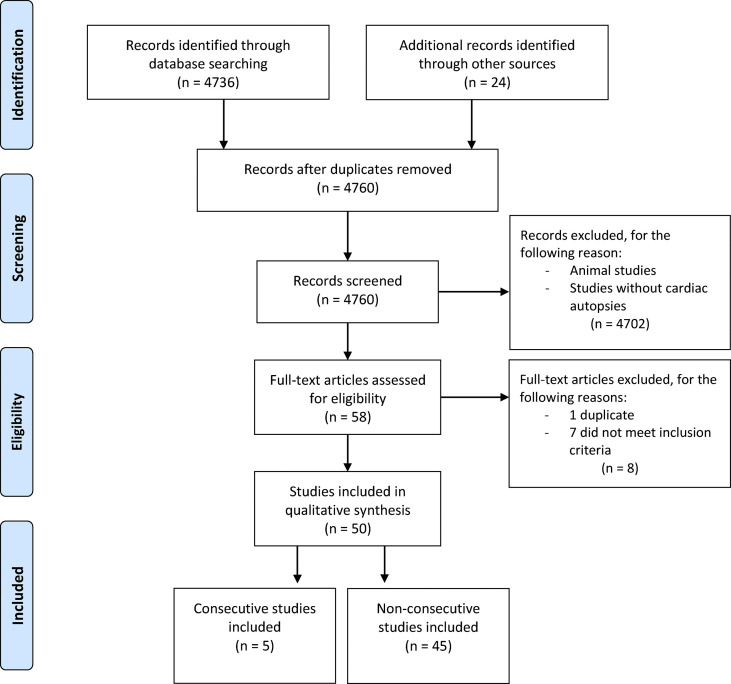
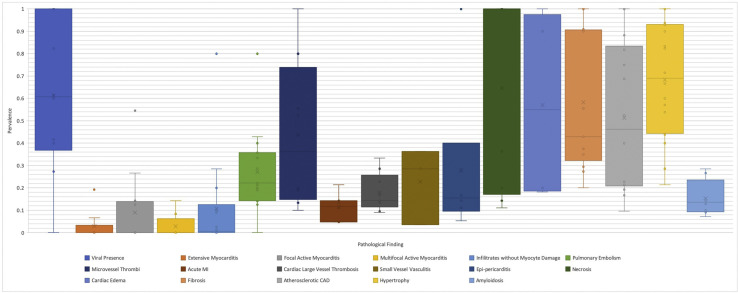
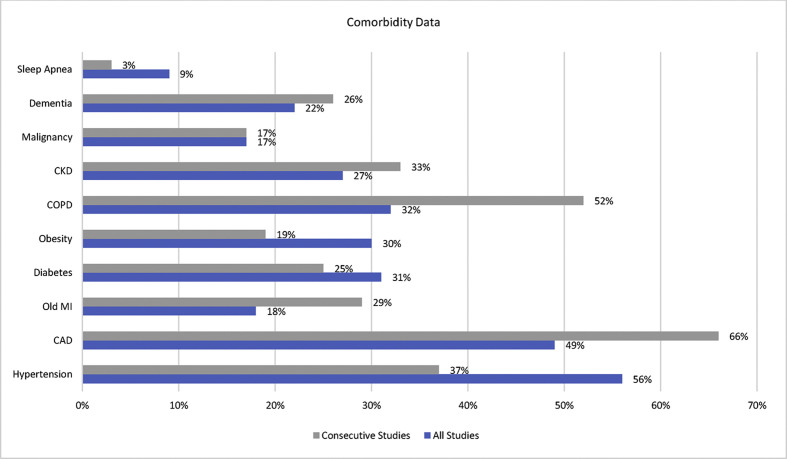
This review cohort contained 50 studies including 548 hearts. The median age of the deceased was 69 years. The most prevalent acute cardiovascular findings were myocardial necrosis (median: 100.0%; IQR, 20%-100%; number of studies = 9; number of patients = 64) and myocardial oedema (median: 55.5%; IQR, 19.5%-92.5%; number of studies = 4; number of patients = 46). The median reported prevalence of extensive, focal active, and multifocal myocarditis were all 0.0%. The most prevalent chronic changes were myocyte hypertrophy (median: 69.0%; IQR, 46.8%-92.1%) and fibrosis (median: 35.0%; IQR, 35.0%-90.5%). SARS-CoV-2 was detected in the myocardium with median prevalence of 60.8% (IQR 40.4-95.6%).
Our systematic review confirmed the high prevalence of acute and chronic cardiac pathologies in COVID-19 and SARS-CoV-2 cardiac tropism, as well as the low prevalence of myocarditis in COVID-19.
许多尸检研究探讨了 COVID-19 的心血管影响,并提供了有价值的信息,但由于样本量小而受到限制。
本系统综述的目的是通过汇集大量尸检研究的数据,更好地了解 COVID-19 心血管并发症的各个方面。
我们在 Ovid EBM Reviews、Ovid Embase、Ovid Medline、Scopus 和 Web of Science 等在线数据库中搜索了与尸检或组织病理学相结合的 COVID-19 概念,检索时间从数据库建立到 2021 年 2 月。我们还使用冷泉港实验室运营的 medRxiv 服务搜索了未发表的手稿。
如果报告了在确诊的 SARS-CoV-2 感染个体中存在的人类死后心血管发现,则认为符合纳入标准。
具有经尸检证实的 COVID-19 心血管发现的确诊 COVID-19 患者。
无。
单独评估了研究的选择、检测和报告偏倚风险。中位数及四分位数范围(IQR)的不同尸检发现的流行率。
本综述队列包含 50 项研究,共纳入 548 例心脏。死者的中位年龄为 69 岁。最常见的急性心血管发现是心肌坏死(中位数:100.0%;IQR:20%-100%;研究数量=9;患者数量=64)和心肌水肿(中位数:55.5%;IQR:19.5%-92.5%;研究数量=4;患者数量=46)。广泛、局灶性活跃和多灶性心肌炎的报告流行率中位数均为 0.0%。最常见的慢性变化是心肌细胞肥大(中位数:69.0%;IQR:46.8%-92.1%)和纤维化(中位数:35.0%;IQR:35.0%-90.5%)。SARS-CoV-2 在心肌中的检出率中位数为 60.8%(IQR:40.4%-95.6%)。
本系统综述证实了 COVID-19 中急性和慢性心脏病变以及 SARS-CoV-2 心脏嗜性的高流行率,以及 COVID-19 中心肌炎的低流行率。