Sukumaran Sivakumar, Krishna Hari, Singh Kuldeep, Mottaleb Khondoker Abdul, Reynolds Matthew
1Global Wheat Program, International Maize and Wheat Improvement Center (CIMMYT), Mexico City, Mexico; 2Scioeconomics Program, CIMMYT, Mexico City, Mexico; 3Division of Plant Breeding and Genetics, Indian Agricultural Research Institute, New Delhi, India; 4National Institute of Plant Genetic Resources (NIPGR), New Delhi, India.
Curr Genomics. 2021 Dec 30;22(6):440-449. doi: 10.2174/1389202922666210705125006.
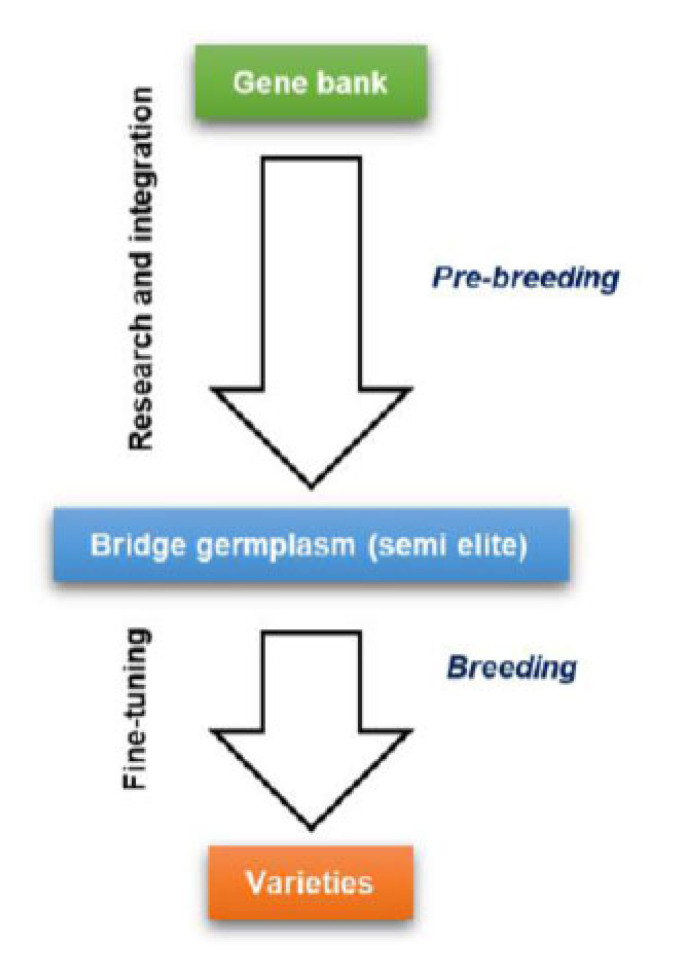
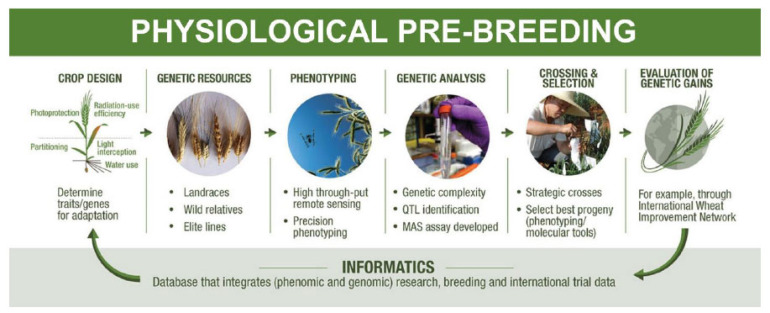
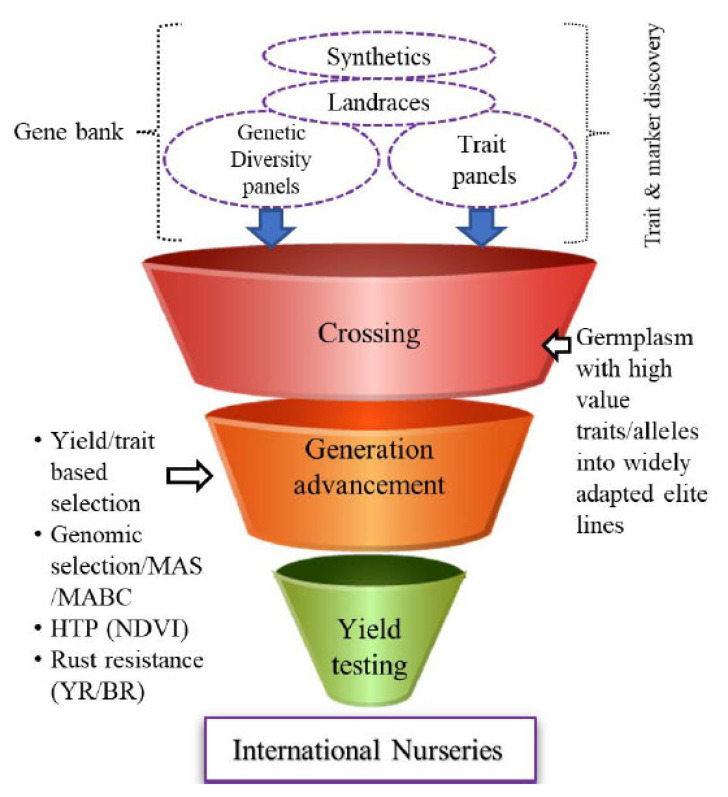
Developing climate-resilient wheat is a priority for South Asia since the effect of climate change will be pronounced on the major crops that are staple to the region. South Asia must produce >400 million metric tons (MMT) of wheat by 2050 to meet the demand. However, the current average yield <3 t/ha is not sufficient to meet the requirement. In this review, we are addressing how pre-breeding methods in wheat can address the gap in grain yield as well as reduce the bottleneck of genetic diversity. Physiological pre-breeding which incorporates screening of diverse germplasm from gene banks for physiological and agronomic traits, the strategic crossing of complementary traits, high throughput phenotyping, molecular markers-based generation advancement, genomic prediction, and validation of high-value heat and drought tolerant lines to South Asia can help to alleviate the drastic effect of climate change on wheat production. There are several gene banks, if utilized well, can play a major role in breeding for climate-resilient wheat. CIMMYT's wheat physiological pre-breeding has delivered several hundred lines the Stress Adapted Trait Yield Nursery (SATYN) to the NARS in many South Asian countries; India, Pakistan, Nepal, Bangladesh, Afghanistan, and Iran. Some of these improved germplasms have resulted in varieties for farmer's field. We conclude the review by pointing out the importance of collaborative interdisciplinary translational research to alleviate the effects of climate change on wheat production in South Asia.
培育适应气候变化的小麦是南亚的一项优先任务,因为气候变化对该地区主要主食作物的影响将十分显著。到2050年,南亚必须生产超过4亿吨小麦才能满足需求。然而,目前平均产量低于3吨/公顷,不足以满足需求。在本综述中,我们探讨了小麦的预育种方法如何弥补产量差距以及减少遗传多样性瓶颈。生理预育种包括从基因库中筛选具有生理和农艺性状的不同种质、互补性状的策略性杂交、高通量表型分析、基于分子标记的世代推进、基因组预测以及向南亚验证高价值耐热和耐旱品系,这有助于减轻气候变化对小麦生产的严重影响。有几个基因库,如果利用得当,可在培育适应气候变化的小麦方面发挥重要作用。国际玉米小麦改良中心(CIMMYT)的小麦生理预育种已向许多南亚国家(印度、巴基斯坦、尼泊尔、孟加拉国、阿富汗和伊朗)的国家农业研究系统(NARS)提供了数百个品系,即胁迫适应性状产量圃(SATYN)。其中一些改良种质已育成供农民田间种植的品种。我们在综述结尾指出,开展跨学科合作转化研究对于减轻气候变化对南亚小麦生产的影响至关重要。