Turuspekov Yerlan, Baibulatova Aida, Yermekbayev Kanat, Tokhetova Laura, Chudinov Vladimir, Sereda Grigoriy, Ganal Martin, Griffiths Simon, Abugalieva Saule
Institute of Plant Biology and Biotechnology, Almaty, Kazakhstan, 050040.
Kazakh Rice Research Institute, Kyzylorda, Kazakhstan, 120016.
BMC Plant Biol. 2017 Nov 14;17(Suppl 1):190. doi: 10.1186/s12870-017-1131-2.
Spring wheat is the largest agricultural crop grown in Kazakhstan with an annual sowing area of 12 million hectares in 2016. Annually, the country harvests around 15 million tons of high quality grain. Despite environmental stress factors it is predicted that the use of new technologies may lead to increases in productivity from current levels of 1.5 to up to 3 tons per hectare. One way of improving wheat productivity is by the application of new genomic oriented approaches in plant breeding projects. Genome wide association studies (GWAS) are emerging as powerful tools for the understanding of the inheritance of complex traits via utilization of high throughput genotyping technologies and phenotypic assessments of plant collections. In this study, phenotyping and genotyping data on 194 spring wheat accessions from Kazakhstan, Russia, Europe, and CIMMYT were assessed for the identification of marker-trait associations (MTA) of agronomic traits by using GWAS.
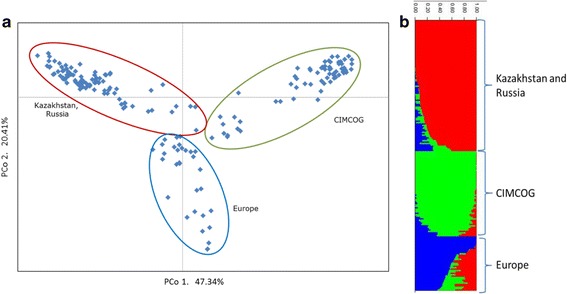
Field trials in Northern, Central and Southern regions of Kazakhstan using 194 spring wheat accessions revealed strong correlations of yield with booting date, plant height, biomass, number of spikes per plant, and number of kernels per spike. The accessions from Europe and CIMMYT showed high breeding potential for Southern and Central regions of the country in comparison with the performance of the local varieties. The GGE biplot method, using average yield per plant, suggested a clear separation of accessions into their three breeding origins in relationship to the three environments in which they were evaluated. The genetic variation in the three groups of accessions was further studied using 3245 polymorphic SNP (single nucleotide polymorphism) markers. The application of Principal Coordinate analysis clearly grouped the 194 accessions into three clades according to their breeding origins. GWAS on data from nine field trials allowed the identification of 114 MTAs for 12 different agronomic traits.
Field evaluation of foreign germplasm revealed its poor yield performance in Northern Kazakhstan, which is the main wheat growing region in the country. However, it was found that EU and CIMMYT germplasm has high breeding potential to improve yield performance in Central and Southern regions. The use of Principal Coordinate analysis clearly separated the panel into three distinct groups according to their breeding origin. GWAS based on use of the TASSEL 5.0 package allowed the identification of 114 MTAs for twelve agronomic traits. The study identifies a network of key genes for improvement of yield productivity in wheat growing regions of Kazakhstan.
春小麦是哈萨克斯坦种植面积最大的农作物,2016年的年播种面积为1200万公顷。该国每年收获约1500万吨优质谷物。尽管存在环境压力因素,但预计采用新技术可能会使产量从目前的每公顷1.5吨提高到3吨。提高小麦产量的一种方法是在植物育种项目中应用新的基因组导向方法。全基因组关联研究(GWAS)正成为通过利用高通量基因分型技术和植物群体的表型评估来理解复杂性状遗传的有力工具。在本研究中,对来自哈萨克斯坦、俄罗斯、欧洲和国际玉米小麦改良中心(CIMMYT)的194份春小麦种质的表型和基因分型数据进行了评估,以通过GWAS鉴定农艺性状与标记的关联(MTA)。
在哈萨克斯坦北部、中部和南部地区使用194份春小麦种质进行的田间试验表明,产量与抽穗期、株高、生物量、单株穗数和单穗粒数之间存在很强的相关性。与当地品种的表现相比,来自欧洲和CIMMYT的种质在该国中部和南部地区显示出较高的育种潜力。使用单株平均产量的GGE双标图方法表明,根据评估种质的三种环境,可将种质明显分为三个育种来源组。使用3245个多态性单核苷酸多态性(SNP)标记进一步研究了这三组种质的遗传变异。主坐标分析的应用根据其育种来源将194份种质清晰地分为三个进化枝。对来自九个田间试验的数据进行GWAS,鉴定出了12种不同农艺性状的114个MTA。
对国外种质的田间评估表明,其在哈萨克斯坦北部(该国主要的小麦种植区)的产量表现不佳。然而,发现欧盟和CIMMYT的种质在提高中部和南部地区的产量表现方面具有很高的育种潜力。主坐标分析的应用根据其育种来源将样本清晰地分为三个不同的组。基于TASSEL 5.0软件包的GWAS鉴定出了12种农艺性状的114个MTA。该研究确定了哈萨克斯坦小麦种植区提高产量生产力的关键基因网络。