
基于R的计算机器学习的空间转录组学分析揭示中医理论中阳虚或阴虚证的基因特征。
Spatial Transcriptomic Analysis Using R-Based Computational Machine Learning Reveals the Genetic Profile of Yang or Yin Deficiency Syndrome in Chinese Medicine Theory.
作者信息
Zhang Cheng, Tam Chi Wing, Tang Guoyi, Chen Yuanyuan, Wang Ning, Feng Yibin
机构信息
School of Chinese Medicine, Li Ka Shing Faculty of Medicine, The University of Hong Kong, Hong Kong, China.
出版信息
Evid Based Complement Alternat Med. 2022 Mar 16;2022:5503181. doi: 10.1155/2022/5503181. eCollection 2022.
OBJECTIVES
Yang and Yin are two main concepts responsible for harmonious balance reflecting health conditions based on Chinese medicine theory. Of note, deficiency of either Yang or Yin is associated with disease susceptibility. In this study, we aim to clarify the molecular feature of Yang and Yin deficiency by reanalyzing a transcriptomic data set retrieved from the GEO database using R-based machine learning analyses, which lays a foundation for medical diagnosis, prevention, and treatment of unbalanced Yang or Yin.
METHODS
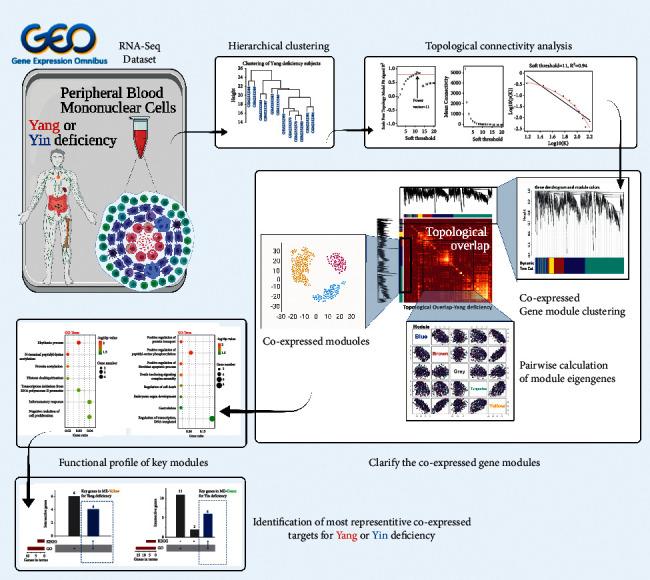
Besides conventional methods for target mining, we took the advantage of spatial transcriptomic analysis using R-based machine learning approaches to elucidate molecular profiles of Yin and Yang deficiency by reanalyzing an RNA-Seq data set (GSE87474) in the GEO focusing on peripheral blood mononuclear cells (PBMCs). The add-on functions in R including GEOquery, DESeq2, WGCNA (target identification with a scale-free topological assumption), Scatterplot3d, Tidyverse, and UpsetR were used. For information in the selected GEO data set, PBMCs representing 20,740 expressed genes were collected from subjects with Yang or Yin deficiency ( = 12 each), based on Chinese medicine-related diagnostic criteria.
RESULTS
The symptomatic gene targets for Yang deficiency (KAT2B, NFKB2, CREBBP, GTF2H3) or Yin deficiency (JUNB, JUND, NGLY1, TNF, RAF1, PPP1R15A) were potentially discovered. CREBBP was identified as a shared key contributive gene regulating either the Yang or Yin deficiency group. The intrinsic molecular characteristics of these specific genes could link with clinical observations of Yang/Yin deficiency, in which Yang deficiency is associated with immune dysfunction tendency and energy deregulation, while Yin deficiency mainly contains oxidative stress, dysfunction of the immune system, and abnormal lipid/protein metabolism.
CONCLUSION
Our study provides representative gene targets and modules for supporting clinical traits of Yang or Yin deficiency in Chinese medicine theory, which is beneficial for promoting the modernization of Chinese medicine theory. Besides, R-based machine learning approaches adopted in this study might be further applied for investigating the underlying genetic polymorphisms related to Chinese medicine theory.
目的
根据中医理论,阴阳是维持和谐平衡、反映健康状况的两个主要概念。值得注意的是,阳虚或阴虚都与疾病易感性相关。在本研究中,我们旨在通过使用基于R的机器学习分析重新分析从基因表达综合数据库(GEO)检索到的转录组数据集,阐明阳虚和阴虚的分子特征,为阴阳失调的医学诊断、预防和治疗奠定基础。
方法
除了传统的靶点挖掘方法外,我们利用基于R的机器学习方法进行空间转录组分析,通过重新分析GEO中聚焦于外周血单个核细胞(PBMC)的RNA测序数据集(GSE87474),来阐明阴虚和阳虚的分子特征。使用了R中的附加功能,包括GEOquery、DESeq2、WGCNA(基于无标度拓扑假设的靶点识别)、Scatterplot3d、Tidyverse和UpsetR。对于所选GEO数据集中的信息,根据中医相关诊断标准,从阳虚或阴虚受试者(各12例)中收集代表20740个表达基因的PBMC。
结果
潜在地发现了阳虚(KAT2B、NFKB2、CREBBP、GTF2H3)或阴虚(JUNB、JUND、NGLY1、TNF、RAF1、PPP1R15A)的症状性基因靶点。CREBBP被确定为调节阳虚或阴虚组的共同关键贡献基因。这些特定基因的内在分子特征可能与阳虚/阴虚的临床观察结果相关,其中阳虚与免疫功能障碍倾向和能量失调有关,而阴虚主要包括氧化应激、免疫系统功能障碍以及脂质/蛋白质代谢异常。
结论
我们的研究为支持中医理论中阳虚或阴虚的临床特征提供了代表性的基因靶点和模块,这有利于推动中医理论的现代化。此外,本研究中采用的基于R的机器学习方法可能会进一步应用于研究与中医理论相关的潜在基因多态性。



 Zotero 插件