Lachs Liam, Chong Fiona, Beger Maria, East Holly K, Guest James R, Sommer Brigitte
School of Natural & Environmental Sciences Newcastle University Newcastle upon Tyne UK.
Department of Biological & Marine Sciences University of Hull Hull UK.
Ecol Evol. 2022 Mar 14;12(3):e8724. doi: 10.1002/ece3.8724. eCollection 2022 Mar.
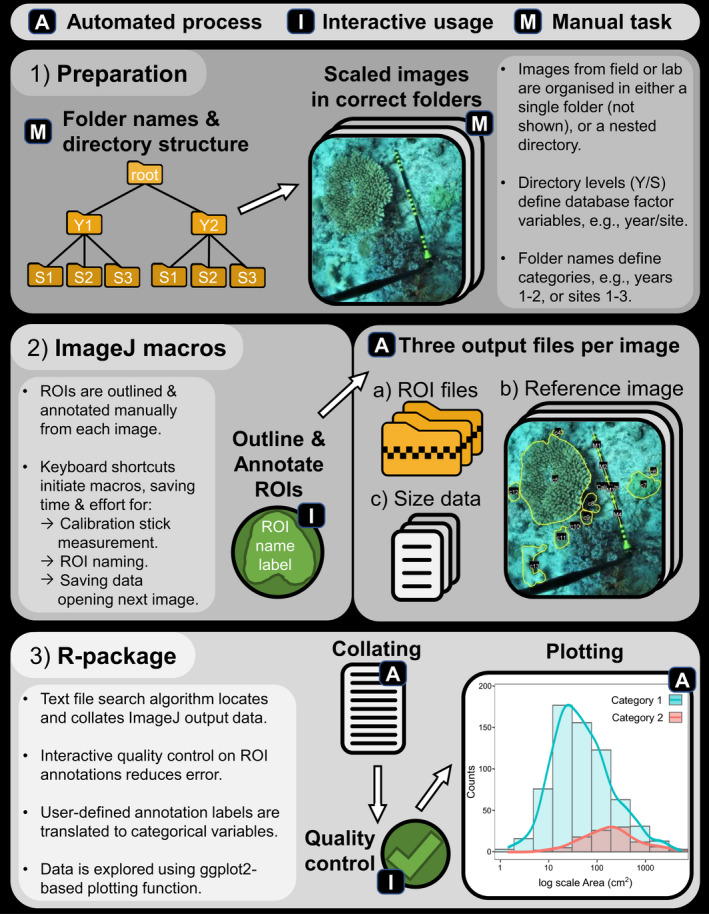
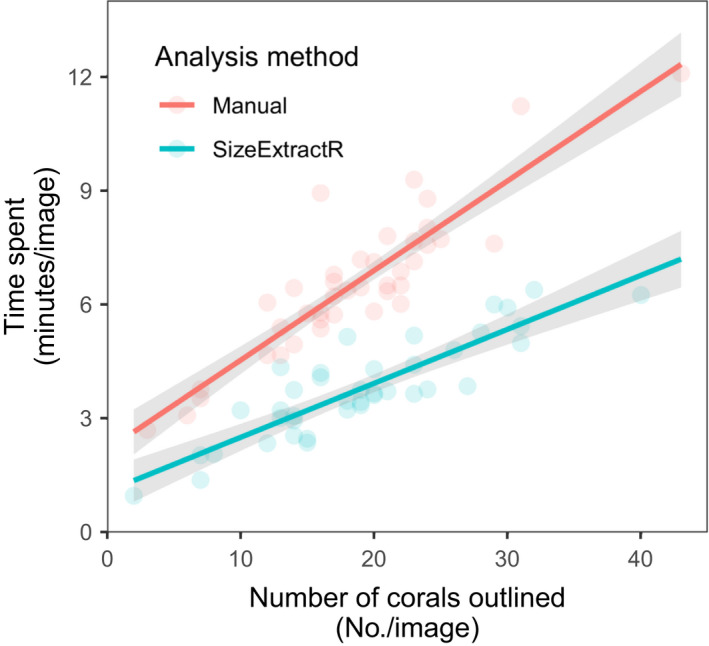
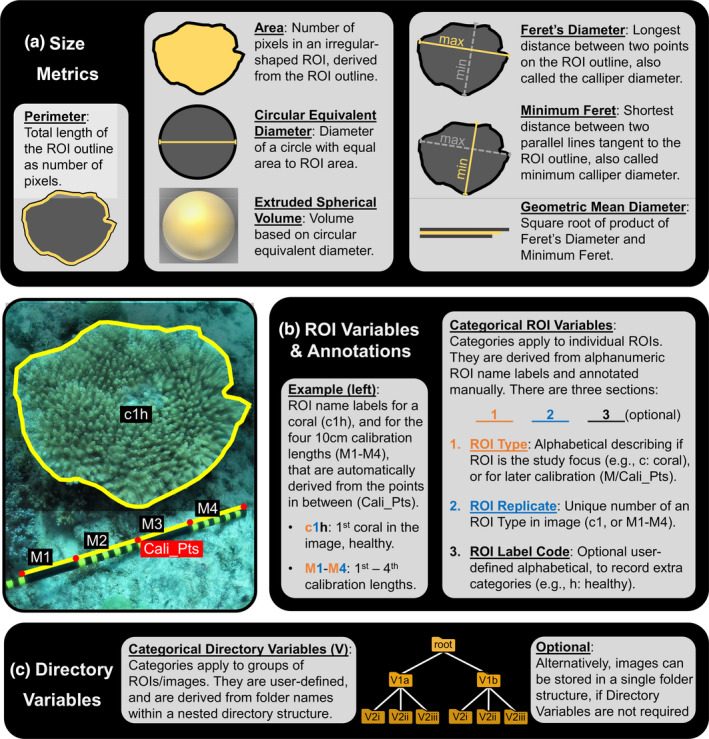
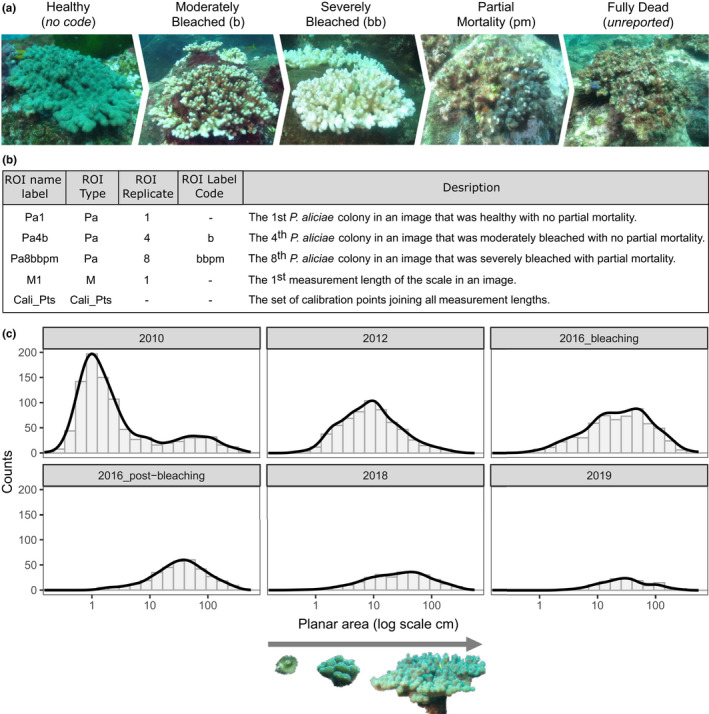
Size is a biological characteristic that drives ecological processes from microscopic to geographic spatial scales, influencing cellular energetics, species fitness, population dynamics, and ecological interactions. Methods to measure size from images (e.g., proxies of body size, leaf area, and cell area) occur along a gradient from manual approaches to fully automated technologies (e.g., machine learning). These methods differ in terms of time investment, expertise required, and data or resource availability. While manual methods can improve accuracy through human recognition, they can be labor intensive, highlighting the need for semi-automated, and user-friendly software or workflows to increase the efficiency of manual techniques.Here, we present SizeExtractR, an open-source workflow that enables faster extraction of size metrics from scaled images (e.g., each image includes a ruler) using semi-automated protocols. It comprises a set of ImageJ macros to speed up size extraction and annotation, and an R-package for the quality control of annotations, data collation, calibration, and visualization.SizeExtractR extracts seven common size dimensions, including planar area, min/max diameter, and perimeter. Users can record additional categorical variables relating to their own study, for example species ID, by simply adding alphanumeric annotations to individual objects when prompted. Using a population size structure case study for hard corals as an example, we show how SizeExtractR was used to quantify the impact of mass coral bleaching on coral population dynamics. Lastly, the time saving benefit of using SizeExtractR was quantified during a series of timed image analyses, revealing up to a 49% reduction in image analysis time compared to a fully manual approach.SizeExtractR automatically archives results, allowing re-analysis of size extraction and promoting quality control and reproducibility. It has already been employed in marine and terrestrial sciences to assess population dynamics and demography, energy investment in eggs, and growth of nursery reared corals, with potential to be applied to a wide range of other research fields.
大小是一种生物学特征,它驱动着从微观到地理空间尺度的生态过程,影响着细胞能量学、物种适应性、种群动态和生态相互作用。从图像中测量大小的方法(例如,身体大小、叶面积和细胞面积的代理指标)沿着从手动方法到全自动技术(例如,机器学习)的梯度发展。这些方法在时间投入、所需专业知识以及数据或资源可用性方面存在差异。虽然手动方法可以通过人工识别提高准确性,但它们可能劳动强度大,这凸显了对半自动化且用户友好的软件或工作流程的需求,以提高手动技术的效率。在此,我们展示了SizeExtractR,这是一种开源工作流程,它能够使用半自动协议从缩放图像(例如,每张图像都包含一把尺子)中更快地提取大小指标。它包括一组用于加速大小提取和注释的ImageJ宏,以及一个用于注释质量控制、数据整理、校准和可视化的R包。SizeExtractR提取七个常见的大小维度,包括平面面积、最小/最大直径和周长。用户可以通过在提示时简单地向单个对象添加字母数字注释来记录与他们自己的研究相关的其他分类变量,例如物种ID。以硬珊瑚的种群大小结构案例研究为例,我们展示了如何使用SizeExtractR来量化大规模珊瑚白化对珊瑚种群动态的影响。最后,在一系列定时图像分析中对使用SizeExtractR节省时间的好处进行了量化,结果显示与完全手动方法相比,图像分析时间最多可减少49%。SizeExtractR会自动存档结果,允许对大小提取进行重新分析,并促进质量控制和可重复性。它已经被应用于海洋和陆地科学中,以评估种群动态和人口统计学、卵中的能量投资以及养殖珊瑚的生长情况,并且有可能应用于广泛的其他研究领域。