Mayfour Katherine Woolard, Hruschka Daniel
School of Human Evolution and Social Change, Arizona State University, Cady Mall, Tempe, AZ, 85281, USA.
SSM Popul Health. 2022 Mar 18;17:101065. doi: 10.1016/j.ssmph.2022.101065. eCollection 2022 Mar.
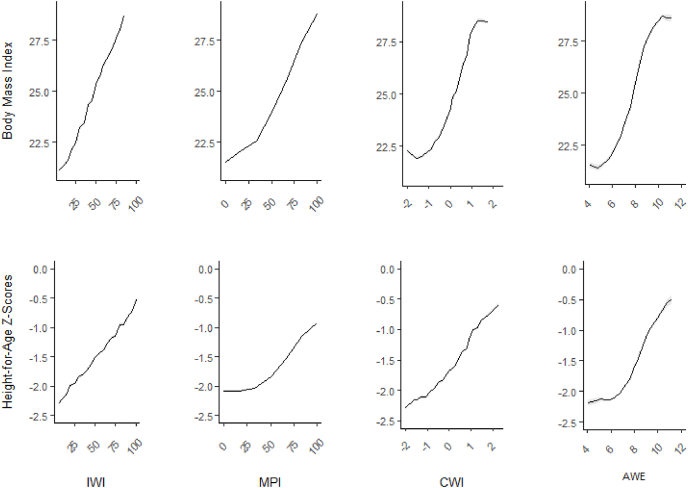
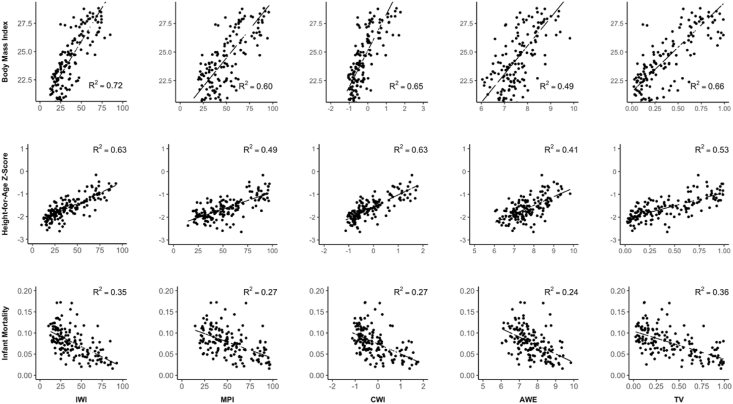
Social scientists and policymakers have increasingly relied on asset-based indices of household wealth to assess social disparities and to identify economically vulnerable populations in low- and middle-income countries. In the last decade, researchers have proposed a number of asset-based measures that permit global comparisons of household wealth across populations in different countries and over time. Each of these measures relies on different assumptions and indicators, and little is known about the relative performance of these measures in assessing disparities. In this study, we assess four comparative, asset-based measures of wealth-the Absolute Wealth Estimate (AWE), the International Wealth Index (IWI), the Comparative Wealth Index (CWI), and the "Standard of Living" portion of the Multi-Dimensional Poverty Index (MPI), along with a variable measuring television ownership-and compare how well each predicts health related variables such as women's BMI, children's height-for-age Z scores, and infant mortality at the household and survey level. Analyzing data from over 300 Demographic and Health surveys in 84 countries (n = 2,304,928 households), we found that AWE, IWI, CWI, MPI are all highly correlated (r = 0.7 to 0.9). However, IWI which is based on a common set of universally weighted indicators, typically best accounts for variation in all three health measures. We discuss the implications of these findings for choosing and interpreting these measures of wealth for different purposes.
社会科学家和政策制定者越来越依赖基于资产的家庭财富指数,来评估低收入和中等收入国家的社会差距,并确定经济上脆弱的人群。在过去十年中,研究人员提出了一些基于资产的衡量方法,这些方法可以对不同国家不同人群的家庭财富进行全球比较,并随着时间推移进行比较。这些衡量方法中的每一种都依赖于不同的假设和指标,而对于这些方法在评估差距方面的相对表现,人们了解甚少。在本研究中,我们评估了四种基于资产的比较性财富衡量方法——绝对财富估计(AWE)、国际财富指数(IWI)、比较财富指数(CWI)以及多维贫困指数(MPI)中的“生活水平”部分,同时还评估了一个衡量电视拥有情况的变量,并比较它们在家庭和调查层面预测与健康相关变量(如女性的体重指数、儿童的年龄别身高Z评分和婴儿死亡率)的能力。通过分析来自84个国家的300多项人口与健康调查的数据(n = 2304928户家庭),我们发现AWE、IWI、CWI、MPI都高度相关(r = 0.7至0.9)。然而,基于一组通用的普遍加权指标的IWI,通常最能解释所有这三项健康指标的变化。我们讨论了这些发现对于为不同目的选择和解释这些财富衡量方法的意义。