Department of Cardiology, The First Affiliated Hospital of Guangxi Medical University, Nanning, China.
Department of Cardiology, Guilin People's Hospital, Guilin, China.
Anatol J Cardiol. 2022 Mar;26(3):154-162. doi: 10.5152/AnatolJCardiol.2021.766.
Catheter ablation combined with left atrial appendage closure is effective in treating atrial fibrillation. However, the effectiveness of this combined treatment compared with catheter ablation alone is still controversial.
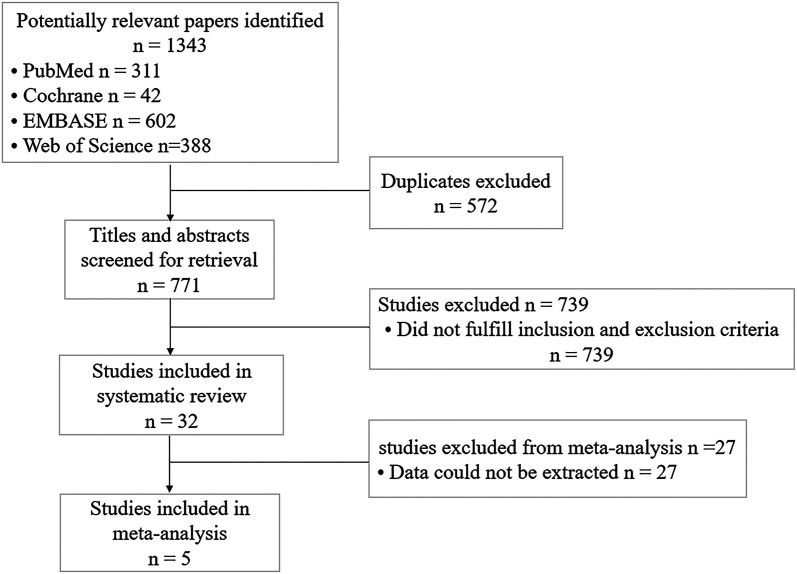
We searched studies in databases, including The Cochrane Library, PubMed, EMBASE, and Web of Science, that compared catheter ablation combined with left atrial appendage closure and catheter ablation alone in the treatment of atrial fibrillation. These studies reported at least one of the following outcomes: the freedom from atrial arrhythmia rate, the procedure time, the fluoroscopy time, perioperative complications, thromboembolic events, and bleeding events during follow-up. The risk ratio and standard mean difference with 95% CI were analyzed by the random-effects model.
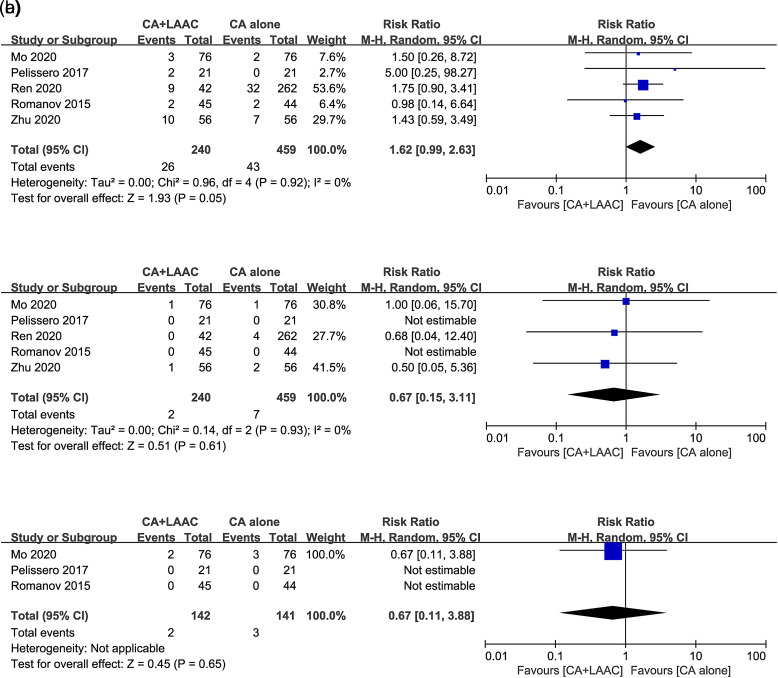
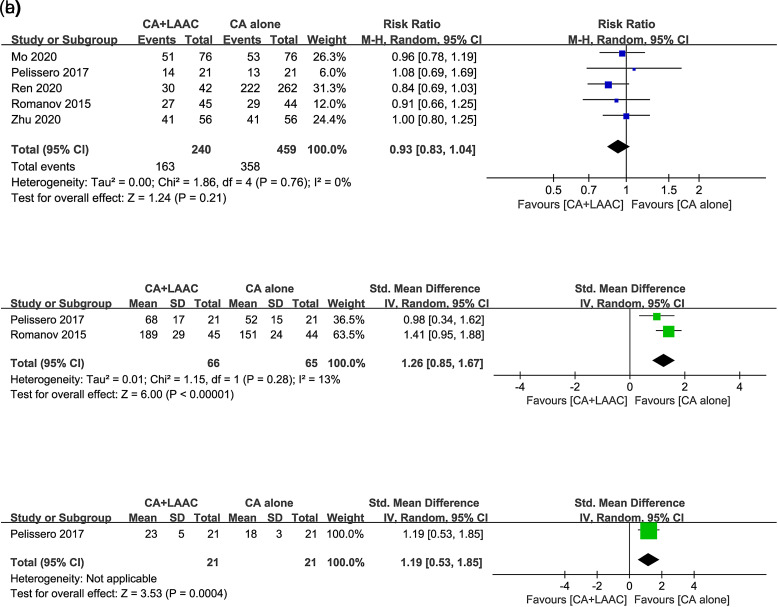
Five studies involving 699 people were included in our meta-analysis. We found no significant difference in the freedom from atrial arrhythmia rate (risk ratio=0.93, 95% CI=0.83-1.04, I 2=0%, P=.21) between the 2 groups. Catheter ablation combined with left atrial appendage closure showed significantly longer procedure and fluoroscopy times than catheter ablation alone (standard mean difference=1.26, 95% CI=0.85-1.67, P <.00001 and standard mean difference=1.19, 95% CI=0.53-1.85, P=.0004, respectively). With regard to safety outcomes, no significant differences were observed in perioperative complications (RR=1.62, 95% CI=0.99-2.63, I 2=0%, P=.05), thromboembolic events (RR=0.67, 95% CI=0.15-3.11, I 2=0%, P=.61), or bleeding events (RR=0.67, 95% CI=0.11-3.88, P=.65) between the 2 groups during follow-up.
The freedom from atrial arrhythmia rate and safety outcomes of catheter ablation combined with left atrial appendage closure are similar to those of catheter ablation alone. Catheter ablation combined with left atrial appendage closure appears to have longer procedure and fluoroscopy times than catheter ablation alone.
导管消融联合左心耳封堵术治疗心房颤动是有效的。然而,这种联合治疗与单纯导管消融相比的有效性仍存在争议。
我们在包括 Cochrane 图书馆、PubMed、EMBASE 和 Web of Science 在内的数据库中检索了比较导管消融联合左心耳封堵术与单纯导管消融治疗心房颤动的研究。这些研究报告了至少以下结果之一:无房性心律失常率、手术时间、透视时间、围手术期并发症、血栓栓塞事件和随访期间出血事件。采用随机效应模型分析风险比和标准均数差及 95%置信区间。
纳入了五项共 699 人的研究进行荟萃分析。我们发现两组间无房性心律失常率无显著差异(风险比=0.93,95%CI=0.83-1.04,I 2=0%,P=.21)。导管消融联合左心耳封堵术的手术时间和透视时间明显长于单纯导管消融(标准均数差=1.26,95%CI=0.85-1.67,P<.00001 和标准均数差=1.19,95%CI=0.53-1.85,P=.0004)。关于安全性结局,两组间围手术期并发症(RR=1.62,95%CI=0.99-2.63,I 2=0%,P=.05)、血栓栓塞事件(RR=0.67,95%CI=0.15-3.11,I 2=0%,P=.61)或出血事件(RR=0.67,95%CI=0.11-3.88,P=.65)无显著差异。
导管消融联合左心耳封堵术的无房性心律失常率和安全性结局与单纯导管消融相似。导管消融联合左心耳封堵术似乎比单纯导管消融的手术时间和透视时间更长。