Department of Orthopaedics and Trauma, Medical University of Graz, 8036 Graz, Austria.
Department of Orthopaedics and Trauma, Medical University of Graz, Auenbruggerplatz 5, 8036 Graz.
Acta Orthop. 2022 Mar 18;93:367-374. doi: 10.2340/17453674.2022.2254.
Albeit pediatric flexible flat foot (FFF) is a common condition, only a minority of patients become symptomatic. Long-term outcomes of surgically treated pediatric patients with symptomatic FFF are largely unknown. In this systematic review, studies providing outcomes at a mean follow-up of at least 4 years after the procedure in these patients were analyzed.
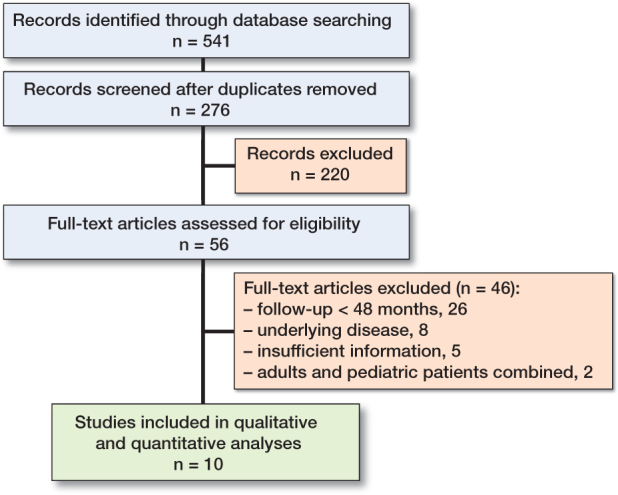
A PubMed search was undertaken involving original articles published up to July 2021 on outcome in children aged 6 to 14 with surgically treated FFF and mean (or minimum) follow-up of at least 4 years. Radiographic and clinical outcomes were analyzed.
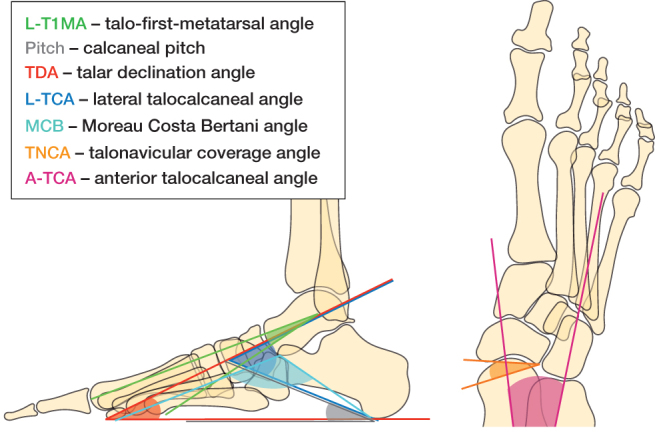
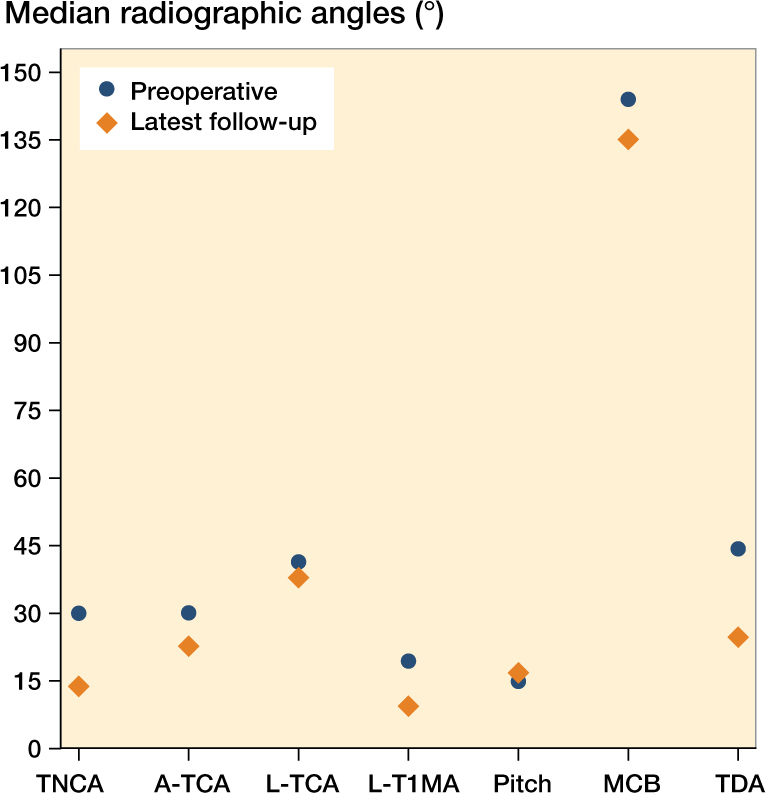
Of initially 541 entries, 10 could be included in the systematic review (all level IV), involving 846 pediatric patients with 1,536 symptomatic FFF. Pooled mean radiological (n = 8) and clinical follow-up (n = 10) was 5.3 (range 0.5-15) and 7.0 (range 4.1-15) years, respectively. Surgical procedures included arthroereisis (n = 8), lateral column lengthening (n = 1), and Horseman procedure (n = 1). Overall relative frequency of implant-associated complications and wound-healing problems was 3.2% and 1.3%, as well as 2.8% and 1.6% following subtalar arthroereisis only. From preoperative to latest radiological assessment following subtalar arthroereisis (including 3 studies with radiological follow-up < 48 months), pooled median decrease in talonavicular coverage angle (TNCA; -9.2°), anteroposterior talocalcaneal angle (A-TCA; -6.5°), lateral talocalcaneal angle (L-TCA; -3.5°), talar declination angle (TDA; -14°), Moreau Costa Bertani angle (MCB; -13°), and talo-firstmetatarsal angle (L-T1MA; -10°) was observed, as was an increase in calcaneal pitch (4.5°).
In symptomatic pediatric FFF patients, surgery is associated with a manageable complication profile, and results in satisfactory long-term clinical as well as radiological outcome. Yet scientific evidence is low, warranting larger scaled studies in the future.
尽管小儿柔性平足(FFF)是一种常见病症,但只有少数患者出现症状。接受手术治疗的有症状小儿 FFF 患者的长期结果在很大程度上尚不清楚。在本系统评价中,分析了在这些患者手术后平均随访至少 4 年时提供结果的研究。
对截至 2021 年 7 月在接受手术治疗的 6 至 14 岁儿童的 FFF 中,有症状且平均(或最低)随访至少 4 年的研究进行了 PubMed 搜索,纳入了原始文章。分析了影像学和临床结果。
最初的 541 项研究中,有 10 项可纳入系统评价(均为 IV 级),共纳入 846 例小儿患者,共 1536 例有症状的 FFF。汇总的平均影像学(n=8)和临床随访(n=10)分别为 5.3(范围 0.5-15)和 7.0(范围 4.1-15)年。手术方法包括关节固定术(n=8)、外侧柱延长术(n=1)和 Horseman 手术(n=1)。植入物相关并发症和伤口愈合问题的总相对频率分别为 3.2%和 1.3%,仅行距下关节固定术时分别为 2.8%和 1.6%。从术前到距下关节固定术的最新影像学评估(包括 3 项影像学随访<48 个月的研究),距骨跟骨覆盖角(TNCA;-9.2°)、跟距前后角(A-TCA;-6.5°)、外侧距跟角(L-TCA;-3.5°)、距骨倾斜角(TDA;-14°)、Moreau Costa Bertani 角(MCB;-13°)和距骨第一跖骨角(L-T1MA;-10°)的中位数下降,而跟骨倾斜角(4.5°)增加。
在有症状的小儿 FFF 患者中,手术相关并发症可管理,且长期临床和影像学结果令人满意。然而,科学证据不足,未来需要更大规模的研究。