Department of Diagnostics, Division of Clinical Pathology, Geneva University Hospitals, Geneva, Switzerland.
University Grenoble Alpes, CNRS, CEA, IBS, Grenoble, France.
J Mol Med (Berl). 2022 May;100(5):735-746. doi: 10.1007/s00109-022-02190-7. Epub 2022 Mar 26.
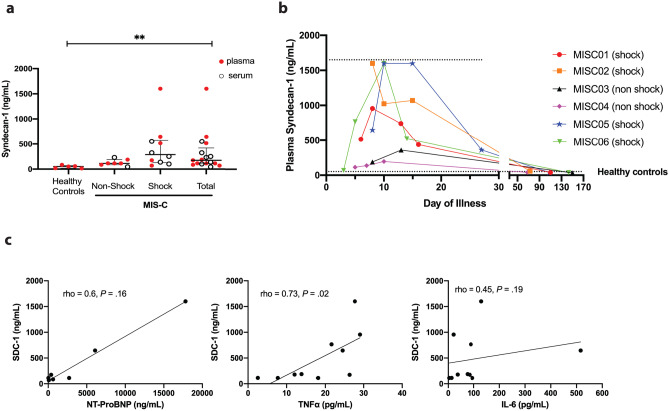
Multisystem inflammatory syndrome in children (MIS-C) represents a rare but severe complication of severe acute respiratory syndrome coronavirus 2 infection affecting children that can lead to myocardial injury and shock. Vascular endothelial dysfunction has been suggested to be a common complicating factor in patients with coronavirus disease 2019 (COVID-19). This study aims to characterize endothelial glycocalyx degradation in children admitted with MIS-C. We collected blood and urine samples and measured proinflammatory cytokines, myocardial injury markers, and endothelial glycocalyx markers in 17 children admitted with MIS-C, ten of which presented with inflammatory shock requiring intensive care admission and hemodynamic support with vasopressors. All MIS-C patients presented signs of glycocalyx deterioration with elevated levels of syndecan-1 in blood and both heparan sulfate and chondroitin sulfate in the urine. The degree of glycocalyx shedding correlated with tumor necrosis factor-α concentration. Five healthy age-matched children served as controls. Patients with MIS-C presented severe alteration of the endothelial glycocalyx that was associated with disease severity. Future studies should clarify if glycocalyx biomarkers could effectively be predictive indicators for the development of complications in adult patients with severe COVID-19 and children with MIS-C. KEY MESSAGES : Children admitted with MIS-C presented signs of endothelial glycocalyx injury with elevated syndecan-1 and heparan sulfate level. Syndecan-1 levels were associated with MIS-C severity and correlated TNF-α concentration. Syndecan-1 and heparan sulfate may represent potential biomarkers for patients with severe COVID-19 or MIS-C.
儿童多系统炎症综合征(MIS-C)是一种罕见但严重的儿童严重急性呼吸综合征冠状病毒 2 感染并发症,可导致心肌损伤和休克。血管内皮功能障碍被认为是 2019 年冠状病毒病(COVID-19)患者的常见合并症。本研究旨在描述伴有 MIS-C 的儿童内皮糖萼降解的特征。我们收集了血液和尿液样本,并测量了 17 名患有 MIS-C 的儿童的促炎细胞因子、心肌损伤标志物和内皮糖萼标志物,其中 10 名患有炎症性休克,需要入住重症监护病房并接受血管加压药的血流动力学支持。所有 MIS-C 患者均出现糖萼恶化的迹象,血液中 syndecan-1 水平升高,尿液中肝素硫酸盐和硫酸软骨素水平均升高。糖萼脱落的程度与肿瘤坏死因子-α浓度相关。5 名年龄匹配的健康儿童作为对照。患有 MIS-C 的患者表现出内皮糖萼的严重改变,这与疾病严重程度相关。未来的研究应阐明糖萼生物标志物是否能有效预测成人严重 COVID-19 患者和儿童 MIS-C 患者并发症的发生。关键信息:患有 MIS-C 的儿童出现内皮糖萼损伤的迹象,syndecan-1 和肝素硫酸盐水平升高。syndecan-1 水平与 MIS-C 严重程度相关,并与 TNF-α浓度相关。syndecan-1 和肝素硫酸盐可能是严重 COVID-19 或 MIS-C 患者的潜在生物标志物。