Department of Radiology and Nuclear Medicine, Maastricht University Medical Centre, P.O. Box 5800, 6202 AZ, Maastricht, The Netherlands.
Department of Radiology and Nuclear Medicine, VieCuri Medical Centre, Venlo, The Netherlands.
Eur Radiol. 2022 Jul;32(7):4555-4564. doi: 10.1007/s00330-022-08599-5. Epub 2022 Mar 28.
Magnetic resonance venography (MRV) is underutilized in the evaluation of thrombus properties prior to endovascular treatment but may improve procedural outcomes. We therefore investigated the clinical impact of using a dedicated MRV scoring system to assess thrombus characteristics prior to endovascular intervention for iliofemoral deep vein thrombosis (DVT).
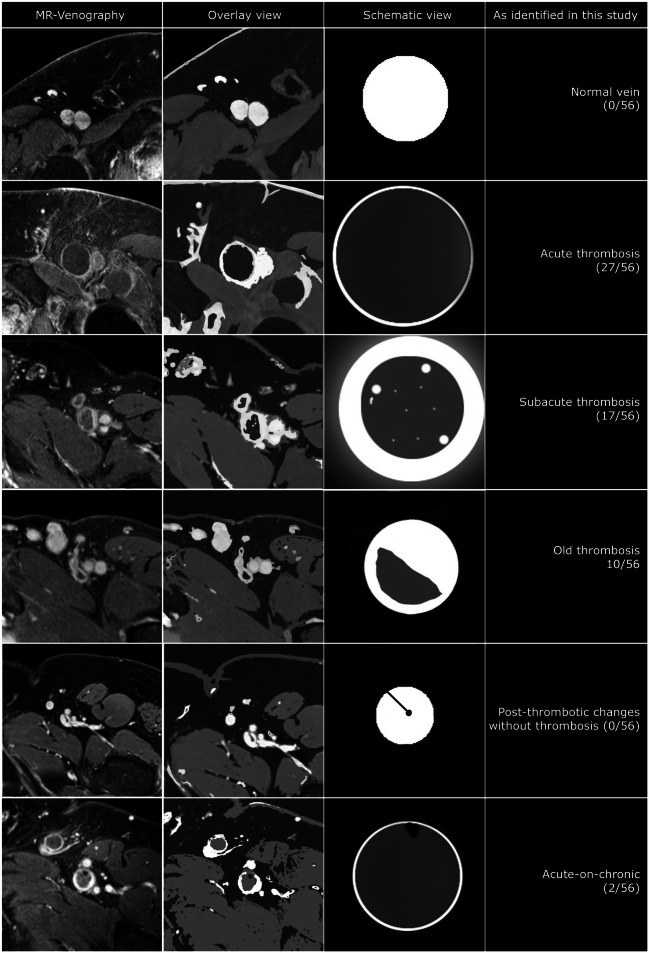
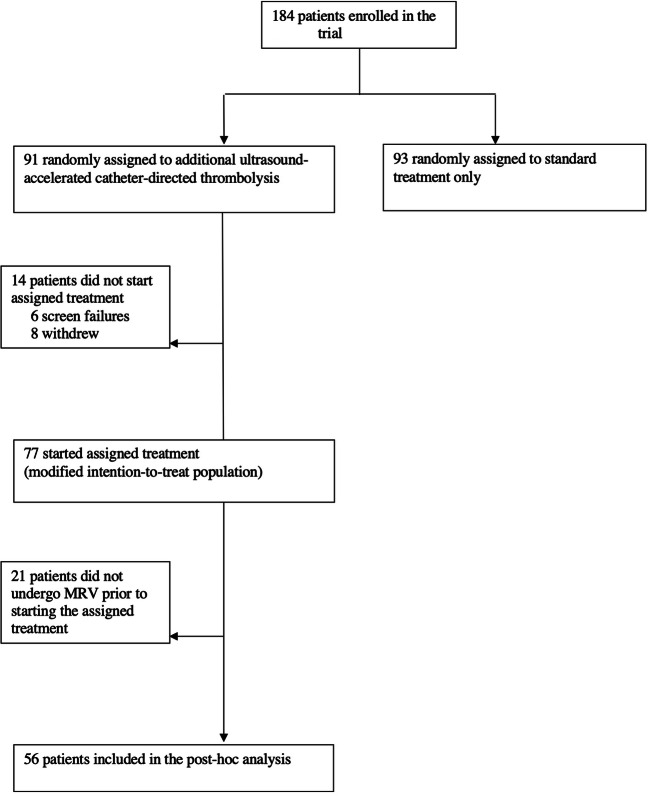
This is a post hoc analysis of data from the CAVA trial ( Clinicaltrials.gov :NCT00970619). MRV studies of patients receiving ultrasound-accelerated catheter-directed thrombolysis (CDT) for iliofemoral DVT were reviewed. Thrombus age-related imaging characteristics were scored and translated into an overall score (acute, subacute, or old). MRV scores were compared to patient-reported complaints. MRV-scored groups were compared for CDT duration and success rate.
Fifty-six patients (29 men; age 50.8 ± 16.4 years) were included. Using MRV, 27 thrombi were classified acute, 17 subacute, and 12 old. Based on patient-reported complaints, 11 (91.7%) of these old thrombi would have been categorized acute or subacute, and one (3.7%) of the acute thrombi as old. Average duration of CDT to > 90% restored patency differed significantly between groups (p < 0.0001): average duration was 23 h for acute thromboses (range: 19-25), 43 h for subacute (range: 41-62), and 85 h for old thromboses (range: 74-96). CDT was almost eleven times more successful in thromboses characterized as acute and subacute compared to old thromboses (OR: 10.7; 95% CI 2.1-55.5).
A dedicated MRV scoring system can safely discriminate between acute, subacute, and old thromboses. MRV-based selection is predictive of procedural duration and success rate and can help avoid unnecessary complications.
• Thrombus age, characterized by MRV as acute, subacute, and old, can predict CDT duration and probability of success. • Accurate pre-interventional MRV-based thrombus aging has the potential to facilitate identification of eligible patients and may thus prevent CDT-related complications.
在血管内治疗前,磁共振静脉造影(MRV)对血栓性质的评估未得到充分利用,但可能改善手术结果。因此,我们研究了在髂股深静脉血栓形成(DVT)血管内介入治疗前使用专用 MRV 评分系统评估血栓特征的临床影响。
这是 CAVA 试验(Clinicaltrials.gov:NCT00970619)数据的事后分析。对接受超声加速导管定向溶栓(CDT)治疗的髂股 DVT 患者的 MRV 研究进行了回顾。对血栓与年龄相关的影像学特征进行评分,并转化为总体评分(急性、亚急性或陈旧性)。将 MRV 评分与患者报告的症状进行比较。比较 MRV 评分组的 CDT 持续时间和成功率。
56 例患者(29 例男性;年龄 50.8±16.4 岁)入选。根据 MRV,27 个血栓被分类为急性,17 个为亚急性,12 个为陈旧性。根据患者报告的症状,11 个(91.7%)陈旧性血栓会被归类为急性或亚急性,1 个(3.7%)急性血栓会被归类为陈旧性。各组达到>90%再通的 CDT 持续时间有显著差异(p<0.0001):急性血栓的平均持续时间为 23 小时(范围:19-25 小时),亚急性血栓的持续时间为 43 小时(范围:41-62 小时),陈旧性血栓的持续时间为 85 小时(范围:74-96 小时)。与陈旧性血栓相比,急性和亚急性血栓的 CDT 成功率几乎高出 11 倍(OR:10.7;95%CI 2.1-55.5)。
专用的 MRV 评分系统可以安全地区分急性、亚急性和陈旧性血栓。基于 MRV 的选择可以预测手术持续时间和成功率,并有助于避免不必要的并发症。
·MRV 表现为急性、亚急性和陈旧性的血栓年龄可预测 CDT 的持续时间和成功率。·准确的介入前基于 MRV 的血栓老化有可能有助于确定合格的患者,从而可能预防 CDT 相关并发症。