Department of Epidemiology and Biostatistics, School of Public Health, Indiana University, Bloomington, IN, 47405, USA.
Department of Kinesiology, School of Public Health, Indiana University, Bloomington, IN, USA.
Breast Cancer Res Treat. 2022 Jun;193(2):467-476. doi: 10.1007/s10549-022-06568-6. Epub 2022 Mar 26.
Aging associated with progressive declines in physical function is well-known; however, it is unclear how breast cancer diagnosis affects the trajectories of physical function over a long period of time. The current study examined the trajectories in objective measures of physical function over 20 years for women with breast cancer and matched controls.
2712 community-dwelling women (452 breast cancer cases and 1:5 matched cancer-free controls) aged 65 years or older at baseline (1986-1988) within the Study of Osteoporotic Fractures were followed for 20 years. Objective physical function was assessed up to 9 times, including hand grip strength, timed chair stand, gait speed and quadriceps strength. Linear mixed models were used to model physical function changes in terms of secular time trend, group (cases or controls), period (pre-and post-diagnosis status), and their interaction terms.
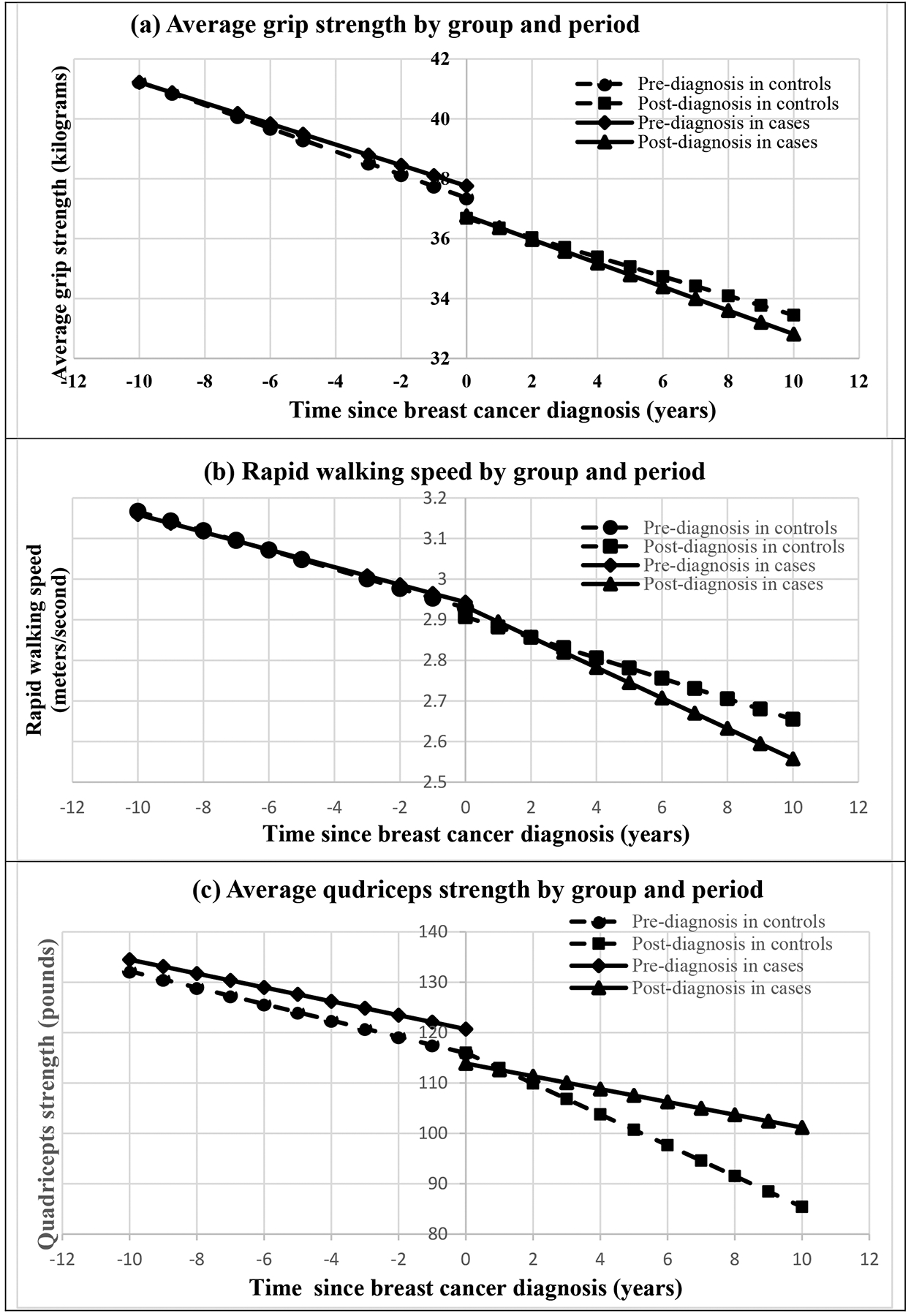
We observed all measures of physical function declined over time. While no differences in trends between cases and controls during the pre-diagnosis period were observed, after cancer diagnosis, grip strength and gait speed declined significantly faster in cases than controls. Quadriceps strength significantly decreased ~ 7 pounds shortly after breast cancer diagnosis, and then improved over time.
Our study revealed that older breast cancer survivors relative to older women without cancer had significantly worse declines in grip strength and gait speed. Breast cancer survivors also had a sharp, short-term drop followed by gradual improvement over time in quadriceps strength. These findings suggest exercise training targeting muscle strength and mobility would be beneficial among older breast cancer survivors.
与身体功能逐渐下降相关的衰老众所周知;然而,乳腺癌诊断如何影响身体功能在很长一段时间内的轨迹尚不清楚。本研究检查了 20 年来患有乳腺癌和匹配对照的女性身体功能的客观指标轨迹。
20 年来,在骨质疏松性骨折研究(Study of Osteoporotic Fractures)中,共有 2712 名年龄在 65 岁或以上的社区居住女性(基线时为 452 例乳腺癌病例和 1:5 例无癌症对照)接受了随访。客观的身体功能评估最多进行了 9 次,包括手握力、定时椅站、步行速度和股四头肌力量。线性混合模型用于根据世俗时间趋势、组(病例或对照)、时期(诊断前和诊断后状态)及其交互项来模拟身体功能变化。
我们观察到所有身体功能指标都随着时间的推移而下降。虽然在诊断前期间,病例和对照之间的趋势没有差异,但在癌症诊断后,病例的握力和步行速度下降明显快于对照。股四头肌力量在乳腺癌诊断后不久显著下降约 7 磅,然后随着时间的推移逐渐改善。
我们的研究表明,与没有癌症的老年女性相比,老年乳腺癌幸存者的握力和步行速度下降更为明显。乳腺癌幸存者的股四头肌力量也有一个急剧的短期下降,然后随着时间的推移逐渐改善。这些发现表明,针对肌肉力量和活动能力的锻炼训练可能对老年乳腺癌幸存者有益。