Department of Cardiology Second Affiliated Hospital Zhejiang University School of Medicine Hangzhou People's Republic of China.
Zhejiang University School of Medicine Hangzhou People's Republic of China.
J Am Heart Assoc. 2022 Apr 5;11(7):e023219. doi: 10.1161/JAHA.121.023219. Epub 2022 Mar 29.
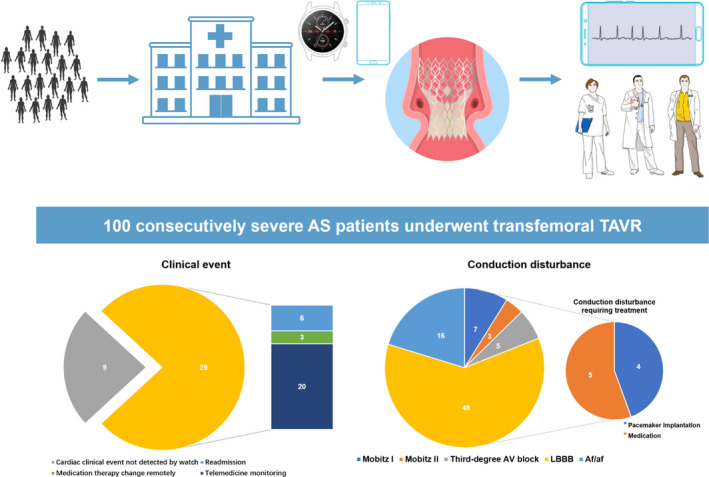
Background In the recent decades, the development of novel digital health technologies enables doctors to monitor ECG and vital signs remotely. But the data on applying the noninvasive wearable smartwatch on patients with transcatheter aortic valve replacement (TAVR) are unknown. Methods and Results We performed a prospective, observational cohort study to evaluate the feasibility of a novel, virtual, and remote health care strategy for patients with TAVR discharged to home with smart wearable devices. A total of 100 consecutive patients with severe aortic stenosis who underwent elective transfemoral TAVR were enrolled and received the Huawei smartwatch at least 1 day before TAVR. Vital signs, including heart rate, rhythm, oxygen saturation, and activity, were continuously recorded. Single-lead ECG was recorded twice per day in the week following TAVR discharge and at least 2 days a week for the subsequent month after TAVR discharge. A designated heart team member provided remote health care with the data from the smartwatch when the patient had a need. Thirty-eight cardiac events were reported in 34 patients after discharge, with most of the events (76.0%) detected and confirmed by the smartwatch. Six patients were advised and readmitted to the hospital for arrhythmia events detected by the smartwatch, of whom 4 patients received pacemaker implantation. The remaining 28 (82.4%) patients received telemedicine monitoring instead of face-to-face clinical visits, and 3 of them received new medication treatment under the online guidance of doctors. New-onset left branch bundle block was found in 48 patients, with transient characteristics, and recovered spontaneously in 30 patients, and new-onset atrial fibrillation was detected in 4 patients. There were no significant differences in the average weekly heart rates or the ratio of abnormal or low oxygen saturation when compared with the baseline. The average daily steps increased over time significantly (baseline, 870±1353 steps; first week, 1986±2406 steps; second week, 2707±2716 steps; third week, 3059±3036 steps; fourth week, 3678±3485 steps, <0.001). Conclusions Smartwatches can facilitate remote health care for patients discharged to home after undergoing TAVR and enable a novel remote follow-up strategy. The majority of cardiac clinical events that occurred within 30-day follow-up were detected by the smartwatch, mainly because of the record of conduction abnormality. Registration URL: https://www.clinicaltrials.gov; Unique identifier: NCT04454177.
背景 在最近几十年,新型数字健康技术的发展使得医生能够远程监测心电图和生命体征。但是,关于将无创可穿戴智能手表应用于经导管主动脉瓣置换术(TAVR)患者的数据尚不清楚。
方法和结果 我们进行了一项前瞻性、观察性队列研究,以评估一种新型虚拟远程医疗策略在 TAVR 出院后使用智能可穿戴设备的可行性。共纳入 100 例因严重主动脉瓣狭窄择期行经股 TAVR 的连续患者,他们在 TAVR 前至少 1 天接受了华为智能手表。连续记录生命体征,包括心率、节律、血氧饱和度和活动。TAVR 出院后一周内每天记录两次单导联心电图,TAVR 出院后至少每周记录两次。当患者有需要时,由指定的心脏团队成员使用智能手表的数据提供远程医疗服务。TAVR 出院后 34 名患者报告了 38 例心脏事件,其中大多数(76.0%)事件由智能手表检测并确认。智能手表检测到 6 例心律失常事件,建议并重新入院治疗,其中 4 例患者植入了起搏器。其余 28 例(82.4%)患者接受远程医疗监测,而不是面对面的临床就诊,其中 3 例在医生的在线指导下接受了新的药物治疗。48 例患者出现新发左束支传导阻滞,具有短暂特征,30 例患者自行恢复,4 例患者新发心房颤动。与基线相比,平均每周心率或异常或低血氧饱和度的比例没有显著差异。平均每日步数随时间显著增加(基线:870±1353 步;第 1 周:1986±2406 步;第 2 周:2707±2716 步;第 3 周:3059±3036 步;第 4 周:3678±3485 步,<0.001)。
结论 智能手表可以为 TAVR 后出院回家的患者提供远程医疗服务,并实现一种新型的远程随访策略。大多数在 30 天随访内发生的心脏临床事件都被智能手表检测到,主要是因为记录了传导异常。
https://www.clinicaltrials.gov;唯一标识符:NCT04454177。